
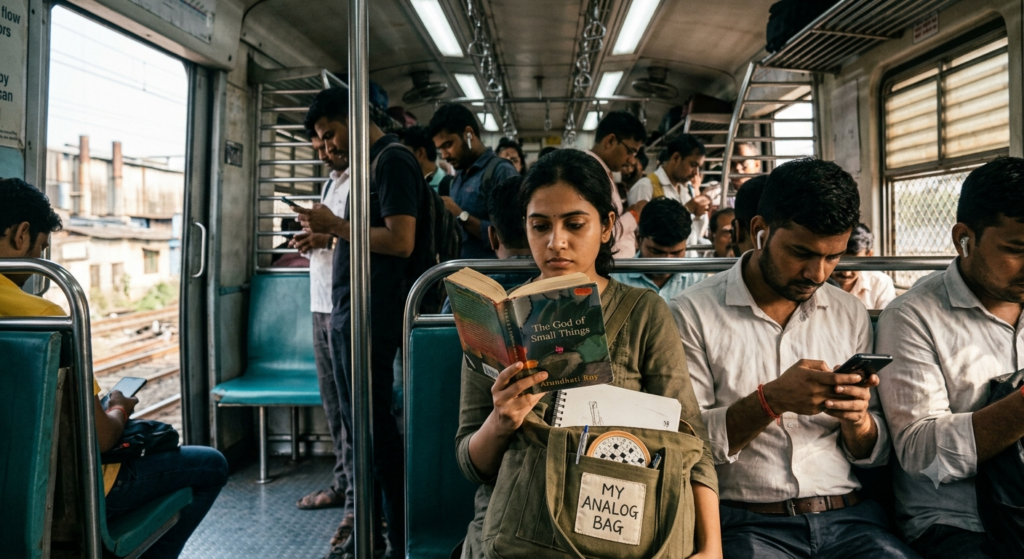
How a simple tote full of paper and yarn is quietly transforming urban commutes
On a weekday morning inside Mumbai’s crowded local train, a subtle rebellion is unfolding. Around them, passengers hunch over glowing rectangles – scrolling Instagram, firing off work emails, skimming news alerts. But a small, growing minority sits differently. Hands empty. Eyes forward. No earbuds. No screens. Some call it “barebacking” to work – commuting without digital crutches. Some are going a step further, toting a surprising new essential that has quietly become the season’s most talked-about accessory: the analog bag.
The concept, first popularized in 2025 by California-based creator Sierra Campbell, is disarmingly straightforward. An analog bag is any carryall – tote, backpack, cross-body – stuffed not with the usual urban survival kit of power banks, cables and wireless pods, but with tactile, screen-free distractions: crossword puzzles, knitting kits, paperback novels, watercolor sets, sketchpads and paper journals. One user called it “a toy box for your wandering mind.” The mission is simple: make reaching for something physical easier than reaching for your phone.
In India, where the average city professional now logs upwards of seven daily hours on screens – working, browsing, comparing, consuming – the appeal is anything but niche. A 2024 study found that 68% of working professionals experience digital eye strain, with symptoms including tired eyes (72%), dryness (64%) and recurring headaches (51%). Among those clocking more than three hours of daily screen time, up to 90% report signs of Computer Vision Syndrome. The statistics paint a clear picture: a workforce stretched to its cognitive breaking point.
Advertisement
According to David Sax, author of The Revenge of Analog, the belief that anyone can simply settle into a meditative posture and immediately reach a state of calm is largely impractical for the vast majority of people. He contends that since mobile devices offer unlimited access to content and connection, having a physical, screen-free substitute readily available becomes a necessary counterbalance when stepping away from digital distractions. The analog bag offers precisely that: a practical, portable toolkit for reclaiming attention in an age of algorithmic hijack.
What urban India is packing inside their anti-boredom kits
The contents vary dramatically – and that’s entirely by design. Nisha Prasad, a Hyderabad-based content creator, keeps it trim: a compact planner, a journal and one novel. Others go bigger: mandala coaster painting sets, miniature knitting projects, a deck of playing cards, even travel-sized Jenga.
Some pack Polaroid cameras, crossword anthologies and biodegradable glitter for offline gatherings. The golden rule isn’t aesthetics – it’s genuine appeal. Fill it with activities you’d actually enjoy reaching for, not what looks good on Instagram.
The trend has taken root across India’s metros, where the creative class – designers, writers, marketers, content producers – treat analog bags as equal parts style statement and mental-health intervention. Unlike rigid digital-detox rules that feel punitive and impossible, analog bags offer something gentler: an invitation, not a commandment. They make phone access marginally less convenient while making offline pleasures delightfully more accessible.
More than a bag – a broader cultural turn
The analog bag isn’t an isolated fad. It sits inside a wider cultural recalibration. Across Instagram (the irony is not lost on anyone), people are documenting their “analog journeys” – replacing digital habits with hands-on, physical rituals. Vinyl sales are climbing. Board-game clubs and community jam sessions are multiplying. “Digital sunsets” – switching off screens at least an hour before bed – have become a mainstream wellness staple. The deeper ambition is to reclaim a lifestyle that values tactile experience, unhurried time and unmediated human connection.
Ironic as it is that much of this movement is broadcast through the very platforms it asks people to step away from, Sax argues the contradiction matters less than the outcome: people are actively redesigning their relationship with screens – not for a weekend, but for the long haul.
In India, this shift shows up in other ways too. Luxury residential programmes in Mumbai, Delhi, Bengaluru and Sikkim now offer 10- to 15-day immersive tech withdrawals – complete with psychiatric evaluation, individual therapy and medically supervised screen-weaning protocols.
Weekend wellness retreats outside Bengaluru and Mumbai structure entire itineraries around yoga, talk therapy and enforced offline hours. Even the Karnataka government has launched “Beyond Screens,” India’s first industry-led digital-detox initiative. The Economic Survey 2026 has formally called for national-level interventions to address rising digital addiction and screen-related mental distress.
A practical tool, not a miracle cure
Sceptics will argue that carrying an analog bag is mostly performance – a way to broadcast offline virtue while staying firmly tethered to the digital economy. And they’re not entirely wrong. Most professionals cannot fully disconnect. Their livelihoods depend on Slack, Gmail, Zoom and WhatsApp.
As Arunima, a Gurugram-based community leader and content creator, puts it: “I don’t believe in extreme detoxes because my work is digital.” Instead, she practices restraint: no mindless scrolling, minimal email checking, only essential calls. She fills reclaimed time with books, journaling, music, yoga or simply sitting quietly with her own thoughts.
This is the deeper promise of the analog-bag trend. It isn’t about renouncing technology or fleeing to a Himalayan hermitage – though a few do exactly that. It’s about carving out small, sustainable pockets of offline presence within a life otherwise consumed by screens. As Dr. Sourojit Gupta, a Delhi based renowned paediatrician, observes: “All activity does not necessarily generate value.” The analog bag is a gentle reminder that sometimes the most valuable thing you can do is nothing at all – or at least, nothing that demands a backlit display.
For India’s urban professionals – drowning in pings and starving for stillness – that message lands hard. The analog bag isn’t a cure for digital fatigue. It’s a tool. A simple, portable nudge that makes it fractionally easier to set down the phone and pick up a pencil, a puzzle or a paperback. And in 2026, for millions navigating the blur between burnout and balance, that small friction might just be enough.
Disclaimer: The opinions and views expressed in this article/column are those of the author(s) and do not necessarily reflect the views or positions of South Asian Herald.