 Join WhatsApp Channel

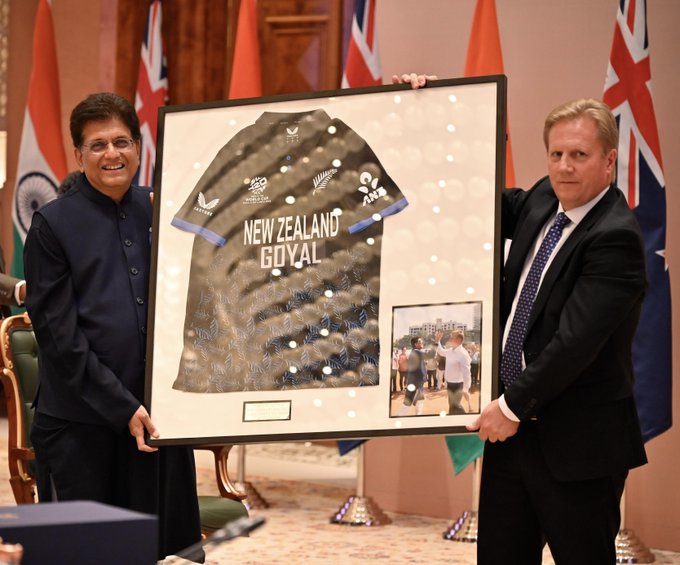
The free trade agreement (FTA) signed between India and New Zealand on Monday has been projected as a sweeping liberalization pact, but a closer reading of its agriculture and dairy provisions suggests a far more cautious and politically calibrated compact—one that selectively opens rural value chains while ring-fencing India’s most sensitive farm sectors.
Unveiled with high-level political backing from Prime Minister Narendra Modi and his New Zealand counterpart Christopher Luxon, the agreement has been framed by both governments as transformative. Yet beneath the rhetoric, the design reflects the enduring constraints of domestic political economy, particularly in agriculture, where trade policy remains tightly intertwined with livelihoods and electoral considerations.
For Wellington, the headline outcome lies in securing preferential access to India’s large and historically protected farm market. Official estimates indicate that up to 95% of New Zealand’s current exports will eventually receive preferential treatment, with 57% turning tariff-free immediately and coverage rising to roughly 82% over time. Within this, New Zealand has underscored “first-ever” gains in segments such as apples, kiwifruit, manuka honey, seafood and wine.
However, the architecture of these concessions tempers their commercial immediacy. Much of the access is channeled through tariff-rate quotas (TRQs), phased tariff reductions and long transition schedules—mechanisms that effectively slow the pace and limit the scale of market entry. The outcome points to a negotiated balance: symbolic breakthroughs in select horticultural lines, but no abrupt exposure of India’s smallholder-dominated farm economy to import shocks.
India’s own narrative, by contrast, emphasizes outward opportunity rather than inward opening. The Ministry of Commerce and Industry has framed the pact as a vehicle to expand agricultural and food exports into a high-income, rules-based market. Official data show India’s agri-exports to New Zealand rising from $95.6 million in FY24 to $108.2 million in FY25, with nearly a third of shipments previously facing tariffs of up to 5%. Under the agreement, duties across all tariff lines are to be eliminated, improving competitiveness for processed foods, cereals, spices, beverages and semi-processed inputs.
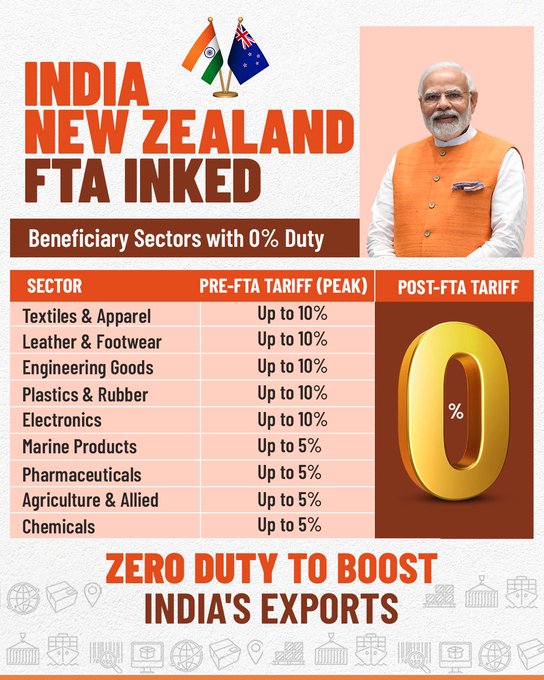
The expectation within government and industry is that gains will accrue less from bulk commodities and more from value-added segments—processed foods, ready-to-eat products, organic offerings and niche agri-exports—many of them linked to MSMEs and rural clusters. Lower tariffs, simplified sanitary and phytosanitary norms and improved logistics frameworks are expected to underpin this shift, although the absolute scale remains constrained by New Zealand’s relatively small import market, estimated at about $6–6.1 billion.
This asymmetry—limited but high-value access for New Zealand into a vast market, versus broad but shallow access for India into a smaller one—defines the rural economics of the agreement.
Nowhere is the calibrated approach more evident than in dairy, long treated as a red line in India’s trade negotiations. Despite New Zealand’s global competitiveness in dairy exports, the pact stops short of opening India’s core dairy market. Concessions are instead confined to peripheral categories such as infant formula and specialized dairy preparations, subject to phased tariff reductions and tightly managed quotas for certain milk proteins.
A notable provision is a “fast-track” mechanism that allows New Zealand dairy inputs to enter India duty-free for processing and re-export, effectively positioning India within global dairy value chains without exposing its domestic consumer market to direct competition. India has also agreed to consult New Zealand in the event of similar concessions in future trade agreements, signaling limited flexibility without immediate market access.
The absence of meaningful dairy liberalization underscores the sector’s political sensitivity, with millions of small farmers tied to cooperative structures that remain central to rural incomes. Even official briefings from the commerce ministry have largely sidestepped detailed discussion of dairy, reflecting the cautious handling of the issue.
Industry assessments suggest the agreement marks a broader shift in India’s trade strategy—from headline tariff cuts towards sequenced liberalization anchored in productivity gains and supply-chain integration. Joint initiatives in horticulture, agri-technology, food processing and logistics are expected to deliver incremental improvements in competitiveness rather than immediate trade surges.
Gulzar Didwania of Deloitte India observed that the pact “moves beyond tariff-led liberalization toward productivity, capability building and long-term cooperation,” while export bodies including the Federation of Indian Export Organizations have pointed to compliance, rules of origin and non-tariff barriers as critical determinants of actual gains.
Corporate and industry responses have been broadly positive, though forward-looking. Manoj Mishra, Partner at Grant Thornton Bharat, described the agreement as a “landmark” that extends beyond goods trade to integrate investment, services and talent mobility, with potential to boost labor-intensive sectors such as textiles, leather and engineering goods through zero-duty access. He also pointed to faster regulatory pathways for pharmaceuticals and medical devices, alongside a proposed $20 billion investment commitment from New Zealand that could support infrastructure and long-term economic engagement.
The Confederation of Indian Industry (CII) echoed this assessment, highlighting the agreement’s provision of duty-free access for Indian exports and its ambition to double bilateral trade to $5 billion over the next five years. CII Director General Chandrajit Banerjee said the pact would enhance competitiveness across sectors ranging from automotive and machinery to electronics and chemicals, while also supporting MSMEs through reduced trade costs and improved market access.
For rural India, the agreement represents neither a disruptive opening nor a lost opportunity, but a measured engagement—one that creates space for export diversification and technology transfer while preserving core protections. For New Zealand, it offers incremental but strategically significant entry into a difficult market.
The dual narratives—of breakthrough and restraint—ultimately converge on a more tempered reality: the India–New Zealand FTA is less a dramatic liberalization of farm trade than a framework for gradual, managed integration, where outcomes will depend less on tariff schedules and more on how effectively businesses, supply chains and rural economies adapt to the carefully negotiated openings embedded within the deal.
Related posts:
 Tariffs, Trust, and the Trump Factor: India Braces for High-Wire Trade Diplomacy
 India–US Interim Trade Pact Brings Tariff Relief but Locks India into Deeper Market and Strategic Concessions
 AAHAR 2026 Opens Amid Push to Turn India into a Global Food Processing Hub
 India’s UK Trade Pact Faces Heat for Prioritizing Optics Over Sovereignty
