 Join WhatsApp Channel

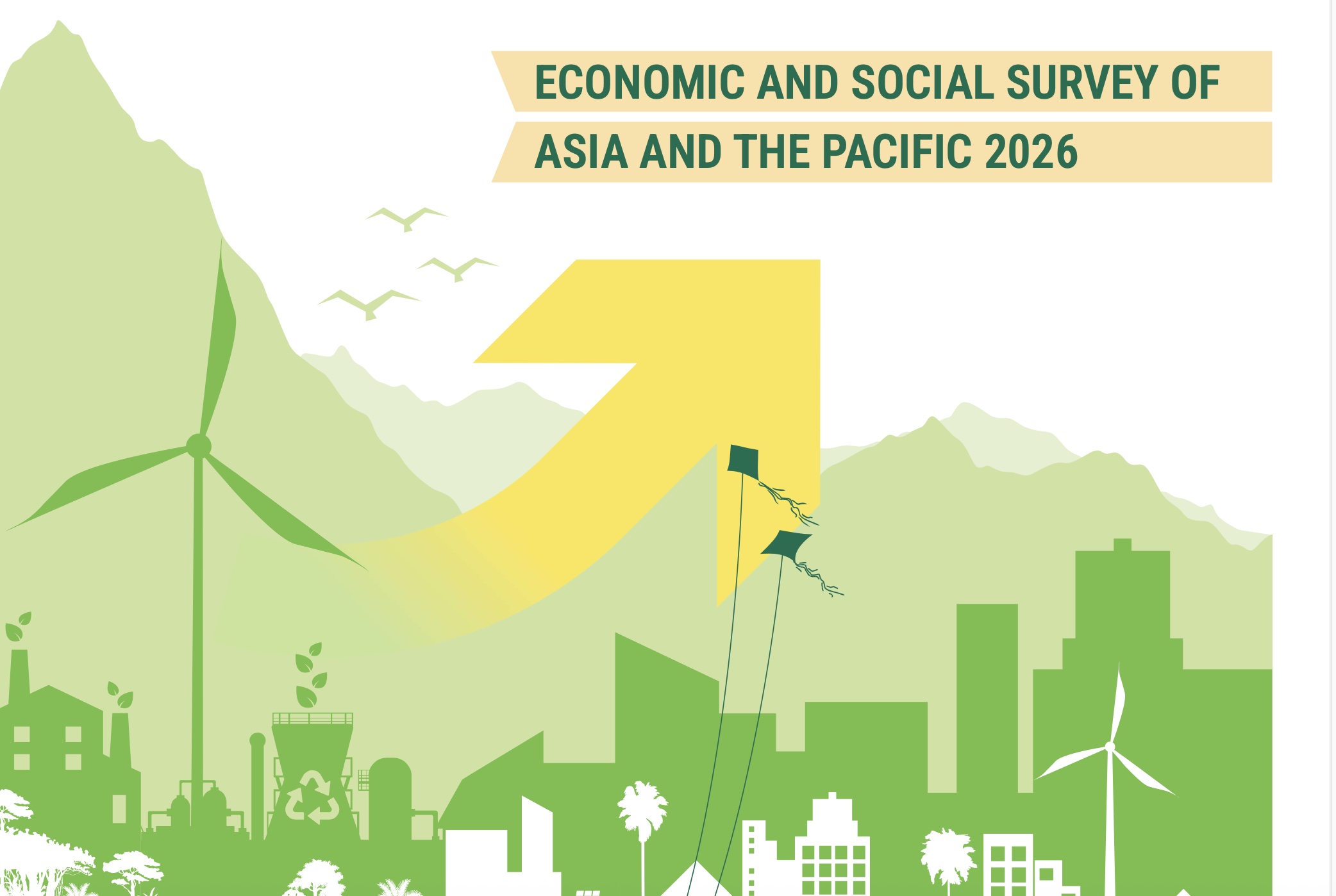
South Asia’s growth story remains intact but increasingly fragile, caught between resilient domestic demand and a tightening web of global uncertainties, according to the latest survey by the United Nations Economic and Social Commission for Asia and the Pacific, which warns that the subregion’s economic trajectory will hinge as much on policy choices at home as on shocks originating far beyond its borders.
In its Economic and Social Survey of Asia and the Pacific 2026, ESCAP notes that while the broader region continues to outpace most developing economies, growth is slowing—from 5.3% in 2023 to 4.6% in 2025, with a further moderation to 4.0% projected in 2026—signaling that even high-performing subregions such as South Asia are entering a more constrained and volatile phase of expansion.
For countries such as India, Bangladesh and Pakistan, the immediate picture is one of relative resilience, underpinned by steady consumption, public investment and a services-led recovery. Yet this resilience, the report suggests, rests on increasingly narrow foundations. A combination of rising global trade protectionism, persistent supply chain fragmentation and geopolitical instability—particularly the fallout from tensions in the Middle East—has heightened exposure to external shocks, especially for energy-importing economies across South Asia.
The implications are far from abstract. A prolonged escalation in West Asian conflict could transmit quickly through higher oil prices, raising import bills, stoking inflation and putting pressure on already strained current accounts. For governments already grappling with elevated debt burdens and rising interest payments, the room to respond with fiscal stimulus is shrinking. In economies such as Sri Lanka, still recovering from a severe balance-of-payments crisis, and Pakistan, where fiscal consolidation remains a delicate exercise, this constraint is particularly acute.
ESCAP’s assessment is blunt in its diagnosis: macroeconomic management in South Asia is becoming a balancing act with diminishing margins for error. Inflation has eased from recent peaks, but remains highly sensitive to food and fuel price volatility, while fiscal positions are under pressure from both legacy debt and new spending demands. Policymakers, the report argues, face a dilemma—tighten too aggressively and risk choking off growth, or loosen prematurely and risk reigniting inflation and financial instability.
Beneath the headline growth numbers, the region’s labor markets tell a more uneven story. Employment recovery remains incomplete, particularly in manufacturing, where output has yet to translate into broad-based job creation. At the same time, job growth has been concentrated in higher-skill services and digital sectors, a shift most visible in India but evident across the subregion, raising concerns about widening skill gaps and structural unemployment. Youth unemployment remains persistently elevated, and the burden of adjustment continues to fall disproportionately on informal workers and women, especially those concentrated in export-oriented industries vulnerable to global demand shocks.
Even as extreme poverty across Asia and the Pacific has fallen to a new low, South Asia’s progress remains uneven, with countries such as Nepal and Afghanistan lagging behind regional peers. The report cautions that without stronger social protection systems, recent gains could prove reversible, particularly in the face of inflationary pressures and employment insecurity.
What emerges from the analysis is a growing recognition that South Asia’s long-standing reliance on external demand—whether through exports or remittances—may no longer provide the same cushion it once did. In a world marked by fragmentation and protectionism, ESCAP argues for a decisive pivot toward domestic and regional demand, supported by productivity gains, improved job quality and deeper economic integration within the subregion. Yet here too, the region faces a paradox: despite geographic proximity and shared economic interests, intra-regional trade in South Asia remains among the lowest globally, limiting its ability to buffer external shocks.
Overlaying these economic challenges is a structural transition that may prove even more consequential—the shift toward an environmentally sustainable economy. South Asia’s energy systems remain heavily dependent on fossil fuels, often accounting for the overwhelming majority of supply, even as demand continues to rise rapidly with urbanization and industrialization. The report identifies the expansion of renewable energy, improvements in energy efficiency and universal access to modern energy as urgent priorities, but underscores that the path forward is fraught with trade-offs.
Efforts to reduce fossil fuel subsidies, for instance, could strengthen fiscal balances and reduce vulnerability to external shocks, yet they also risk triggering inflation and social discontent by raising energy costs for households and businesses. Similarly, while the transition to clean energy promises long-term gains in productivity, public health and economic resilience, the short-term adjustment costs—ranging from job losses in carbon-intensive sectors to higher upfront investment requirements—are likely to be significant.
Financing this transition presents another layer of complexity. While larger economies such as India have begun to deploy instruments such as green bonds and industrial incentives to support clean technology, much of the subregion lacks the fiscal space, financial depth and technological capacity to scale such efforts independently. As a result, ESCAP points to the need for greater international support, including concessional finance and technology transfer, to bridge these gaps.
Yet even where resources are available, implementation remains a formidable challenge. The report highlights entrenched political economy constraints, from fragmented policymaking and competing institutional mandates to resistance from entrenched fossil fuel interests. Energy transitions, it notes, are not merely technical exercises but deeply political processes that redistribute costs and benefits, often provoking resistance from those who stand to lose.
To navigate these complexities, ESCAP advocates a phased approach—building institutional legitimacy, aligning reforms with political cycles and consolidating gains by creating new economic stakeholders in emerging green sectors. It also points to the often-overlooked role of behavioral factors, noting that consumer preferences, social norms and investor perceptions can significantly influence the uptake of new technologies and policies.
Ultimately, the report frames South Asia’s outlook as one of cautious optimism tempered by structural risks. The subregion retains strong growth potential, driven by demographics, urbanization and technological change, but its future trajectory will depend on how effectively it can reconcile competing imperatives—growth and stability, inclusion and efficiency, development and sustainability.
Perhaps most strikingly, ESCAP highlights a critical gap in current policymaking: the limited integration of macroeconomic tools into climate strategies. While most countries acknowledge the importance of growth in their climate commitments, few explicitly incorporate fiscal or monetary policy, suggesting a disconnect that could undermine the coherence and effectiveness of the transition.
For South Asia, the challenge ahead is not simply to sustain growth, but to redefine its foundations in a world that is becoming less predictable, less integrated and more resource-constrained. Whether the subregion can convert this moment of transition into an opportunity for more resilient and inclusive development will depend, as the report makes clear, on the quality of its policy choices—and the political will to carry them through.
Related posts:
 From Poverty Gains to Climate Losses: What ESCAP’s Data Reveal About South Asia
 Rising Heat, Rising Risk: UN Says India Must Brace for a Hotter, Harsher Century
 Pakistan Wins Rating Upgrade on Easing Default Risks, Fiscal Gains
 South Asia’s Recovery Uneven as India Holds Firm, Pakistan and Sri Lanka Struggle
