 Join WhatsApp Channel

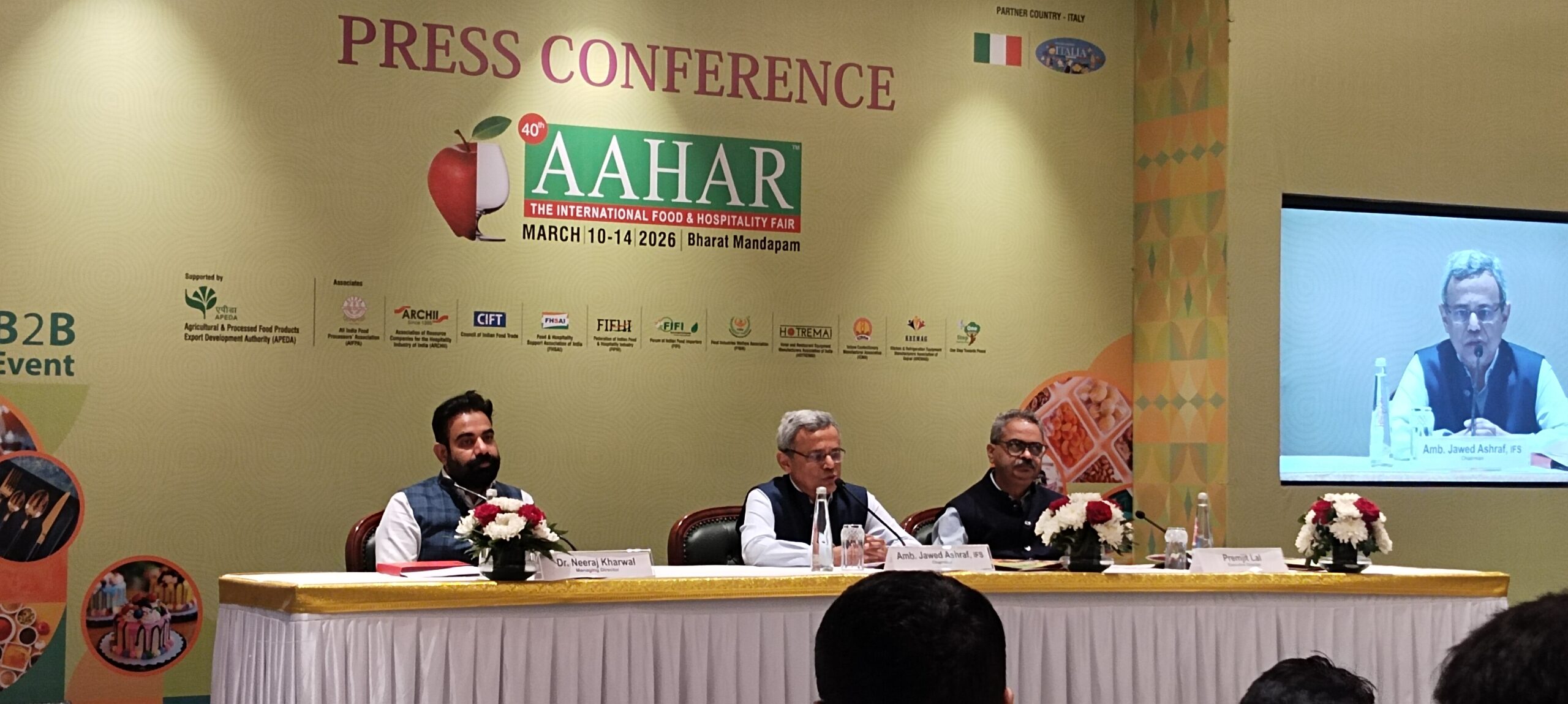
As India seeks to transform its vast agricultural base into a high-value food processing and export powerhouse, the 40th edition of AAHAR — the country’s flagship food and hospitality trade exhibition — will open on Tuesday at Bharat Mandapam, bringing together businesses, policymakers and global buyers from across the food value chain.
The five-day exhibition, organized by the India Trade Promotion Organisation (ITPO) under the Ministry of Commerce and Industry, will be inaugurated by Commerce and Industry Minister Piyush Goyal, with Food Processing Industries Minister Chirag Paswan also expected to attend.
Running from March 10 to 14, AAHAR 2026 will feature more than 1,800 exhibitors and draw an estimated 100,000 business visitors, making it one of Asia’s largest business-to-business gatherings for the food processing and hospitality industries.
But beyond the exhibition halls, the event reflects a larger economic shift underway in India: the effort to move from exporting raw agricultural commodities to building a globally competitive processed food industry.
From Farm Produce to Value Addition
India is the world’s second-largest producer of fruits and vegetables and among the largest producers of cereals, dairy and spices. Yet a relatively small share of this output is processed or exported as high-value food products.
Policy makers increasingly see food processing as the bridge between agriculture and manufacturing — capable of boosting farmer incomes, reducing wastage and generating employment in rural areas.
“The food and hospitality sector is among the fastest-growing segments of the Indian economy,” ITPO Chairman Jawed Ashraf said at a curtain-raiser event for AAHAR. “India is already a major exporter of agricultural products, but value-added food products, equipment and accessories are emerging as the next frontier.”
The sector is also viewed as a strategic pillar of India’s industrial policy. Expanding food processing capacity can absorb agricultural surpluses, stabilize farm incomes and help the country capture a greater share of global food trade, which runs into trillions of dollars annually.
Export Ambitions Gain Momentum
India’s processed food exports have grown steadily in recent years, supported by rising global demand for ready-to-eat foods, specialty ingredients, dairy products and processed fruits and vegetables.
Institutions such as the Agricultural and Processed Food Products Export Development Authority (APEDA) are working to expand market access and support exporters with certification, logistics and trade promotion initiatives.
Government officials say new trade agreements are also expected to play an important role. India’s expanding network of free trade agreements is opening opportunities for processed food exports in Asia, Europe and the Middle East, particularly in segments such as organic products, spices, marine products and specialty foods.
Events such as AAHAR serve as a marketplace where these export ambitions intersect with global buyers and technology providers.
Global Industry Converges in Delhi
AAHAR 2026 will host 155 international exhibitors from 17 countries, highlighting the growing international interest in India’s consumer market and manufacturing base.
Countries including Australia, Brazil, Canada, Chile and Thailand will set up national pavilions, while companies from Belgium, China, Finland, France, Germany, Japan, South Korea, Spain, Taiwan, the United Kingdom and Vietnam will participate individually.
This year, Italy will participate as the partner country for the first time, reflecting expanding cooperation between India and Europe in areas such as gourmet foods, food processing equipment and hospitality technologies.
Spanning more than 115,000 square meters of exhibition space, the fair will showcase innovations across sectors ranging from processed foods and beverages to packaging technology, cold-chain logistics and hospitality infrastructure.
Technology Driving Industry Transformation
One of the central themes of AAHAR 2026 is the growing role of technology in modernizing the food industry.
India’s food supply chain has long struggled with inefficiencies, including inadequate cold storage, fragmented logistics and significant post-harvest losses. Industry experts say improving processing capacity and storage infrastructure could significantly boost both domestic food security and export competitiveness.
The exhibition will highlight new solutions in refrigeration, packaging technology, food-grade materials and automated processing equipment — technologies that are becoming essential as Indian food companies scale up production for global markets.
Several curated pavilions will also be featured, including those organized by APEDA and the Ministry of Food Processing Industries, alongside international participation zones and industry association platforms.
Culinary Diplomacy and Hospitality Growth
Beyond manufacturing and exports, AAHAR also reflects the rapid expansion of India’s hospitality and food services sector.
Urbanization, rising incomes and the growth of tourism and business travel are reshaping food consumption patterns across the country. Restaurants, hotels, catering companies and quick-service chains are expanding rapidly, creating demand for new ingredients, kitchen technologies and supply chain solutions.
Events such as Hospitality Challenge and Culinary Art India 2026 will bring chefs and hospitality professionals together in competitions that celebrate culinary innovation and global cuisines.
Industry bodies supporting the exhibition include the All India Food Processors Association, the Federation of All India Caterers and the Forum of Indian Food Importers, among others.
Digital Tools for a Global Marketplace
Reflecting the growing digitalization of trade exhibitions, ITPO has also launched the official AAHAR 2026 mobile application to help exhibitors and visitors connect more efficiently.
The app provides access to a digital exhibitor directory, interactive floor plans and tools for scheduling business-to-business meetings, allowing companies to identify potential partners before and during the event.
Organizers say the platform is designed to make networking more efficient at an exhibition expected to host tens of thousands of visitors.
A Window into India’s Food Economy
For policymakers and industry leaders, AAHAR is increasingly more than just a trade exhibition. It has become a window into the evolving structure of India’s food economy — from farm production and processing technologies to global trade and hospitality services.
If India succeeds in expanding food processing and value addition, analysts say the sector could play a crucial role in boosting exports, creating rural employment and strengthening supply chains.
In that sense, the bustling halls of Bharat Mandapam this week will represent not only a marketplace for food products and equipment, but also a glimpse of India’s ambitions to become a major player in the global food economy.
Related posts:
 The Aroma of Home: Assam’s Joha Rice Finds Its Way to Diaspora Kitchens in Europe
 India–NZ Trade Pact Balances Access, Protection
 US, India Agree on Framework for Interim Trade Agreement, Set Path Toward Broader Bilateral Deal
 India Launches Indusfood Asia at Singapore FHA to Boost APAC Market Share
