Join WhatsApp Channel


Dubai’s real estate boom — one of the most dramatic post-pandemic property rallies globally — is facing a fresh geopolitical stress test as tensions involving Iran ripple across the Gulf.
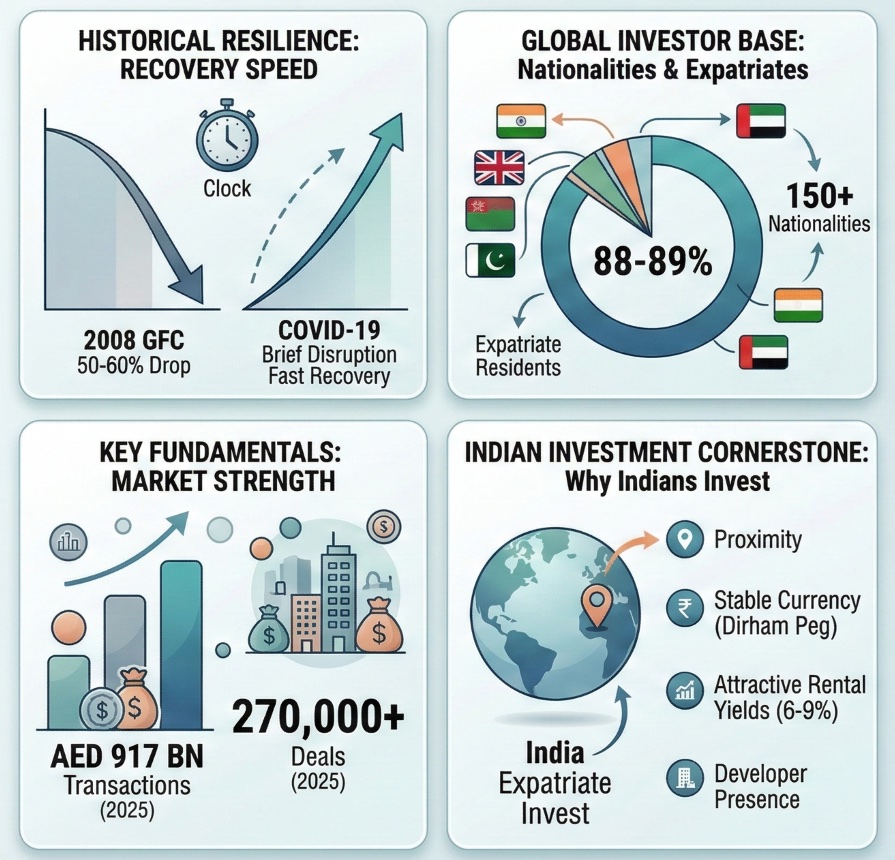
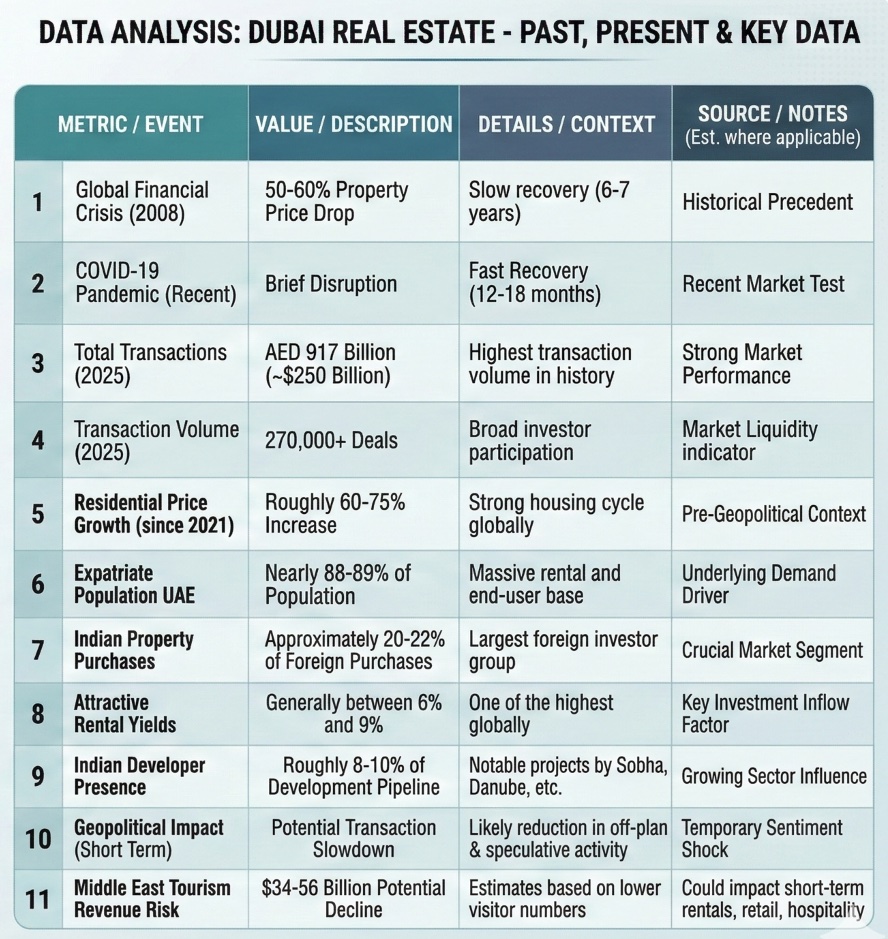
For a market that recorded a staggering AED 917 billion ($250 billion) in property transactions in 2025, investors are now weighing whether the conflict represents merely a temporary sentiment shock or a deeper structural risk to one of the world’s most international real estate hubs.
Analysts say the evidence so far suggests short-term caution rather than systemic disruption, though the trajectory will depend heavily on how long regional tensions persist.
A Market Entering the Crisis From Strength
Dubai’s property sector entered the current geopolitical turbulence with considerable momentum.
According to research by ANAROCK Group, the emirate recorded nearly 270,000 real estate transactions in 2025, the highest on record. Residential deals accounted for around 200,000 transactions valued at roughly AED 538 billion, underlining strong demand from global investors and expatriate residents.
Residential property prices have surged around 60–75% since 2021, making Dubai one of the strongest performing housing markets globally in the post-pandemic cycle.
That growth trajectory matters when assessing the impact of geopolitical shocks.
“While geopolitical tensions can temporarily affect investor sentiment, Dubai’s real estate market has historically demonstrated a remarkable ability to absorb shocks and recover relatively quickly,” said Prashant Thakur, Executive Director and Head of Research & Advisory at ANAROCK.
“Markets that are already in a strong expansion phase tend to see a slowdown in transaction activity rather than an immediate correction in prices.”
The Psychology of Risk
Dubai has long positioned itself as the Middle East’s safest financial and lifestyle hub, a reputation that has helped attract capital from across Asia, Europe and Africa.
However, recent reports of attacks reaching parts of the United Arab Emirates — even if limited in physical impact — introduce a new element of risk perception.
The psychological dimension of geopolitics can influence investor behavior as much as actual economic damage.
“Any perception of rising geopolitical risk can push investors into a temporary wait-and-watch mode,” Thakur said. “In such situations, off-plan and speculative investments are usually the first segments to slow down because they are highly sentiment-driven.”
Off-Plan Segment Likely to Feel First Impact
Dubai’s property ecosystem is unusually global.
Buyers from more than 150 nationalities participate in the market, while expatriates make up roughly 88–89% of the UAE’s population, providing a deep base of housing demand.
But that global investor base also means sentiment shifts can quickly affect certain segments of the market.
Off-plan developments — properties sold before construction is completed — are particularly sensitive to geopolitical uncertainty.
These projects rely heavily on future price expectations and investor confidence, meaning developers could face slower booking rates or delayed launches if buyers pause decisions.
Tourism: Another Transmission Channel
Beyond investor sentiment, tourism represents another potential channel through which geopolitical tensions could affect Dubai’s property sector.
The broader Middle East tourism industry is estimated to be worth roughly $367 billion annually. Industry projections suggest prolonged instability could reduce visitor flows by 23–38 million travelers, translating into $34–56 billion in lost tourism revenue across the region.
If that scenario materializes, the most immediate impact would likely be felt in:
- short-term rental apartments
- hospitality real estate assets
- retail properties in tourist-heavy districts
However, analysts note that Dubai’s residential demand is not solely dependent on tourism.
The city’s large expatriate workforce and role as a global business hub continue to underpin long-term housing demand.
The Indian Factor
One of the most important stabilizing forces in Dubai’s property market is the diversity of its investor base.
Among them, Indian nationals remain the largest foreign investor group, accounting for roughly 20–22% of foreign property purchases in the emirate.
Several structural factors explain this trend:
- geographic proximity between India and the UAE
- the UAE dirham’s peg to the US dollar
- attractive rental yields of 6–9%, among the highest globally for major cities
For many Indian investors, Dubai property has become both an income-generating asset and a diversification tool against currency volatility.
Indian Developers Expanding Their Footprint
Indian companies are also playing an increasing role in the development pipeline.
While the market remains dominated by major UAE developers such as Emaar Properties, DAMAC Properties, Nakheel, and Meraas, Indian-origin developers are gradually expanding their presence.
They are estimated to account for roughly 8–10% of Dubai’s development pipeline.
Among the most prominent is Sobha Realty, which developed the Sobha Hartland community covering nearly 8 million square feet.
Another active player is Danube Properties, which has launched more than 20 residential projects in the emirate.
Developers including Shapoorji Pallonji Real Estate and Casagrand have also begun entering the Dubai market with premium developments.
Lessons From Past Cycles
Dubai’s real estate market has gone through several dramatic cycles over the past two decades.
During the Global Financial Crisis, property prices plunged 50–60%, and the market took nearly six to seven years to fully recover.
Another correction occurred between 2014 and 2019, when prices fell 25–30%, driven largely by lower oil prices and oversupply.
More recently, however, the sector proved far more resilient during the COVID-19 pandemic, rebounding within 12–18 months as global wealth migration and investor demand surged.
These cycles underscore a defining feature of Dubai’s property market: sharp corrections can occur, but recovery has historically been swift once investor confidence returns.
Sentiment Shock — Not Structural Collapse
For now, analysts say the Iran-linked tensions are more likely to slow transaction volumes rather than trigger a major price correction.
“The real estate market is deeply tied to investor confidence,” Thakur noted. “The key question is not whether geopolitical tensions will affect activity — they will — but how quickly confidence returns once the situation stabilizes.”
Dubai’s status as a global financial hub, its diversified investor base, and policy flexibility continue to provide strong structural support.
In that sense, the city’s property market may once again follow a familiar pattern: a temporary pause under geopolitical pressure, followed by recovery once stability returns.