Join WhatsApp Channel


Somewhere in the grey waters of the Persian Gulf, a young Indian engineer begins another watch on the deck of a crude oil tanker.
The sea is calm. The engines hum quietly below. But above him, the sky — and the radio channels — carry the uneasy reminders of a war that has suddenly made the world’s busiest oil corridor one of its most dangerous.
For more than a week now, ships across the Persian Gulf and the Gulf of Oman have been trapped in a tense maritime limbo after the dramatic escalation of conflict involving the United States, Israel and Iran — a conflict triggered by strikes that killed Iran’s Supreme Leader Ali Khamenei.
Iran’s retaliation and warnings to commercial shipping have effectively shut the narrow Strait of Hormuz, the maritime chokepoint through which nearly one-fifth of the world’s oil and liquefied natural gas flows each day.
But behind the strategic calculations and oil price charts lies a far more intimate story — one unfolding quietly on the decks of stranded ships and in the living rooms of anxious families thousands of kilometers away.
The Ships That Cannot Move
Shipping data suggests that more than 200 vessels — oil tankers, LNG carriers and container ships — are now anchored across the region, unable to safely transit the strait.
Among them are about 37 Indian-flagged ships, collectively worth roughly ₹10,000 crore — about $1.2 billion — many carrying crude oil or LPG destined for Indian refineries and ports.
On those vessels alone are over 1,100 Indian sailors, part of a global seafaring workforce that has long powered international trade but rarely appears in the headlines.
Some ships lie west of the strait, trapped inside the Gulf near ports in Iraq, Saudi Arabia and Qatar. Others sit east of the chokepoint in the Gulf of Oman, waiting for a passage that may not open anytime soon.
Onboard, the routine continues — engine maintenance, navigation checks, cargo monitoring.
But the tension is unmistakable.
The men on those ships know they are floating in a conflict zone.
The Sound of War on the Radio
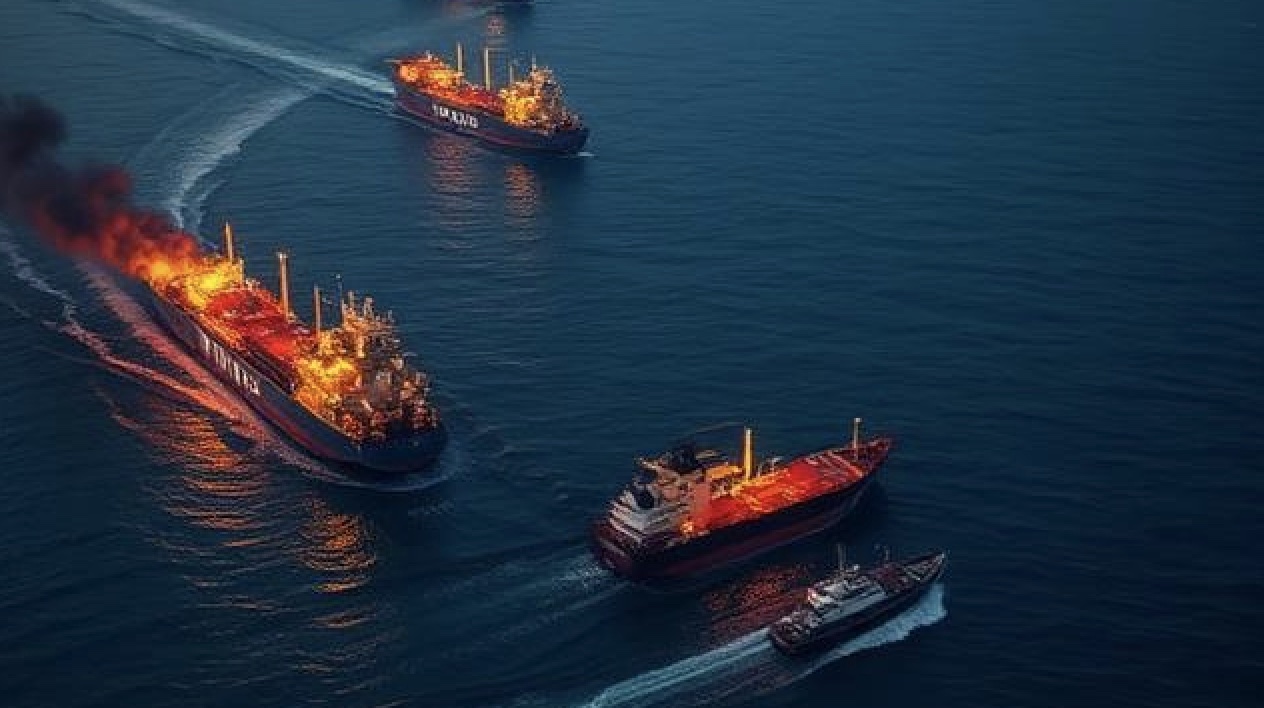
Merchant ship captains navigating the region say maritime radio channels in recent days have carried ominous warnings attributed to Iranian Revolutionary Guard units, cautioning ships that attempt to cross the strait that they could be set ablaze.
Whether psychological warfare or genuine threat, the message has had its intended effect.
Ships have stopped moving.
For crews accustomed to months at sea, the sudden stillness feels unnerving.
Instead of plotting the next port of call, officers now spend long hours studying radar screens and scanning the horizon.
The war, though distant from the deck, feels uncomfortably close.
When the Missiles Came
The risks became brutally real when the oil tanker Skylight, sailing under the Palau flag, was struck near the coast of Oman.
The vessel carried 20 crew members — 15 of them Indian.
Four sailors were injured in the attack before Omani authorities evacuated the crew and rushed them to hospitals.
It was a reminder of how quickly the situation can spiral.
Elsewhere in the region, three Indian seafarers working on foreign-flagged vessels have already been killed in attacks involving drones or projectiles since the conflict intensified.
For the families of sailors still trapped in the Gulf, those reports land like thunderclaps.
Waiting at Home
Across India’s coastal towns — Kochi, Mangalore, Kakinada, Tuticorin — seafaring families have slipped into a routine that mixes patience with dread.
Phones are rarely far from reach.
Calls from ships come through satellite connections — often brief, sometimes patchy.
“They usually say they are fine,” said the relative of one seafarer in Kerala, speaking to local media earlier this week. “But you can hear the tension in their voice.”
Shipping companies say they are maintaining constant contact with crews and their families.
“We are in touch with families at all times,” said Anil Devli, chief executive of the Indian National Shipowners’ Association.
“The priority right now is the safety of the seafarers. Trade through the strait is effectively at a standstill.”
The Invisible Workforce
The crisis has once again thrown a spotlight on the global maritime labour force — a workforce that remains largely invisible despite carrying the lifeblood of international trade.
India alone supplies nearly one in ten seafarers worldwide, with thousands of Indian officers and engineers working on ships flying dozens of different flags.
For the diaspora — particularly Indian communities in the Gulf, Britain, Canada and Australia — the story of stranded sailors resonates deeply.
Many families in those communities have relatives who work at sea.
When maritime routes close because of war, it is not only oil markets that tremble — it is also the fragile rhythm of migrant livelihoods.
The Economics of Fear
Even as sailors wait at anchor, the global shipping industry is scrambling.
War-risk insurance premiums for ships entering the Gulf have surged fivefold, from about 0.2 percent to roughly 1 percent of a vessel’s value.
For a tanker worth $100 million, that means insurance alone can now cost around $1 million for a single voyage.
Freight rates have exploded.
Daily charter costs for very large crude carriers — the giant ships that move Middle Eastern oil to Asia — have jumped to over $424,000 per day, more than four times their pre-crisis levels.
Some companies have begun rerouting ships around Africa’s Cape of Good Hope, adding 10 to 14 days to voyages and hundreds of thousands of dollars in additional fuel and operating costs.
Yet for the men waiting aboard stranded ships, those numbers feel distant.
Their concerns are simpler.
Is it safe to sail?
And when will they finally be able to go home?
Governments Watching, Crews Waiting
India’s maritime authorities are closely monitoring the crisis.
The Directorate General of Shipping has advised Indian seafarers not to join ships operating near Iranian waters and has established a quick-response team to assist sailors and their families if the situation deteriorates.
Meanwhile, the shipowners’ association has appealed to the government to use diplomatic channels to secure safe passage for Indian vessels through the strait.
But diplomacy moves slowly, and wars rarely follow predictable timetables.
Life in Suspension
On the deck of a tanker somewhere near the mouth of the Gulf, a sailor may step outside during a quiet watch and stare across the dark water.
In the distance, dozens of ships sit anchored like silent cities of steel.
Each one holds a crew.
Each crew holds a story — of a family waiting, a contract unfinished, a journey paused by geopolitics far beyond their control.
In a global economy that depends on movement, these sailors have become the human markers of a trade route that has suddenly stopped.
For now, they wait.
And the world waits with them.