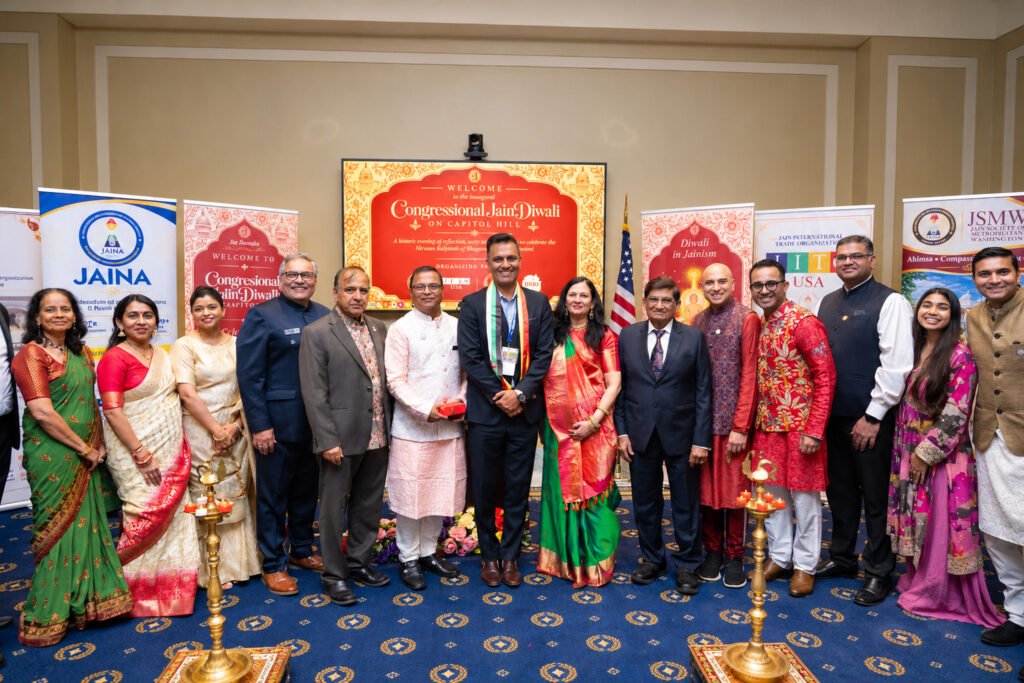
WASHINGTON — Jain Americans from across the country gathered on Capitol Hill on Tuesday, Nov. 17, for what organizers described as the first Congressional Jain Diwali. The celebration, held at the Rayburn House Office Building, drew six members of Congress, representatives of the Government of India and more than 100 community members.
The event was hosted by the Federation of Jain Associations in North America (JAINA) in partnership with Jain International Trade Organization USA (JITO USA), the Jain Society of Metropolitan Washington (JSMW) and the International Digambar Jain Organization (IDJO).
For Jains, Diwali marks Bhagwan Mahavir’s Nirvaan Kalyanak, the day the 24th Tirthankara of Jainism attained moksha, or spiritual liberation. Within the tradition, the festival stands for the triumph of spiritual enlightenment over ignorance and attachment.
The evening’s program included traditional prayers, cultural performances and the ceremonial lighting of a diya. Speakers touched on several core principles of Jainism, among them ahimsa (nonviolence), anekantavada (respect for multiple perspectives), compassion and peaceful coexistence.
Advertisement
Members of Congress Join Jain Community for Diwali
Members of Congress at the event were Rep. Grace Meng, chair of the Congressional Asian Pacific American Caucus (CAPAC); Rep. Judy Chu, CAPAC chair emerita; and Reps. Shri Thanedar, Tom Suozzi, Suhas Subramanyam and James Walkinshaw.
Also attending were Congressman-elect Amish Shah, Virginia State Sen. Kannan Srinivasan, D.C. Shadow Senator Ankit Jain and Ambassador Namgya C. Khampa, deputy chief of mission at the Embassy of India in Washington. A statement from U.S. Sen. Chris Van Hollen was read during the program.
Amish Shah is one of two Jain Americans elected to the U.S. House of Representatives this year. He won Arizona’s 1st Congressional District, while Congresswoman-elect Pia Dandiya won Florida’s 22nd. Organizers said the two victories gave the Capitol Hill gathering added meaning for the community.
JAINA and JITO USA Leaders Reflect on the Milestone
JAINA President Atul Shah said the evening went beyond a festival observance.
“Tuesday evening was more than a celebration of Diwali. It was a powerful affirmation that the Jain American community and our timeless values have an important place in America’s national story,” he said.
Atul Shah pointed to the community’s work in service, entrepreneurship, education, medicine and philanthropy. He said seeing Jain Americans come together with elected officials in Congress was a source of pride for the next generation.
Captain (Ret.) Dr. Sushil Jain, chairman of JITO USA and a U.S. Navy veteran, said the occasion carried personal weight for him.
“As someone who has proudly served this country, it was especially meaningful to witness our faith and heritage celebrated in the United States Congress,” he said. He added that organizers hope the gathering will encourage more civic participation, public service and leadership among younger Jain Americans.
Several former JAINA presidents were also in the audience, including Bindesh Shah, Haresh Shah, Manoj Dharamsi and Dr. Sushil Jain. Attendees came from a range of fields, including business, medicine, philanthropy, the arts and public service.
Planning the First Congressional Jain Diwali
According to organizers, Rahul Jain, chair of the JITO USA Washington, D.C., chapter, brought the participating Jain organizations together into a single coalition and coordinated the planning and logistics for the event.
Vaibhav Jain, a senior adviser to JAINA with a long background in Asian American civic engagement, led community outreach and drew Jain American leaders, professionals and families from around the country. He has previously worked with the White House, elected officials and state legislatures on issues affecting the community.
Savita Jain, who leads public relations for JAINA, served as emcee for the evening.
Organizers said they view the event as a first step toward broader engagement between the Jain community and Congress, as well as other national institutions, and toward greater visibility for Jain Americans in Washington.