Join WhatsApp Channel


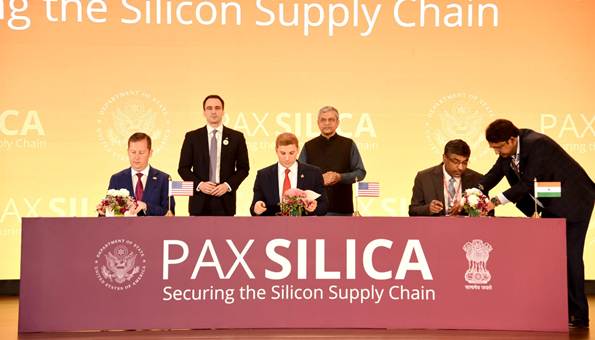
On day five of the India AI Impact Summit 2026, a carefully choreographed signing in New Delhi carried consequences far beyond the conference halls. India formally joined Pax Silica, a U.S.-led strategic technology initiative that aims to secure — and democratically govern — the entire global “silicon stack,” from critical minerals buried deep in the earth to the AI systems reshaping economies.
For Washington and New Delhi alike, the move marks a decisive deepening of strategic technology cooperation. For the rest of the world, it is another clear signal that geopolitics is no longer defined by oil and shipping lanes alone, but by fabs, data centers, and who controls the intelligence that runs on them.
From Minerals to Models
Launched in December 2025, Pax Silica is envisioned as a coalition of trusted nations committed to building resilient, non-coercive supply chains for technologies critical to the AI age. Its scope is intentionally broad: critical minerals, semiconductor fabrication, advanced manufacturing, energy systems, and AI deployment infrastructure are all part of the same strategic picture.
The underlying logic is simple and stark. Overconcentration in supply chains has become a national security risk. Economic coercion through technology choke points is no longer theoretical. Pax Silica’s answer is alignment among democratic partners — not just on policy, but on investment, standards, and long-term industrial capacity.
India’s entry makes it the tenth full member of the coalition, joining a group that already includes the United States, Japan, South Korea, the Netherlands, Israel, the United Kingdom, and others. Its inclusion brings scale, talent, and a rapidly expanding semiconductor and AI ecosystem into the fold.
“We Are Building the Future”
For Ashwini Vaishnaw, India’s Minister of Electronics and Information Technology, the moment was about far more than a diplomatic signature.
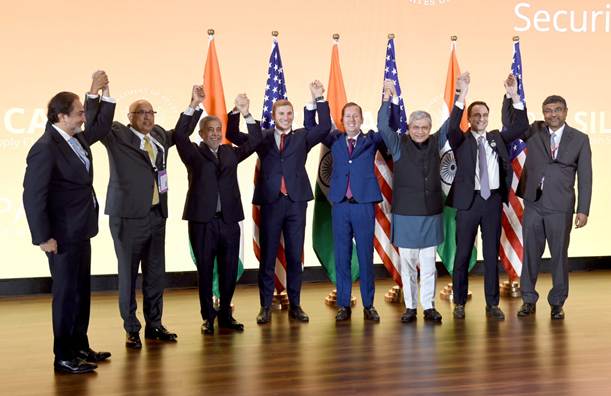
“We are not just holding a summit; we are building the future,” he told the audience, framing the agreement as a generational inflection point. Drawing a long arc from Independence to the present, Vaishnaw emphasized the compounding power of growth — and how that logic now applies to semiconductors and AI.
India, he noted, already has engineers designing some of the world’s most advanced two-nanometer chips. With the global semiconductor industry expected to require nearly one million new skilled professionals, the opportunity is vast — and India intends to seize it.
The subtext was clear: India does not see itself as a junior partner in the AI age, but as a shaper of its industrial foundations.
Economic Security Is National Security
From the U.S. side, the language was equally unambiguous. Jacob Helberg, U.S. Under Secretary of State for Economic Growth, Energy, and the Environment, called the declaration “not merely an agreement on paper, but a roadmap for a shared future.”
Invoking the democratic histories of both nations, Helberg framed Pax Silica as a rejection of “weaponized dependency” and economic blackmail. “Economic security is national security,” he said, distilling a view now widely shared in Washington.
The ambition, he added, is to secure the “full stack of the future” — the minerals, the wafers, and the intelligence itself. Pax Silica, in that sense, is less about containment than construction: building systems robust enough that coercion simply does not work.
A Coalition to Define the Century
That theme was echoed by Sergio Gor, U.S. Ambassador to India, who described India’s entry as both “strategic and essential.”
“Pax Silica is the coalition that will define the 21st-century economic and technological order,” Gor said, laying out a vision that spans mines, fabs, and frontier AI data centers. At its core, he argued, the initiative is about whether free societies will control the commanding heights of the global economy.
“We choose freedom. We choose partnership. We choose strength,” he said — a line clearly designed to resonate well beyond the summit audience.
Industry Steps In
If the morning was about geopolitics, the afternoon shifted decisively toward execution. A high-level fireside chat brought together policymakers and industry leaders, including S. Krishnan, Secretary at India’s Ministry of Electronics and IT; Sanjay Mehrotra, CEO of Micron Technology; and Randhir Thakur, CEO and Managing Director of Tata Electronics.
Krishnan emphasized India’s coordinated push across AI, semiconductors, and critical minerals, framing the goal as “resilient collaboration with trusted partners who share our values.” Gor underscored the urgency: “The AI revolution is not on the horizon — it is already here.”
Mehrotra brought the supply-chain reality into focus, calling Pax Silica a “shared commitment to building resilient, secure supply chains” and a “win-win ecosystem to advance AI for good.” Thakur, meanwhile, described the initiative as a timely step in a journey that has always been driven by materials, innovation, and compute.
Silicon Geopolitics, Accelerated
Taken together, the day’s announcements underscored a broader shift already underway. Power in the 21st century is increasingly defined by access to chips, minerals, and AI infrastructure — a dynamic some analysts now call “silicon geopolitics.”
Supporters see Pax Silica as a positive-sum framework that aligns complementary strengths and reduces systemic risk. Critics warn it could entrench U.S. dominance or redraw global tech hierarchies into insiders and outsiders. Both sides agree on one thing: the stakes are enormous, and the commitments are long-term.
For India, joining Pax Silica is a clear declaration of intent. The country is betting that its scale, talent base, and growing manufacturing muscle make it indispensable to any credible alternative to fragile, concentrated tech supply chains.
As the India AI Impact Summit drew to a close, one message rang through the speeches and side conversations alike: the future of AI and advanced technology will not be left to chance. It will be built — deliberately — by those who control the silicon stack beneath it.