Join WhatsApp Channel


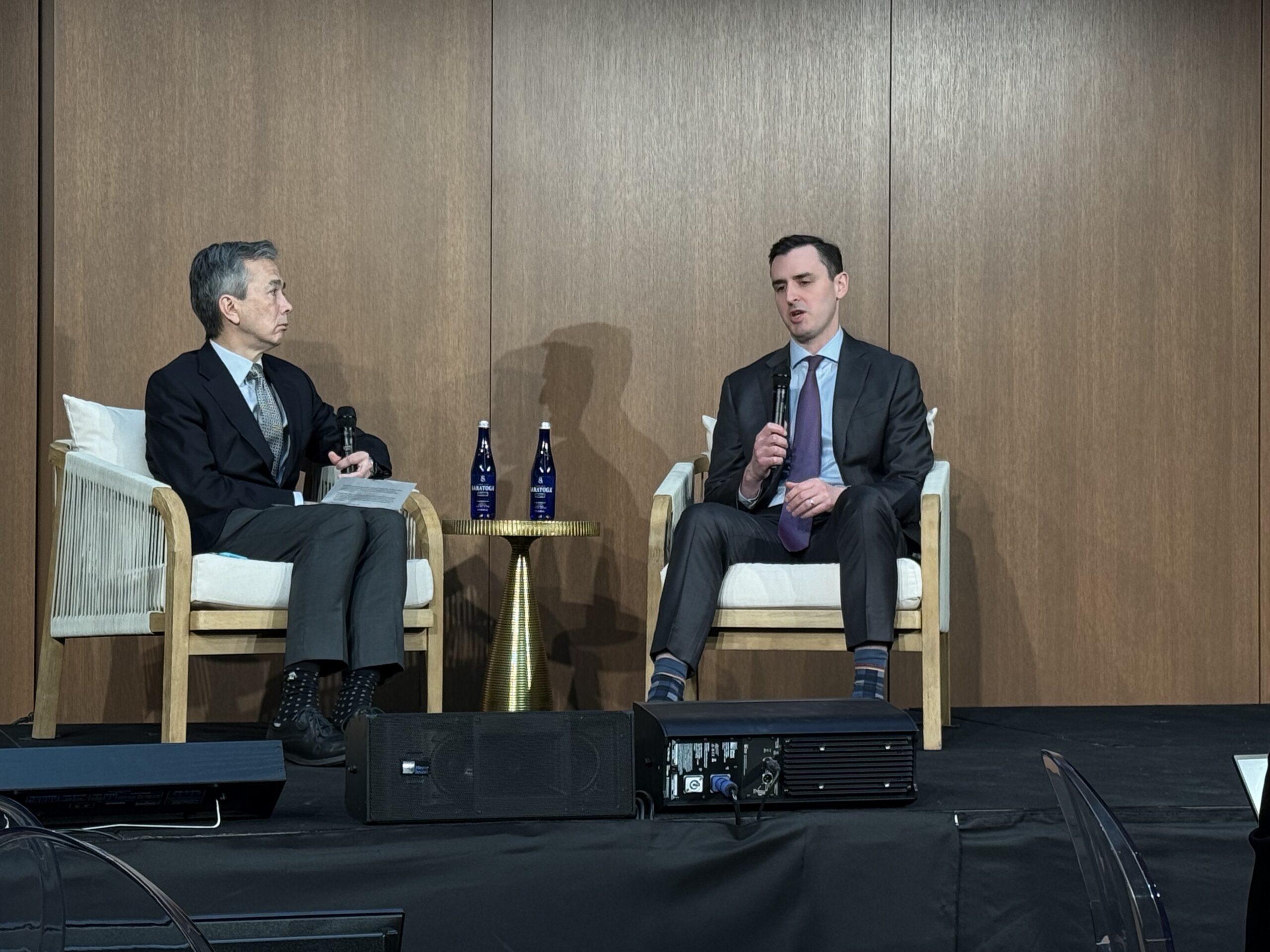
The recent escalation in the Middle East could significantly influence the global economy, although the scale of the impact remains uncertain, International Monetary Fund (IMF) First Deputy Managing Director Dan Katz said during a discussion at the Milken Institute’s inaugural Future of Finance Conference on March 3, 2026, in Washington DC.
Speaking at a session titled “Global Economic Outlook: A Conversation with IMF First Deputy Managing Director,” Katz said “We have a significant escalation in the Gulf, and that certainly has the potential to be very impactful on the global economy across a range of metrics, whether it’s inflation, growth and so on,” adding, “But it’s very early at this point to have any sort of firm conviction about what the likely impact is going to be really.”
According to Katz, the ultimate economic consequences will largely depend on how the geopolitical situation evolves. Before the weekend escalation in which the United States began its attack on Iran, IMF had been assessing a global economy that performed strongly in 2025 and was expected to continue expanding at a healthy pace in 2026.
“The economic impact is ultimately going to be downstream of the geopolitical situation, and the persistence of the conflict in particular is going to drive much of the impact,” he said.
Katz noted “Before the weekend where the US began its attack on Iran, the IMF was looking at a global economy that had grown at a very healthy pace in 2025, and projecting that would continue to grow at a healthy level,” adding “And, I would say two factors that I think really drove the narrative in 2025 that I was expecting to drive the narrative again in 2026 which were the sort of changing nature of international economic linkages and then AI.”
He said that Artificial Intelligence (AI) was expected to become an increasingly dominant economic theme this year, potentially replacing concerns around shifting global economic relationships as the primary source of uncertainty.
“I was expecting a bit of a shift from the historic source of some degree of uncertainty or anxiety in 2025 which was the changing nature of international economic relations towards AI, is going to be a big story in 2026. That was a potential source of disruption,” he said.
Energy Prices and Monetary Policy
Addressing concerns about rising oil prices and inflation expectations amid the Iran conflict, Katz said central banks would need to assess the situation carefully and respond depending on the duration and severity of the shock.
“About increase in energy prices, if it’s short term, one would expect central banks to really look through that, assuming that inflation expectations continue to remain well anchored,” he said.
However, he added that a prolonged rise in energy prices could prompt policy action.
“But if you’re in a world where there’s a more persistent shock, and higher energy costs do result in a destabilizing of inflation expectation, then that’s a scenario in which you could see central banks responding,” Katz noted. “But again, it really depends, on the exact nature of the shock, and what happens on the geopolitical front.”
He added that extended geopolitical uncertainty could make central banks more cautious in their policy decisions.
“And if you have prolonged uncertainty and the risk of energy price impacts, I would expect such banks to be cautious and to respond to the situation as it materializes,” he said.
China’s Growth Model Under Pressure
Katz also addressed the structural challenges facing China’s economy, emphasizing the need for a shift toward domestic consumption.
“On China, he noted I would take a step back and come at this actually, not from the direction of the Chinese external surplus, but from the balance of forces in the Chinese domestic economy,” Katz said.
He pointed to the IMF’s policy recommendations urging China to move away from a growth model driven primarily by exports.
Noting the fund’s very consistent policy advice to China over in recent years, he said “This is reflected very strongly in the article four consultation from 2025 that I was a part of is that the Chinese growth model really needs a shift from one that relies heavily on external demand to one where consumption from within China is the primary driver of economic activity,” he said.
Katz added that weak domestic demand is creating economic pressures and increasing tensions with trading partners.
“Right now, what we have is a situation where consumer demand is relatively weak, that is creating pressure on the external sector, and China is simply too large to grow on the back of external demand, and it’s causing very significant trade tensions with many of its trading partners,” he said.
Stablecoins and the Future of Payments
Katz also discussed the emerging role of stablecoins in the global financial system, noting their potential to improve cross-border payments and expand financial inclusion.
“Stablecoins are actually quite small, but I think do offer high degree of potential,” he said.
He pointed to international payments as one of the key areas where stablecoins could bring improvements.
“One is international payments, which, I think we can all agree are too cumbersome and too expensive today,” Katz said. “Second important one, I would say, is financial inclusion, and we do need to recognize that much of the world and much of the populations in the IMF membership still lack access to high quality financial services.”
Dollar Still Dominant in Global Finance
Despite ongoing discussions about potential shifts in the international monetary system, Katz said the U.S. dollar continues to play a central role.
“There is this narrative out there, about the role of the dollar and the international monetary system, and whether things are changing on a fundamental level,” he said. “I think, across a range of metrics, it’s still very clear that the dollar is playing the role of the heart of the international monetary system that it always has.”
Katz added that while the dollar softened slightly in 2025, it remained historically strong.
“In 2025 the dollar had retreated a bit, but this is from historically strong levels at the end of 2024. And over a medium- or long-term level, the level of dollar is still quite strong,” he said.
The discussion was moderated by Greg Ip, Chief Economics Commentator at The Wall Street Journal.
Congress Debates AI Regulation in Financial Services
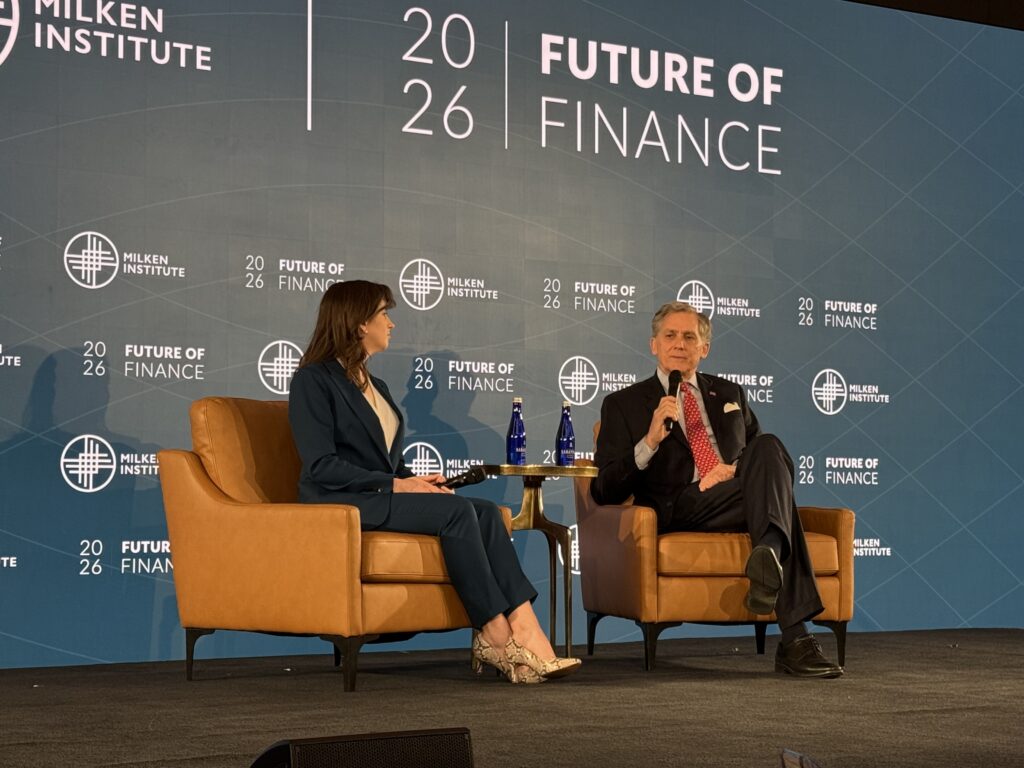
In a separate session titled “Shaping the Future of Finance: A Conversation with U.S. House Financial Services Committee Chairman French Hill,” Chairman Hill, among several important issues, discussed Congress’s evolving approach to regulating artificial intelligence.
Hill said that when Speaker Mike Johnson assumed office, he established a bipartisan AI Task Force that includes members from multiple congressional committees. He noted that House Democratic Leader Hakeem Jeffries also joined the bipartisan task force.
Hill mentioned that he serves on the committee alongside Representative Bill Foster of Illinois at the request of former Financial Services Committee Chairman Patrick McHenry.
Hill said the task force has produced a comprehensive report examining AI developments across different policy areas.
Highlighting the approach of the House Financial Services Committee, Hill said he and Congresswoman Maxine Waters recently passed a bipartisan resolution emphasizing the importance of AI in the financial sector.
“Our committee has taken the approach that if you’re a vendor in financial services, a broker, insurance, a bank, a non-bank, Fintech, you have an obligation to comply with federal law,” Hill said. “So, if you’re using AI in any of those ways I just discussed, you have your federal law obligation.”
Hill also emphasized the need for coordination between federal and state governments on AI regulation.
“We need to make sure we have lanes of responsibility around AI, between federal responsibility and state so that we again can have a very clear, innovative course and not get off track by a bad state law,” he said.
The session was moderated by Emily Wilkins of CNBC.
AI Driving Digital Transformation in Finance
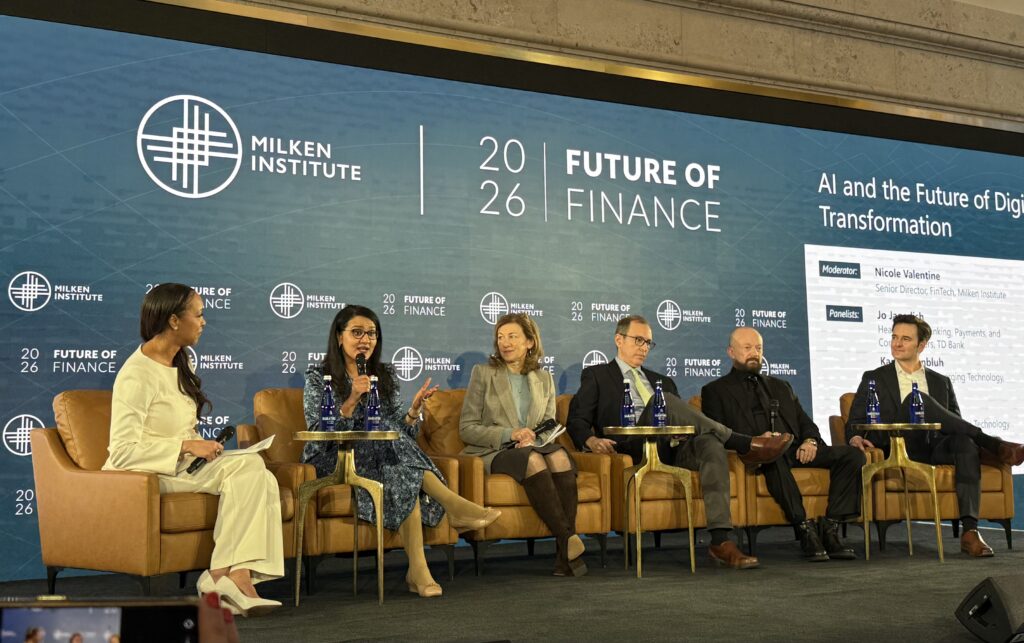
Another panel at the conference examined the role of artificial intelligence and the future of digital transformation. Participants included Jo Jagadish of TD Bank, Karen Kornbluh of the Milken Institute, Eric Mandl of Guggenheim Securities, Igor Tulchinsky of WorldQuant, and Kip Wainscott of JPMorgan Chase & Co. The session was moderated by Nicole Valentine of the Milken Institute.
Jagadish discussed how AI is transforming banking operations, including digital banking, payments systems, and customer service. She highlighted the concept of “human in the loop,” where AI supports human decision making and increases efficiency in routine tasks. Jagadish also noted that TD Bank saw strong adoption of its AI-driven knowledge management tools, with adoption rates reaching 80 percent within the first few weeks of launch.
Kornbluh compared the current AI revolution to the digital transformation that began in the late 1980s and early 1990s, noting its potential to boost productivity while also reshaping labor markets. She also pointed to the disruption caused by social media in journalism and stressed the importance of thoughtful AI deployment to ensure positive outcomes for businesses and society.
Discussing the market’s struggle to understand the timing and magnitude of AI’s impact, predicting more positive outcomes in the future, Mandl emphasized the importance of balancing social equity with technological advancements in finance.
Tulchinsky described the current AI revolution as a significant step change, with AI making processes 100 times faster. Discussing the potential of quantum computing to solve complex problems quickly, he noted it won’t replace GPUs anytime soon.
Wainscott emphasized that trust, confidence, and clear policy objectives will be critical in ensuring that AI delivers long-term benefits. He also highlighted JPMorgan Chase’s efforts to evaluate AI policy issues across its global operations.
Related posts:
 IMF’s Gita Gopinath Highlights Role of Resilient Capital Markets and AI at IMF-IOSCO Conference
 Global Economy Shows Resilience Amid Tariffs and Uncertainty, Say Singapore’s Shanmugaratnam, IMF’s Georgieva, and ECB’s Lagarde
 IMF Forecasts Mixed Outlook for South Asia: India Leads, Bangladesh and Sri Lanka Stabilize
 IMF Reaches Staff-Level Agreement with Nepal Under ECF, Flags Financial Sector Risks and 3–3.5% Growth Outlook