Join WhatsApp Channel


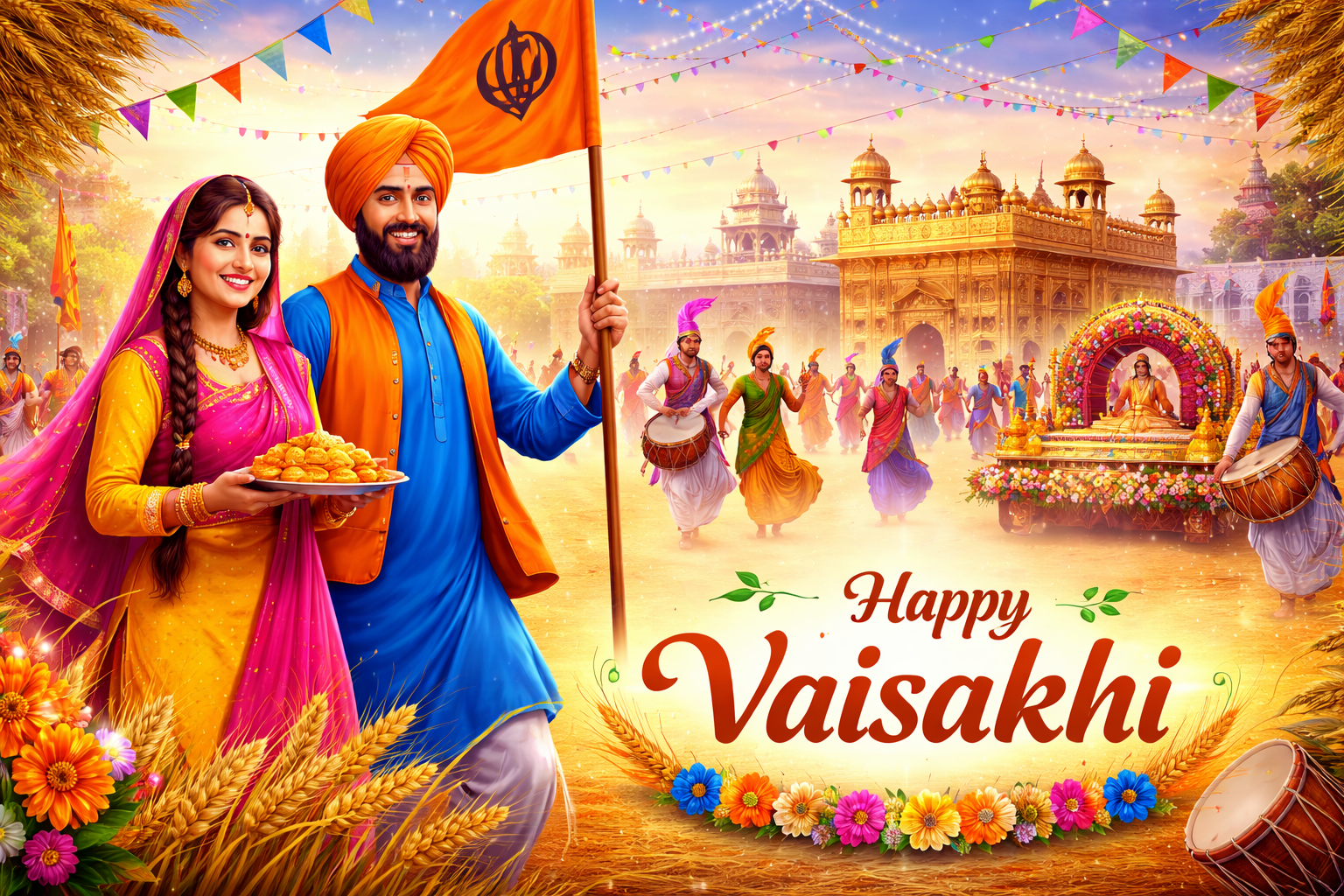
For Punjabis worldwide, Vaisakhi is not only a religious or seasonal festivity but much more. Though many other South Asian communities, including Tamils, Malayalees, Biharis, and Bengalis, celebrate this mid-April festival with traditional fervor and gaiety, it continues to be acknowledged as a Punjabi festival in general and a Sikh religious festival in particular.
If there is any Indian festival other than Diwali that has universal appeal, it is Vaisakhi. Punjabis or Sikhs, like potatoes, are a universal community. Wherever they go, they carry with them not only the sacred Sikh scriptures, including Sri Guru Granth Sahib, but also their favorite pastimes, including playing Kabaddi to remain physically and mentally fit, and field hockey, a sport of British origin that has been widely dominated by Punjabis worldwide.
As a global community, overseas Punjabis have carved out a distinct socio-economic and cultural identity. Vaisakhi, or the first day of the month of Vaisakh in the Vikram Samvat calendar, carries strong religious overtones as it marks the birth anniversary of the Khalsa, the pure. Traditionally, it is also associated with the start of the wheat harvesting season in North India, reflecting the socio-economic progress of the farming community. For many Indian communities, it also marks the onset of summer.
Despite global conflicts and rapidly evolving geopolitical developments, the Sikh community remains upbeat about the upcoming Vaisakhi celebrations.
Vaisakhi celebrations and the organization of Kabaddi tournaments worldwide have traditionally been closely linked. This year, however, will be different. The Kabaddi community worldwide, except in India and a few other places, decided earlier this year not to hold events until internal structures are streamlined. The community aims to introduce discipline, establish rules and regulations, and implement player registration systems.
Beyond Kabaddi, certain developments, including the assassination of Hardeep Singh Nijjer in Surrey a few years ago, contributed to a significant strain in bilateral relations between India, the original home of Sikhs, and Canada, home to one of the youngest and most affluent Sikh diaspora communities. Tensions escalated, affecting the daily lives of the Indian community in Canada. Protests at Indian diplomatic missions intensified and, at times, turned violent.
The strain in India-Canada relations has also impacted Vaisakhi celebrations. Notably, the Indian mission in Toronto, in collaboration with Virasat-e-Khalsa, is organizing a major Diwali event featuring a live performance by Jagjit Jeet Bhinder on April 12 at a Brampton banquet hall. In recent years, Vaisakhi celebrations were only subdued during the COVID pandemic.
Following the pandemic, major public events, including Vaisakhi parades or Nagar Kirtan processions, resumed in 2023 after being suspended in 2021 and 2022. During those years, celebrations were limited to gatherings at gurdwaras, with safety measures such as mask-wearing and physical distancing in place.
In 2024, the Nagar Kirtan in Toronto was replaced by a special congregation. Other cities across North America also held Vaisakhi celebrations in line with official guidelines.
The religious significance of Vaisakhi for Sikhs dates back to 1699, when the tenth Sikh Guru, Sri Guru Gobind Singh, established the Khalsa at Sri Anandpur Sahib in Punjab. While the main religious observances take place at Takht Sri Kesgarh Sahib, the Golden Temple in Amritsar, and Takht Sri Damdama Sahib in Talwandi Sabo, Sikhs worldwide mark the occasion through congregations in gurdwaras, reflecting their progress across social, political, cultural, sporting, and economic spheres.
As Sikhism originated in present-day Pakistan, at Nankana Sahib, the birthplace of Sri Guru Nanak Dev, many devotees also visit sacred shrines there during Vaisakhi. The festival, observed annually in the second week of April, commemorates the formation of the Khalsa and the identity of the “Saint Soldier.”
Globally, Vaisakhi celebrations continue to grow in scale, with cities resonating with bhangra performances and demonstrations of Gatka, the traditional Sikh martial art, during Nagar Kirtan processions. Sikhs often take pride in being one of the most affluent minority communities in the world.
These celebrations are particularly prominent in Europe, including the United Kingdom, Germany, Italy, France, Greece, the Netherlands, and Sweden; in North America, especially the United States and Canada; in Australia and New Zealand; in Africa, including Kenya; and in parts of Asia such as Malaysia, Thailand, and Fiji. Several Commonwealth countries, including England, Canada, Australia, and New Zealand, formally recognize Vaisakhi and other Sikh festivals.
In 1999, during the tercentenary of the Khalsa, Canada became the first country outside India to issue a commemorative stamp marking the occasion. Vaisakhi celebrations are now held at Parliament Hill in Ottawa, as well as in several provincial legislatures.
Historically, Sikhs faced significant challenges, including discrimination and denial of rights in parts of the former Commonwealth. Over time, through democratic efforts, they secured equal rights and integrated into mainstream society.
The Nagar Kirtan procession has played a crucial role in presenting the Sikh community globally as peaceful, hardworking, and committed to contributing positively to their adopted countries.
This commitment has contributed to the community’s global success. Early Sikh immigrants to Canada in the early 1900s were denied voting rights in British Columbia from 1907 and had to wait nearly four decades to regain them. In 1950, Naranjan Garewal became the first Sikh elected to public office in Canada as a member of the Mission City Council in British Columbia.
The first Sikh parade took place on January 19, 1908, in Vancouver. By August 28, 1912, Hardial Singh Atwal became the first Canadian-born Sikh.
Today, Nagar Kirtan processions typically feature decorated floats carrying the Guru Granth Sahib, the Panj Piaras carrying Nishan Sahibs, and groups performing Gurbani recitations, alongside bhangra and Gatka performances.
Large-scale processions in North America gained prominence in 1978 during celebrations marking the 500th birth anniversary of Guru Amar Dass. Since then, they have become an annual tradition.
Scholars note that these processions have helped consolidate the Sikh community as a significant political and social force. This was reflected in 1993 when Gurbax Singh Malhi became the first turbaned Sikh elected to the Canadian House of Commons. He later played a key role in organizing national celebrations marking the tercentenary of the Khalsa in 1999.
Related posts:
 Hardeep Singh Puri Seeks Central Intervention for Safekeeping of Guru Gobind Singh’s ‘Holy Jore Sahib’
 Brescia Emerges as Key Hub for Sikh Community in Europe, Hosts Grand Nagar Kirtan Celebrating Sikh New Year
 Maryland Leaders Celebrate 2025 Vaisakhi with Sikh and South Asian Communities in Westminster
 Thousands Gather in Italy’s Cortenova for Hola Mohalla Celebrations, Showcasing Sikh Traditions and Cultural Exchange