Join WhatsApp Channel

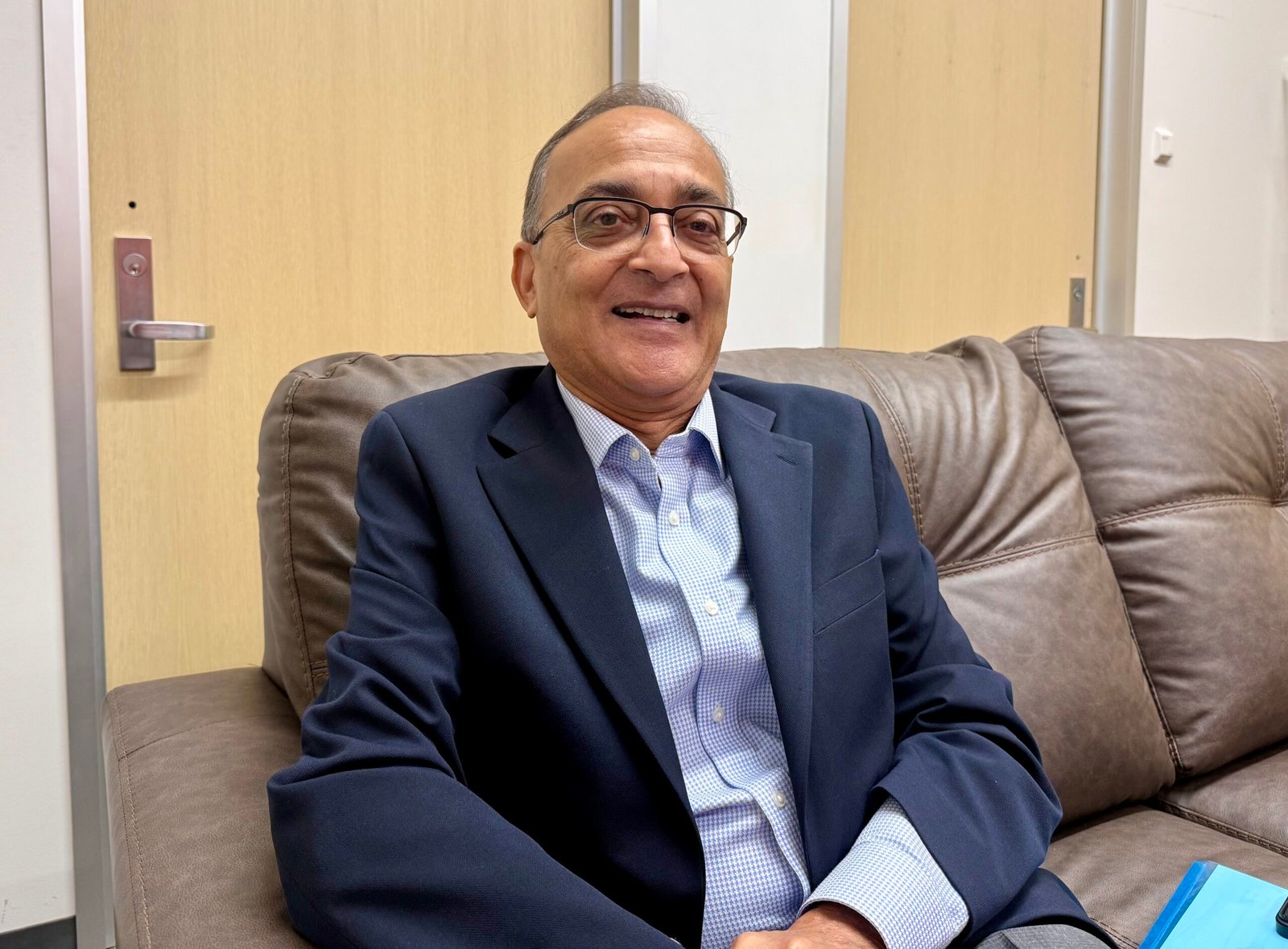
Seattle, Washington: Padma Shri awardee Ajay Bhatt, an Indian-American computer architect, who is widely credited with inventing Universal Serial Bus (USB) technology, has urged India to draw on the expertise of accomplished members of its diaspora as the country works toward becoming a developed nation by 2047.
“I think some of the diaspora members who came here a long time ago have acquired some expertise in our own fields. I think if it can be leveraged by Indian companies or the Indian government, even in developing policies or strategies, then it would be very useful for the 2047 vision,” Bhatt said in an exclusive interview with South Asian Herald on September 17 at the Consulate General of India in Seattle.
Bhatt recalled meeting Prime Minister Narendra Modi at Rashtrapati Bhavan last year when he received the Padma Shri. During their conversation, Bhatt offered to contribute his expertise to India’s development.
“That’s when I asked him if they needed any of my expertise. I was surprised that the Prime Minister knew all about my background,” he said. “So, when I introduced myself, the Prime Minister said, ‘I know all about you.’”
According to Bhatt, Modi brought Home Minister Amit Shah into the conversation, shared details about Bhatt’s background and spoke with him in Gujarati.
Bhatt also recalled that the Gujarat chief minister’s office had approached him years ago to serve as a technology adviser when Modi was the state’s chief minister. At the time, Bhatt was still employed and could not accept the offer.
“We’re in this phase of life when, if I can make any difference, that would be great,” Bhatt said. “There are many of us who have achieved some success here, and it is probably time to give back.”
Discussing India’s technological progress, Bhatt described the country as “unique” and said he had closely followed its development for more than two decades.
When he worked at Intel, Bhatt recalled, the company had a small sales office near MG Road in Bengaluru with about five or six employees. Intel later established major development centers along Sarjapur Ring Road and elsewhere, where advanced microprocessor development is conducted.
Bhatt said the expansion reflected the depth of India’s technical expertise and the growing importance of the work being carried out in the country.
He also described his interactions with students during visits to universities across India. Bhatt said he made it a point to visit a different institution each year after receiving invitations to deliver keynote addresses. His visits included IIT Kharagpur and institutions in Delhi, Mumbai, Chennai, Tiruchirappalli and Varanasi.
“I’m so impressed by the students that we have. They have so much knowledge, so much hunger for knowledge, so much initiative, so much drive,” he said.
Bhatt said the enthusiasm of India’s young people demonstrated their readiness to innovate. He added that the rapid development of artificial intelligence could “democratize” access to knowledge and transform education.
“The way we teach our students is going to change in a major way,” he said. “I think you won’t have to learn everything all at once. You can learn as you go. So, if we can teach our students social skills and learning skills, how to learn new things, and if we can motivate them, then the resources to learn new things will be there.”
Bhatt said India could create significant opportunities by keeping its younger generation motivated and developing its critical-thinking abilities.
For India to become a global technology leader, he said, the country must think “differently.” As an example, he cited the Unified Payments Interface, or UPI, which was designed to address the specific requirements of India and its consumers.
“Now, if we can take AI or any next-generation technology, if we keep in mind who’s going to use it, who’s going to pay for it, how they’re going to benefit from it, and if we can develop indigenous technologies, that’ll be fantastic,” he said.
Discussing the contributions of Indian Americans to the United States, Bhatt said they play a vital role in the technology industry. He broadened that observation to include immigrants generally, describing the United States as a nation shaped by immigration.
“I would just say not only Indian Americans, but actually immigrants. Yes, this is a country of immigrants,” he said, adding that Indian American engineers often do not seek recognition for their work.
Bhatt said he became publicly known only after his company profiled him and presented its engineers as innovators deserving the kind of recognition often accorded to entertainers.
“Our engineers are like rock stars,” said his company’s Ad noted Bhatt adding “That’s how my name came out. Otherwise, even my family in India didn’t know what I was doing.”
Bhatt said technology he helped develop also supports modern artificial intelligence infrastructure, including the systems through which central processing units, graphics processing units and storage networks communicate. He described it as a technological backbone that he helped develop in 2000.
He also reflected on the early development of USB, which began in 1992 and later became a standard feature in computers, phones and other electronic devices.
“We did it in 1992. That’s when I invented it,” he said.
Bhatt said engineers are typically motivated by the challenge of solving problems rather than by public recognition.
“So, in my case, I never sought any success or visibility or even any recognition. I had a problem in front of me, and I saw this as an opportunity to simplify computers,” he said.
Noting that “necessity is the mother of invention,” Bhatt said the idea for USB was partly inspired by his wife’s and daughter’s frustration when they were unable to print documents at home.
“They were having problems with printing, so I said there has got to be a better way. So, I went to my company, talked to my boss, and he said, ‘No, you can’t solve that.’ That was his first reaction,” Bhatt recalled.
He said his immediate supervisor questioned whether the proposal could disrupt personal computers. Bhatt, however, believed the problem required a different approach.
“But I saw things differently. My expertise was in designing CPUs, but I ended up being well known for USB,” he said.
Bhatt said it took him two years to persuade others to support the concept after it was repeatedly rejected. His belief in the idea, however, kept him from abandoning it.
When Bhatt presented USB technology to Microsoft, the company had already decided to pursue a competing technology being developed by Apple.
“It was a competing technology to ours. But after I pitched this idea, they looked at the specifications that I’d written, and they decided to take a detour, sign up with us and not with Apple,” he said.
Following Microsoft’s endorsement, Bhatt said Intel brought IBM and other computer companies into a group formed to advance the technology. Bhatt served as its chief architect and worked across the participating companies to build consensus around the technical specifications.
“I was the lead who worked across companies to get consensus on the specifications in 1995. And once the specifications were completed, they were adopted by everybody,” he said.
Apple became the first company to bring USB to the consumer market when it introduced the iMac in 1998, Bhatt said. The product became a turning point for Apple, which had been struggling at the time. Windows-based personal computers later helped make USB ubiquitous.
“These things took time to gain a foothold. But what was good is that it evolved over the last 30 years or so. But the basic idea is still the same. Even today’s device is compatible with the one that we did on day one, and that’s the beauty of it,” he said.
Bhatt attributed USB’s success to its ability to address problems faced by consumers, manufacturers and developers. He said it also allowed companies investing in the technology to recover their costs.
Bhatt said he has consistently approached product design from the perspective of people who are not proficient with computers.
“I always think that way. Why is this so complicated? Even now, if I see something new, I say to myself, why is it this way? You could do it this way. That is so simple,” he said.
Despite advances in wireless technology, Bhatt said wired connections would continue to serve an important purpose.
“You’ll always need one wire. We’ve gone through this debate for a while,” he said.
Bhatt noted that wireless technology can be frustrating when it fails, while a physical connection can provide users with greater confidence that a device will work.
He said the ability to charge devices through USB emerged partly by accident. While developing the technology, Bhatt wanted to avoid the need for an additional wire and incorporated power delivery into the cable. Before USB, comparable computer connections did not provide power in the same way.
“It was our invention, and we did it for convenience and simplicity,” he said.
Bhatt said engineers generally do not pursue “fame or fortune.” He noted that USB technology was made available without royalties because he wanted it to be widely accessible. Reflecting on his journey from Vadodara, Gujarat, to becoming a prominent technology innovator in the United States, Bhatt said the broader impact of his work mattered more to him than financial rewards or awards.
“That means a lot more to me than any award, any money or anything else. It’s just a great joy,” he said.
Bhatt said technology would play an essential role in achieving India’s 2047 development goals. He encouraged the country to develop solutions designed around its own challenges and circumstances. “Let’s find a uniquely Indian solution. If you don’t take the risk, there is no reward,” he said.
Bhatt praised Modi’s willingness to set “big, audacious goals,” saying ambitious objectives require a determination to succeed. He recalled receiving similar skepticism while developing USB. “I used to tell my team, we don’t fail. We’re not allowed to fail. I didn’t even know the answer, but I had this mentality. We’ll figure it out,” he said.
Bhatt also credited India with taking the lead in several areas, including hosting an artificial intelligence summit this year. He said current immigration-related developments in the United States could create opportunities for India by encouraging talented professionals to remain there.
Bhatt said he might never have left India had the country offered the same educational and professional opportunities that are available today.
“When I left India, you could not get higher education in computing. My dad did not want me to leave India,” Bhatt said. “I had to convince him and plead with him to let me go. But if I were growing up in India now, I would advise kids to stay there and take on a challenge. Because it’s so good.”
Related posts:
 Raman Institute Finds Noise Can Help Build More Robust Quantum Systems
 From Maruti to Microchips: Japan’s India Investment Story Enters a New Era
 CGI Seattle Hosts Indian American Tech CEOs Forum Featuring Satya Nadella
 Thousands Fill Marvel Stadium as Modi, Albanese Headline Melbourne Meets Modi Reception