“The power to interrupt commercial or financial relations with any country … is the root cause of the influence or power position which a country acquires in other countries.”
— Albert O. Hirschman, National Power and the Structure of Foreign Trade, 1945
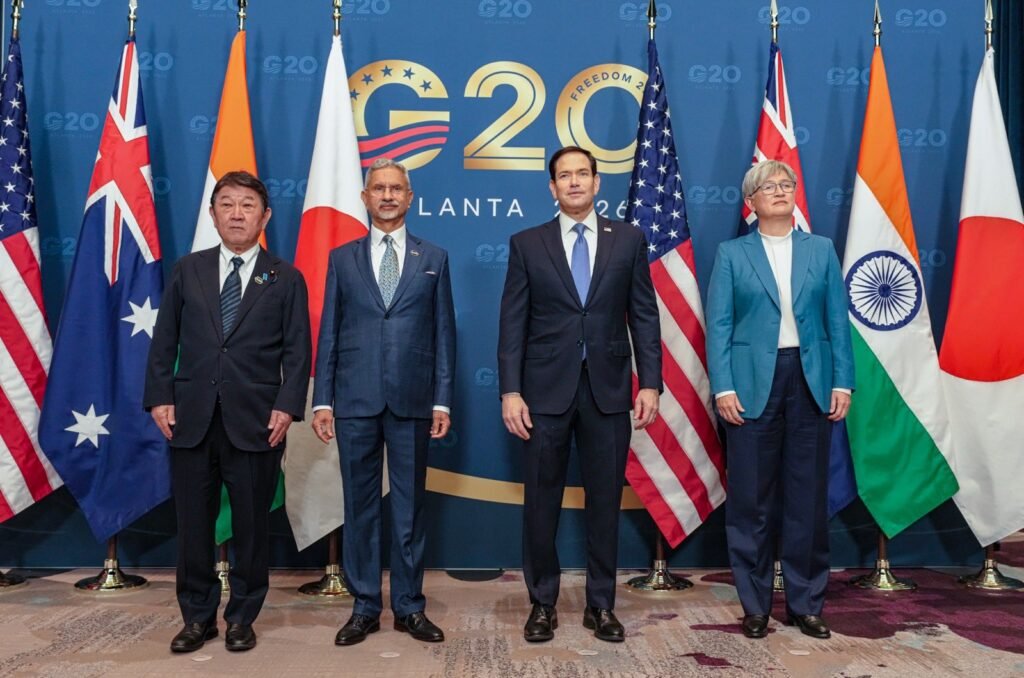
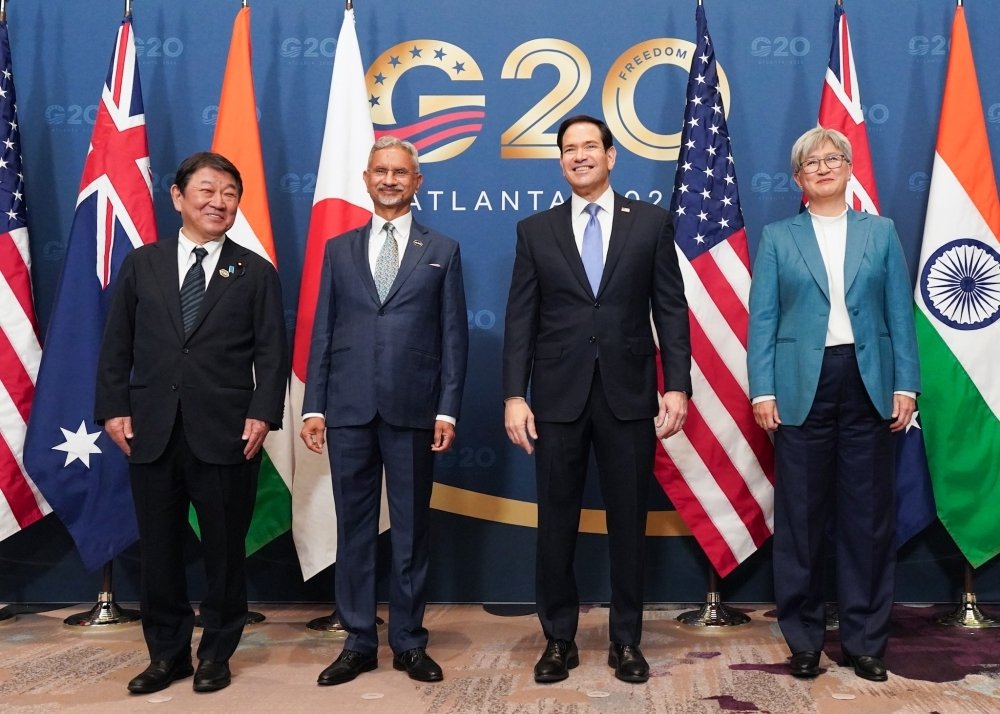
When the foreign ministers of the Quad met in Atlanta on October 31, they did not talk about warships.
Representatives of the United States, India, Japan, and Australia had no shortage of traditional security issues to discuss. Yet much of their attention turned elsewhere, toward critical minerals, semiconductors, artificial intelligence infrastructure, supply chains, undersea cables, and export restrictions.
One phrase in the joint statement particularly stood out. The four countries agreed to identify semiconductor and AI supply-chain “chokepoints” before they could cause disruption.
Advertisement
For a grouping often seen through the lens of maritime security and China’s increasing influence in the Indo-Pacific, the language chosen is telling. Security now stretches beyond sea lanes and disputed frontiers. It depends on who controls the resources and technologies that underpin modern economies.
Critical minerals offer one of the clearest examples. Rare earths, gallium, germanium, graphite, lithium, and cobalt rarely attract the attention that oil does. Most people will never see many of them or know where they come from. Yet they sit quietly inside aircraft, missiles, satellites, electric vehicles, wind turbines, electronics, data centers, and the machinery that manufactures semiconductors.
China understood their importance earlier than most countries. China’s advantage rests not only in what lies below its soil, but in the steps that follow extraction. Refining these materials to the standards advanced industries demand is where its advantage quietly accumulates.
Recent Chinese export restrictions have offered governments a glimpse of what such dominance can mean. The International Energy Agency estimates that fully implementing China’s broader rare-earth restrictions could expose about $6.5 trillion in annual downstream production outside China to risk.
It is an extraordinary imbalance. Materials counted in kilograms can drive industries valued in billions.
Indian External Affairs Minister S. Jaishankar addressed the same problem at the G20 Foreign Ministers’ Meeting in Atlanta. Diversification and de-risking, he argued, are now essential to resilient supply chains. More pointedly, he said that spreading production across geographies could discourage the “weaponisation of finance, resources, production and market share.”
Rare earths are only part of that equation. Finance, sanctions, currencies, technologies, shipping routes, data, and infrastructure can each become sources of dependence or pressure.
Some of these pressure points have existed for centuries. Hormuz remains one of the world’s most important energy arteries. Bab el-Mandeb connects the Indian Ocean with the Red Sea and the Suez Canal. Trouble at either can send shipping costs and energy markets moving thousands of miles away.
Others are less visible on any map. Advanced semiconductor manufacturing is clustered in a handful of locations. An even smaller group of firms and countries produces the equipment that makes such manufacturing possible. Undersea cables carry most of the world’s international data traffic between continents. Computing power, now central to artificial intelligence, is gathering in similarly concentrated networks.
Much of this was the logical outcome of globalization. Businesses went where production was cheapest and expertise strongest. Inventories shrank. Manufacturing became specialized. Supply chains spanned oceans. Why maintain several expensive sources for a component when one efficient supplier could provide it more cheaply?
For decades, the model worked remarkably well. Yet it left weaknesses in its wake. Interdependence was mutual, but seldom equal. Importing is not itself a weakness; lacking alternatives is.
Globalization sought to smooth away friction. Geopolitics has now found reason to restore it.
Former British Prime Minister Rishi Sunak approached the same problem from the opposite direction during a recent conversation with Jaishankar. Countries, he suggested, should identify areas in which they can “make yourself indispensable.”
His words point to an uncomfortable reality. Every country wants protection from another’s chokepoint. Many would also like to possess one themselves.
Governments are already responding. Washington is limiting access to advanced technologies and investing in semiconductor production. Beijing has demonstrated the leverage of mineral processing. Japan has worked for years to reduce its exposure in strategic supply chains. European governments now speak of economic security in terms once reserved for defense.
India has more reason than most to pay attention. India’s ambitions in semiconductors, defense, renewable energy, electric vehicles, electronics, and advanced technologies will demand vast quantities of materials and components. Many must come from abroad, some through supply chains over which India has little influence.
Trying to make everything at home is unrealistic. Replacing reliance on China with another source won’t solve much either. India’s priority is room to maneuver. Multiple suppliers, domestic refining where viable, reserves for scarce materials, recycling, stable ties with mineral producers, and technology partnerships where needed would help.
Atlanta therefore deserves more attention than communiqués and summit photographs.
Australia’s mineral resources, Japanese technology and technical skill, American capital and innovation, and India’s industrial growth do not eliminate the risks each country faces. Working together opens possibilities none can achieve alone.
Washington’s $10 million commitment to critical-mineral recovery in India and Southeast Asia is modest beside the challenge. More important is what it represents. Critical minerals are moving out of the specialist world of mining and commodity policy and into the Indo-Pacific’s security calculations.
India should not think only about escaping other countries’ chokepoints. Its size and growing economy offer the potential to become indispensable in parts of the global economy. Pharmaceuticals already provide a glimpse of this. India’s digital public infrastructure has drawn notice far beyond its borders. Electronics, space, advanced manufacturing, data, and, in time, mineral refining could extend that reach.
Strategic autonomy in the coming decade may depend as much on supply chains as on diplomacy.
Aircraft carriers will not disappear because governments suddenly care about rare earths. Nuclear weapons, armies, alliances, territory, and geography remain central to power. What has changed is how many places pressure can be applied.
Generations of students learned to study maps for straits, canals, mountain passes, naval bases, and oil fields. Today’s map includes places more easily missed, such as a semiconductor plant, a rare-earth facility, a cable landing station, a payment network, a data center, and a processing plant. Geography hasn’t shrunk; it’s simply moved from borders toward bottlenecks.
Power has always been partly about controlling territory. Increasingly, it is also about controlling access. That is what makes ours the age of chokepoints.
Disclaimer: The opinions and views expressed in this article/column are those of the author(s) and do not necessarily reflect the views or positions of South Asian Herald.