 Join WhatsApp Channel


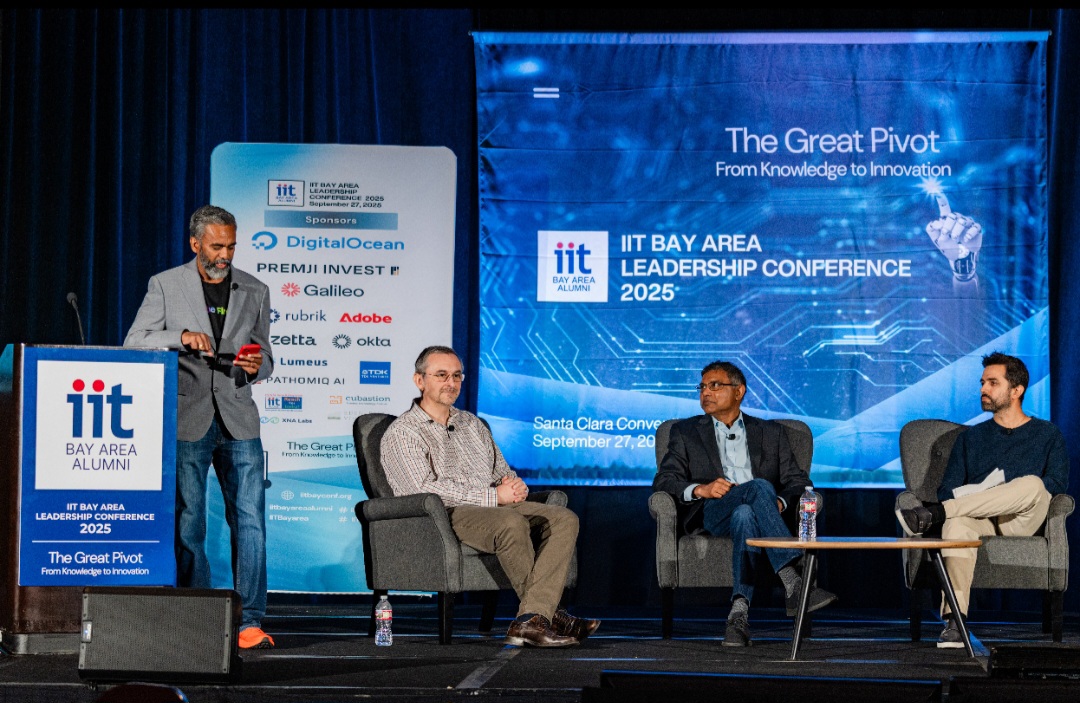
2026 is a momentous occasion for the Indian Institute of Technology (IIT) community – it is the 10th anniversary of the IIT Bay Area Alumni Association (IITBAA) as well as the 75th anniversary of the founding of the first IIT at Kharagpur. This convergence highlights a juncture where a proven legacy of technical excellence at IITs meets the accelerated future of Silicon Valley.
Over the past ten years, the IIT Bay Area Leadership Conference has served as a living chronicle of the Valley’s shifting innovation priorities. Early conferences focused on foundational entrepreneurship, building global scale, and the rising Indian leadership footprint. By 2019, the scope broadened to global ecosystems, and in 2022 pivoted sharply toward the limits of technology, energy, silicon, and sustainability. The previous three years have been defined by the rise of Artificial Intelligence, with the conference stage becoming a barometer for how intelligence is now threading through every product, platform, and business model.
In 2023, NVIDIA founder and CEO Jensen Huang headlined the 2023 conference, framing accelerated computing and deep learning as structural shifts, not temporary trends. His keynote underscored the momentum behind AI factories and new agentic workflows ideas that have since permeated every corner of global tech. This momentum culminated in the 2025 Leadership Conference, “The Great Pivot: From Knowledge to Innovation,” which saw headliners push the boundaries of what AI means for risk, enterprise, and diplomacy.
The 2025 conference brought together visionaries who articulated the challenges and opportunities of the AI era. Their insights underscored the urgency of innovation, the necessity of risk-taking, and the importance of purpose-driven leadership. Vinod Khosla, founder of Khosla Ventures, on embracing risk, said, “The biggest risk is not taking any risk. In a world that’s changing fast, the only strategy guaranteed to fail is not taking risks.”
Khosla’s call was a stirring challenge to the community, urging entrepreneurs to abandon incrementalism for “moonshot” ideas, especially in critical areas like climate, healthcare, and education, where exponential technology can drive systemic change.
This ambition was brought to a practical, actionable plane by President & COO of ServiceNow, Amit Zavery, who said, “We’re not chasing AI utopias – we’re building real-world solutions that empower people and accelerate outcomes.” Zavery grounded the conversation in the practicalities of enterprise transformation, focusing on how platforms can unite data, workflows, and intelligence to streamline decision-making and automate complex operations for real-world business value.
A more developer-focused perspective was added by Bratin Saha, Chief Product & Technology Officer at DigitalOcean, on developer empowerment: “Developers don’t just need tools they need intelligent collaborators. Agentic infrastructure is the next frontier.” Saha articulated the shift toward an “Agentic Cloud” model, where AI agents become core to cloud-native innovation, democratizing access to powerful AI capabilities for startups and individual developers.
Finally, the Consul General of India in San Francisco, Dr. K. Srikar Reddy, commented on the human side of AI through leadership, purpose, and diaspora: “True leadership is not about titles or positions – it’s about purpose, integrity, and impact.”
Dr. Reddy, highlighting the critical role of the IIT diaspora in strengthening India–US innovation corridors, emphasized that global technological leadership must be anchored in civic responsibility and ethical purpose.
The historical backdrop to this next chapter is the 75th anniversary of the IIT system. Conceived in the late 1940s and inaugurated at the site of the former Hijli Detention Camp, the founding of IIT Kharagpur in 1951 symbolized India’s commitment to self-reliance through world-class technical education. The IIT system quickly scaled, earning recognition as Institutes of National Importance and becoming a global source of talent and innovation.
This legacy will be on full display at IIT2026, a global conference in Long Beach, California, designed to bridge reflection and action. The gathering promises multi-track programming focusing on AI, Health & Sustainability, Investment, and Global Connect, convening leaders from industry, policy, and academia to chart the next 75 years of global impact, focusing on several high-impact themes.
First, AI as the Operating System for Strategy. The roadmap demands a shift toward autonomous, agentic systems that translate human intent into complex outcomes across application stacks. Interfaces will recede, enabling humans to focus on creativity and critical oversight, leveraging AI for productivity gains for designers, scientists, and product managers. This involves moving swiftly from pilots to production-grade platforms with governance-first architectures.
Second, Sustainability as a Design Constraint: the community’s 2022 pivot to sustainability is proving prescient. As compute intensifies, future software will be measured not just by its capability, but by its energy efficiency, carbon impact, and materials awareness. This requires a focus on green compute, energy-aware architectures, and materials innovation at the silicon layer.
Third, Global Collaboration at Scale: the unique distribution of the IIT diaspora positions it to forge robust cross-border innovation corridors—India–US, Bay Area–APAC, Europe–Middle East—where capital, talent, and regulation can meet effectively. The IIT2026 platform is specifically designed to accelerate these bridges, fostering multidisciplinary coalition-building.
Fourth, Trust, Provenance, and Safety: the focus is moving from “Know Your Customer” (KYC) to “Know Your Agent” (KYA). Scaling autonomous AI requires new standards for data lineage, commercial safety, and auditing of AI actions. Responsible adoption is non-negotiable for enterprise and governmental scale.
The first decade of IIT Bay Area was about proving the model of convening top-tier talent around frontier topics. The next decade is about compounding outcomes: building high-impact startups, helping global enterprises modernize with hub-and-spoke AI platforms, and nurturing talent pathways that reflect IIT’s deep commitment to excellence. The focus is concrete: measuring impact in jobs created, carbon avoided, and complex global problems solved.
As the IIT diaspora gathers for the IIT75 global summit, the sentiment remains one of audacious ambition paired with the humility of the engineer. The journey so far confirms that excellence in science and engineering shapes economies and cultures. The next ten years will test whether the community can translate this vision into unparalleled velocity, ensuring that the headline a decade from now will reaffirm the powerful notion: “The best is yet to come.”
Related posts:
 Agentic AI and the Future of DPI: Governing Autonomy in Democracies
 AI Leadership Global Summit 2025: Shaping the Future of Innovation, Governance, and Diplomacy
 ASEI’s Career Readiness Conference Illuminates the Future of AI and Responsible Technology
 In Conversation with Rajesh Mehta: Rajan Navani
