 Join WhatsApp Channel

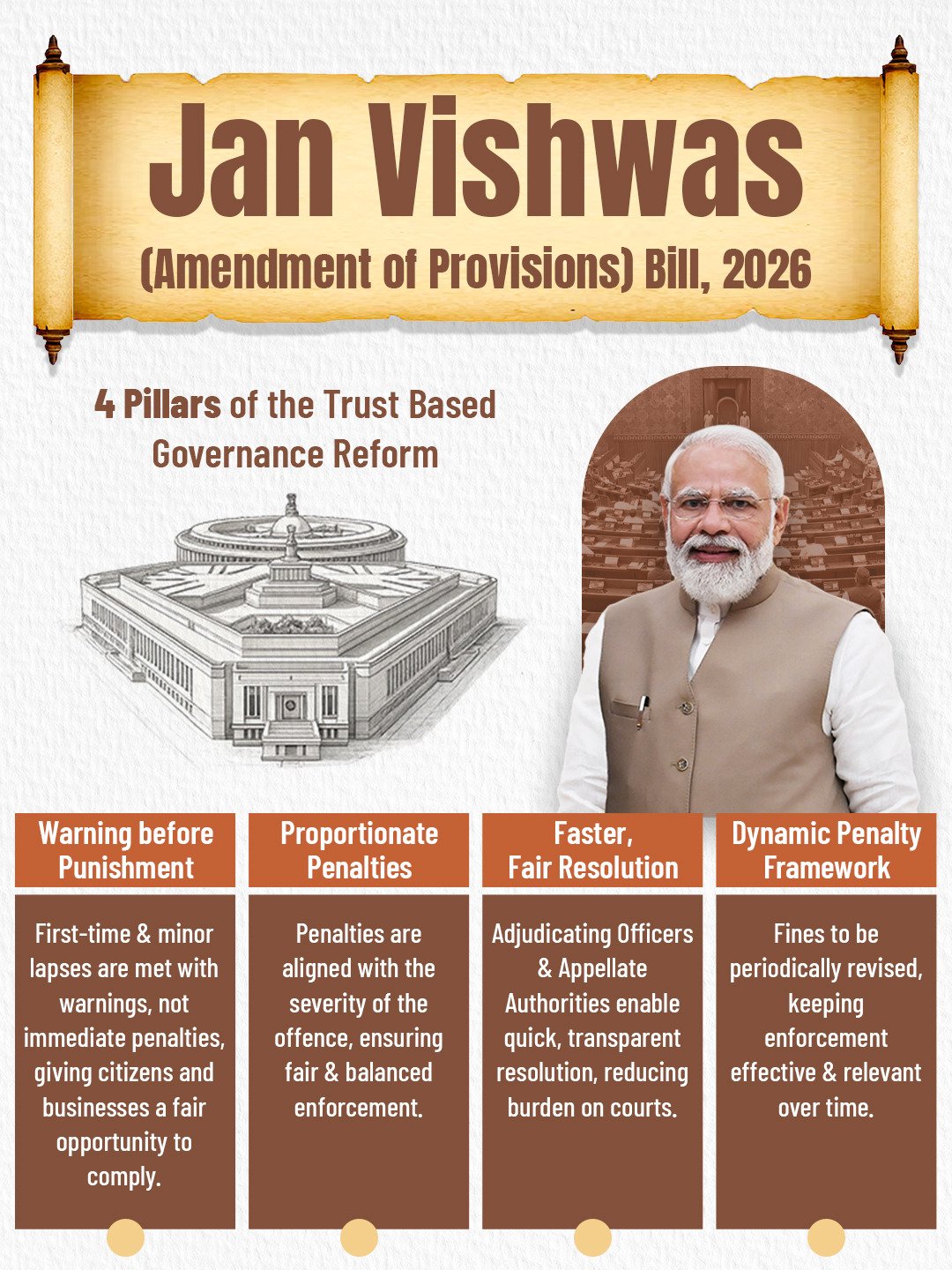
In a major step toward decriminalization and ease of compliance, the Jan Vishwas (Amendment of Provisions) Act, 2026, passed recently by Lok Sabha and Rajya Sabha, seeks sweeping reforms to the Cantonments Act, 2006, replacing criminal penalties for minor offences with a civil penalty framework and rationalizing multiple provisions to improve regulatory efficiency.
The Act was initially introduced in the Lok Sabha on August 18, 2025, as the Jan Vishwas (Amendment of Provisions) Bill, 2025. It proposed amendments to 355 provisions across 16 Central Acts administered by 10 Ministries/Departments and was subsequently referred to a select Committee of the Lok Sabha.
The select Committee, chaired by Tejasvi Surya, held 49 sittings and submitted its report on March 13, 2026. The Committee undertook extensive stakeholder consultations and, in addition to the provisions under consideration, examined further provisions within the same Acts and recommended decriminalization across 62 additional Central Acts.
As part of the reforms, 34 out of 38 provisions under the Cantonments Act, 2006, are proposed to be decriminalized. The overarching approach shifts enforcement from punitive criminal action to administrative penalties, thereby reducing litigation and promoting ease of doing business within cantonment areas.
A key feature of the Bill is the substitution of the term “fine” with “penalty” across a wide range of sections, including Sections 81, 82, 88, 116, 143, 145, 155(4), 166, 174, 197, 259(2), 263, 269, 271, 272, 276, 281, 282, 283(4), 284, 289, 290, 291, 295, 296, 313, 333 and 349(1).
For instance, under Section 81 dealing with notice of transfers, failure to comply with statutory requirements will no longer invite criminal punishment but instead attract a monetary penalty. Similarly, Sections 82 and 88 relating to building notices and occupation of vacant premises respectively replace fines with penalties, maintaining financial deterrence while removing criminal liability.
The reforms extend to public health and sanitation provisions as well. Under Section 143, overcrowding of dwelling houses will attract penalties instead of fines, including additional penalties for continuing defaults. Likewise, Section 145, which empowers authorities to require cleansing of land or buildings, now prescribes penalties for non-compliance, with escalating daily penalties for continued violations. In Section 155(4), dealing with communicable diseases, the revised provision increases the penalty amount while maintaining safeguards for reasonable cause.
Significant changes have also been introduced in regulatory enforcement related to trade, construction and civic administration. Section 166 (failure to report), Section 197 (misuse of water supply), and Section 259 (defacement of street names or building numbers) all transition from criminal fines to administrative penalties.
In Section 263, unauthorized digging of public land is recast to impose penalties, including daily penalties for continuing violations. Similarly, Sections 269, 271 and 272 governing markets and slaughterhouses now impose penalties instead of fines for licensing violations, ensuring compliance without criminal prosecution.
In the area of licensing and urban regulation, Sections 281 and 282 dealing with trade without a license and feeding animals on unhygienic substances have been fully substituted to introduce a penalty-based regime. Section 283(4) on seizure of unfit articles, Section 284 on import of cattle, and Section 289 addressing public nuisances, including disorderly conduct, sanitation violations and public disturbance, also undergo similar modifications, replacing fines with penalties across all sub-clauses.
Animal control and public safety provisions have also been rationalized. Sections 290 and 291 relating to dog control and traffic rules now impose penalties for violations, while Section 295 governing public performances introduces penalties for non-compliance with licensing conditions. Section 296 has been partially restructured to distinguish between serious offences (retaining fines) and lesser violations (penalties), particularly in cases involving hazardous activities.
The Bill also introduces nuanced changes in enforcement severity. Under Sections 244 and 247, violations relating to building use and illegal construction will attract penalties for the first offence, while subsequent offences will continue to invite fines, thereby maintaining a deterrent against repeat violations. This graded approach balances decriminalization with accountability.
Importantly, Sections 90, 91 and 92, relating to octroi, terminal tax and toll, are proposed to be omitted entirely, aligning the Act with the Goods and Services Tax (GST) regime and eliminating outdated taxation provisions.
A major institutional reform is the introduction of a new Section 333A, which establishes a structured adjudication and appeals mechanism. Under this provision, penalties will be imposed by an officer not below the rank of Chief Executive Officer of the Cantonment Board, with the President of the Cantonment Board designated as the Appellate Authority.
Appeals must be filed within 30 days, and the authority is required to dispose of them within 60 days, ensuring time-bound resolution. The provision also mandates a fair hearing process and allows recovery of unpaid penalties as arrears of land revenue, strengthening enforcement without resorting to criminal prosecution.
Further, Section 313 has been revised to distinguish between obstruction and assault, retaining criminal consequences only for serious acts such as assault, while treating minor obstruction as a civil penalty. Section 333 (general penalty) and Section 349 (breach of bye-laws) have also been restructured to align with the new penalty-based regime, including provisions for daily penalties in case of continuing contraventions. (UNI)
Related posts:
 India Moves to Decriminalize Corporate Offences, Replace Jail With Penalties
 From Compliance to Coercion: Why India’s Tax System Still Criminalizes Errors
 Indian PM Modi’s BJP Hopes to Tighten Control of the Upper House of Parliament
 India’s Data Protection Rules Take Effect, but Compliance Costs and Regulatory Gaps Loom Large
