India’s inflation trajectory for FY2027 is beginning to look less benign than recent data might suggest, as early monsoon warnings, uneven crop sowing patterns, and rising geopolitical costs converge into what economists increasingly describe as a structurally inflationary mix rather than a transient blip.
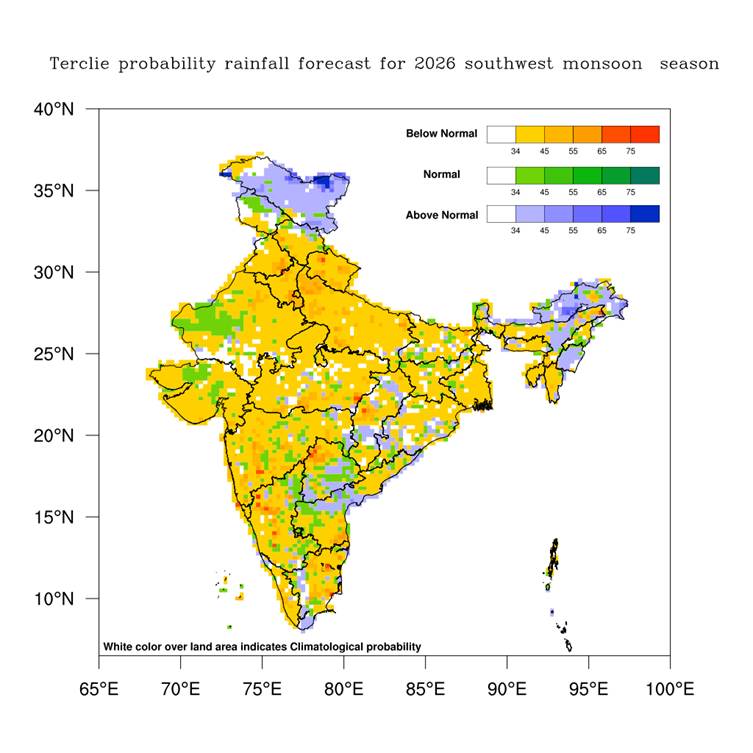
The India Meteorological Department’s projection of 92% of the Long Period Average (LPA) for the 2026 southwest monsoon—its weakest initial forecast in over a quarter century—has reinforced caution already flagged by Skymet Weather. On paper, a 92–94% monsoon may appear only mildly deficient; in practice, the implications hinge far more on distribution, timing, and crop sensitivity than on the headline number itself.
What sharpens the concern this year is the simultaneous emergence of El Niño conditions, historically correlated with weaker and more erratic rainfall, alongside intensifying geopolitical disruptions in West Asia that are already feeding into input costs.
Early Sowing Data Signals Stress Beneath the Surface
Advertisement
Fresh data from the Ministry of Agriculture suggests that stress is already visible at the field level, even before the onset of the main kharif season.
As of April 10, total summer crop sowing stood at 63.33 lakh hectares, marginally below last year’s 64.10 lakh hectares, indicating a net contraction of 0.77 lakh hectares. The composition of this decline, however, is more revealing than the aggregate:
- Rice, the single most critical staple, has seen a sharp drop of 1.72 lakh hectares, a trend that could have direct implications for foodgrain inflation if sustained into the kharif cycle.
- Pulses acreage, while showing a modest net increase year-on-year, reflects mixed intra-crop trends, with green gram and black gram both witnessing lower coverage in the latest data window—concerning given India’s structural dependence on pulse imports.
- Oilseeds, another inflation-sensitive category, have recorded a 0.69 lakh hectare decline, raising the risk of tighter edible oil balances later in the year.
- Coarse cereals (including maize and millets) remain relatively resilient, but these are less effective substitutes in controlling headline food inflation.
The early sowing pattern, therefore, points not merely to a quantitative shortfall but to qualitative vulnerabilities in inflation-critical crops, particularly rice, pulses, and oilseeds.
Inflation Risks: From Cyclical to Structural
India’s retail inflation cooled to 3.4% in March, but the Reserve Bank of India has projected an average of around 4.6% for FY2027. That estimate, economists caution, may prove optimistic under current conditions.
“This, along with the ongoing crisis in West Asia, poses downside risks to growth and material upside risks to inflation,” said Aditi Nayar of ICRA Limited, noting that inflation could comfortably exceed 4.5% despite relatively healthy reservoir levels.
The concern is not simply about rainfall deficiency, but about how multiple variables are aligning in the same direction—a dynamic that tends to produce persistent, rather than episodic, inflation.
The Double Squeeze: Weather and Costs
A detailed assessment by Systematix Research underscores the scale of the challenge, describing the rural economy as facing a “twin shock” of sub-par monsoon and rising input costs.
On the climate side, global models point to a high probability of El Niño developing during the monsoon months, with rainfall likely to weaken particularly in the latter half of the season—precisely when crops such as pulses and oilseeds require sustained moisture.
On the cost side, geopolitical tensions—especially disruptions linked to shipping routes in West Asia—are pushing up prices of fertilizers, natural gas, and critical agro-inputs, increasing the cost of cultivation even before output uncertainties are resolved.
This combination creates a classic cost-push plus supply-shock scenario: farmers face higher input costs, potentially reduce application or acreage, and then confront weaker yields due to rainfall variability—feeding directly into higher market prices.
Why Distribution Matters More Than Deficit
Even at 92% of LPA, the monsoon’s inflationary impact will depend disproportionately on its intra-seasonal behavior:
- A delayed onset could compress sowing windows, especially for rice.
- Erratic rainfall during flowering stages could sharply reduce yields despite adequate cumulative rainfall.
- Regional imbalances could disproportionately hit rain-fed belts in central and western India.
- A late withdrawal could disrupt harvesting cycles, tightening supply chains.
In short, a “near-normal” monsoon on aggregate can still produce above-normal inflation outcomes if its temporal and spatial distribution turns adverse.
Fiscal and Policy Spillovers
The inflation risk is not confined to consumer prices—it has broader macroeconomic implications.
Higher food prices could force the government to:
- Expand food and fertilizer subsidies, already under pressure
- Manage rising import dependence in pulses and edible oils
- Absorb fiscal slippages amid elevated global commodity prices
Systematix estimates that fertilizer subsidies alone could rise by ₹10,000–25,000 crore if global prices remain elevated and domestic output falters.
For the RBI, the situation presents a policy dilemma: easing rates to support growth risks stoking inflation, while tightening to control prices could dampen an already fragile rural demand cycle.
A Narrowing Margin for Comfort
There are, admittedly, some buffers. Reservoir levels remain relatively comfortable, and early sowing declines are not yet severe enough to signal a full-blown supply shock. But these positives are increasingly being overshadowed by forward-looking risks.
The broader picture that emerges is one of compressed policy space and heightened sensitivity to weather shocks—a reminder that, despite structural shifts in the economy, India’s inflation dynamics remain deeply intertwined with the monsoon.
With the IMD set to update its forecast in late May, the coming weeks will be critical. For now, however, the signals—from climate models to sowing data—are converging in a way that suggests inflation in FY2027 may not just be higher, but also more stubborn than anticipated.