Join WhatsApp Channel

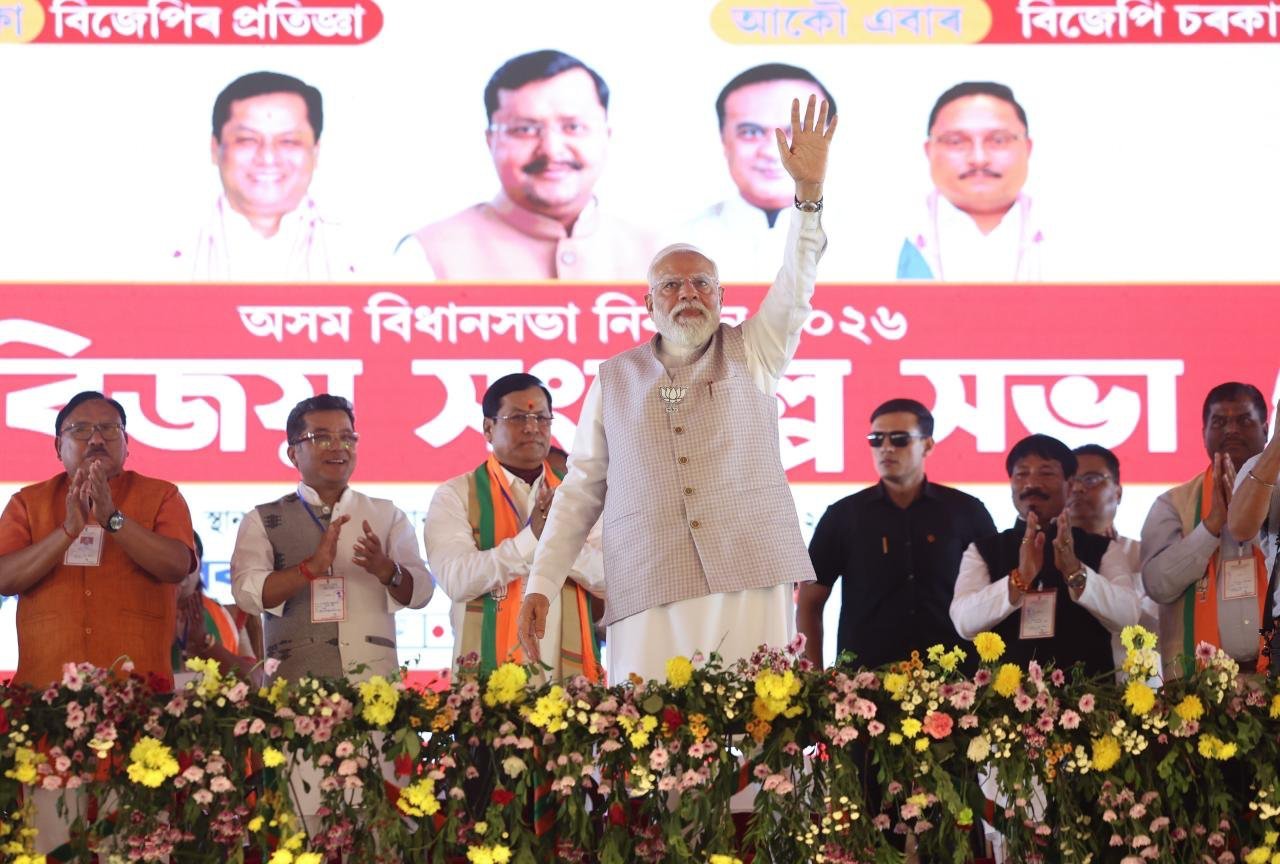
There is a particular kind of political courage — or audacity, depending on where you stand — in proposing to simplify what has resisted simplification for seventy-five years. Narendra Modi, speaking on the Bharatiya Janata Party’s 47th foundation day, demonstrated precisely that quality when he signaled that two of India’s most enduring ideological ambitions — the Uniform Civil Code and “One Nation, One Election” — had moved from the realm of aspiration into what he called “serious and positive discussion.”
The phrasing was careful. This was not a legislative announcement. It was something more potent in the short term: a declaration of direction, a signal to the electorate that the BJP’s vision of India — unified, efficient, legally coherent — is not merely a campaign promise but a governing philosophy inching toward execution.
Both proposals have genuine administrative merit. Both carry genuine democratic risk. And together, they illuminate a tension that sits at the very heart of Indian statecraft: the permanent, unresolved argument between the nation’s appetite for order and its genius for disorder.
The Case for One Law; India’s current system of personal law is, by any technical standard, an anomaly among modern democracies. Marriage, divorce, inheritance, and adoption are governed not by a single code but by a mosaic of religion-specific statutes — Hindu law, Muslim personal law, Christian law — each carrying its own historical logic and its own political constituency. The Directive Principles of the Constitution called for a Uniform Civil Code in 1950. Seventy-six years later, that aspiration remains exactly that.
Modi’s argument is deceptively straightforward: a modern democratic republic cannot sustain two legal standards for citizens who are otherwise equal before the law. If a Hindu woman and a Muslim woman are both Indian citizens, both taxpayers, both subject to the same criminal code, why should their rights in marriage and divorce differ based on the faith they were born into?
From a gender-equity standpoint, the argument is particularly sharp. Personal laws, as they currently exist, are uneven in their treatment of women across communities, but Muslim personal law — specifically the practice of instant triple talaq, since abolished — has been the most politically visible example of a discriminatory provision embedded in religiously sanctioned custom.
Modi’s government pursued that reform with conspicuous success, and the political dividend was real: Muslim women, in substantial numbers, expressed support for a government that had intervened on their behalf, even as Muslim male political leaders opposed the move. It was a preview of the fault lines a full UCC would detonate.
The deeper philosophical premise of the UCC is not merely administrative. It is a claim about what kind of republic India should be — one in which citizenship is the primary legal identity, superseding community and faith. This is not a fringe position. It was the position of B.R. Ambedkar, the Constitution’s principal architect, warned that India could not build a genuine democracy on a foundation of legally distinct communities.
And yet. The UCC’s appeal to universalism cannot be fully separated from the political context in which it arrives. In a Hindu-majority country where Hindu personal law was itself codified and substantially reformed in the 1950s — while Muslim personal law was largely left untouched as a concession to minority anxiety — the demand for uniformity today carries an asymmetric political charge.
The question is not simply whether one law for all is desirable in principle. It is: uniformity modeled on whose traditions? Administered by whose courts? Interpreted by whose judiciary? These are not paranoid questions. They are the questions that any honest accounting of the proposal must answer.
The Efficiency Argument for One Election; If the UCC is primarily a debate about identity, “One Nation, One Election” is primarily a debate about money and governance — which makes it, at first glance, easier to defend. India holds elections almost continuously. A general election alone unfolds across weeks, with phases staggered through states to distribute the logistical and security burden. Layer onto this the cycle of state assembly elections, by-polls, and local body contests, and the country is, with very little exaggeration, in permanent campaign mode.
The cost is not abstract. Conducting elections requires the mobilization of millions of officials, billions of rupees from public treasuries, and — critically — the transfer of paramilitary forces across state lines to maintain order, draining security capacity from its primary duties.
Equally consequential is the Model Code of Conduct, the regulatory freeze on major policy announcements that kicks in during election periods. In a country that cycles through elections the way India does, governments at both the state and national level spend a remarkable proportion of their mandates unable to govern decisively.
Modi’s proposal — synchronizing all elections into a single, periodic national exercise — addresses these costs directly. The financial savings would be substantial. The governance dividend, in terms of uninterrupted policymaking, could be larger still.
The Democratic Complications; Here is where the efficiency argument meets its limits, and where the comparison between the UCC and ONOE becomes instructive rather than merely illustrative.
Both proposals assume that simplification is a neutral act — that removing complexity produces better outcomes without producing new distortions. In the case of One Nation, One Election, the distortion risk is structural and measurable. When state and national elections coincide, empirical evidence from India’s own electoral history suggests that voters tend to align their choices across levels.
National narratives crowd out local ones. Regional parties, whose entire political architecture is built around the granularity of local issues, lose competitive oxygen. The gravitational pull of a nationally dominant party — a party, it should be noted, like the BJP — becomes significantly stronger.
This is not a coincidental benefit for the proposal’s principal advocate. ONOE would structurally advantage parties with strong national brands and centralized leadership models over those rooted in regional identity and federal diversity. For a country whose political stability has historically depended on the vitality of regional parties — parties that emerged precisely because national governments were insufficiently attentive to local concerns — this is not a minor consideration.
The same logic applies, with different texture, to the UCC. If legal uniformity, as its critics fear, means legal uniformity on majoritarian terms — if the code that eventually emerges reflects Hindu tradition more than it synthesizes across communities — then the reform that was meant to transcend identity politics will instead have codified a new hierarchy within it.
What Modi Is Really Proposing; Taken together, Modi’s twin proposals amount to a coherent, if contested, vision of the Indian state: more centralized, more uniform, more legible. Less messy. The BJP’s ideological project has always been animated by a particular discomfort with India’s managed pluralism — the idea, embedded in the post-independence settlement, that national unity was best preserved by formally accommodating difference rather than dissolving it.
That settlement has produced real costs. The persistence of discriminatory personal laws is one. The fiscal hemorrhage of perpetual elections is another. Modi is not wrong to point at these costs. He is right that they exist, right that they matter, and right that previous governments lacked either the political will or the parliamentary arithmetic to address them.
Where his case becomes genuinely vulnerable is in the transition. Constitutional amendments are required for both proposals. ONOE would necessitate either extending or curtailing existing legislative terms — a manipulation of democratic mandates that courts would scrutinize intensely. A UCC would require drafting a code that is simultaneously fair across communities and perceived as such, a drafting challenge of extraordinary delicacy that no government has yet been willing to attempt in earnest.
India has rarely been a country that yields easily to elegance. Its complexity is not bureaucratic residue. It is, in large measure, a political achievement — the accumulated product of negotiations between communities, regions, and histories that had every reason to fracture but chose, repeatedly and imperfectly, to cohere. Any proposal to simplify that complexity must first explain what it plans to do with the reasons the complexity exists.
Modi’s argument, at its most compelling, is that India’s diversity can be honored without being institutionalized in separate legal regimes — that common citizenship is a stronger foundation for pluralism than formal differentiation. That argument deserves serious engagement. What it does not deserve, and what it has not yet received, is an honest accounting of what uniformity costs when it is imposed rather than negotiated, and when the power to define the uniform falls, as it always does, to someone.
The test of these proposals will not come in speeches on foundation days. It will come in the fine print of legislation, in courtrooms, and in the quiet resistance of communities that have learned, over centuries, to protect themselves through the very complexity that Modi now proposes to simplify.
India votes across five states this month. Results are expected May 4.
Disclaimer: The opinions and views expressed in this article/column are those of the author(s) and do not necessarily reflect the views or positions of South Asian Herald.