Join WhatsApp Channel


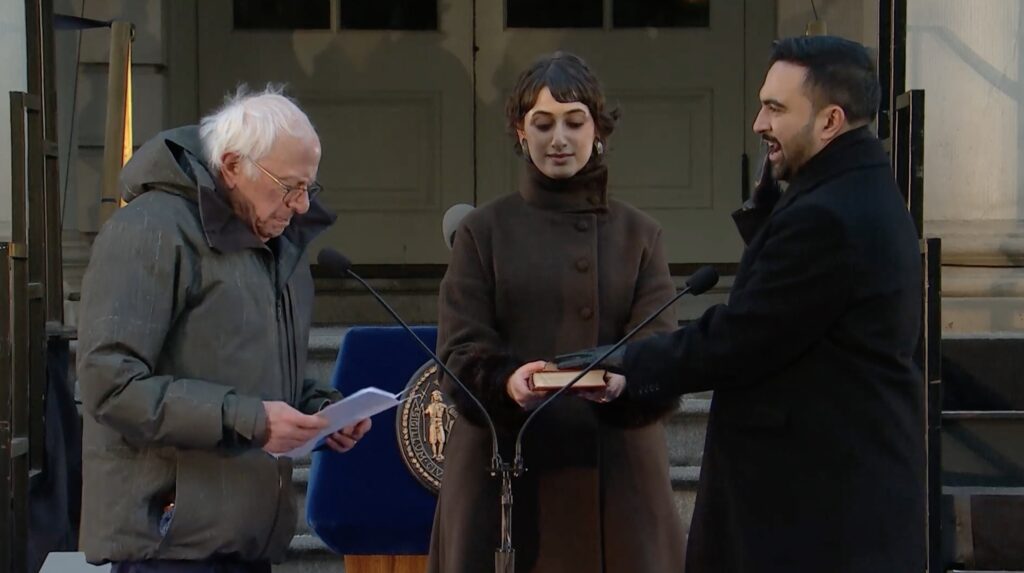
Standing alongside tens of thousands of people gathered at City Hall in Lower Manhattan and braving the January chill beneath what he described as a “resurgent flame of hope,” 34-year-old Zohran Mamdani was sworn in as the 112th Mayor of New York City during a public inauguration on January 1, 2026.
Earlier, just after midnight, Mamdani privately took the oath of office beneath City Hall at the long-closed Old City Hall subway station. Mamdani was sworn in by Attorney General for the state of New York, Letitia James at the private ceremony.
Addressing the crowd at the public ceremony on Thursday afternoon, Mamdani thanked those who placed their trust in him, marking what he described as a historic moment as the city’s first Muslim mayor.
“I do not stand alone,” he said, adding, “I stand alongside countless more New Yorkers watching from cramped kitchens in Flushing and barbershops in East New York, from cellphones propped against the dashboards of parked taxi cabs at LaGuardia, from hospitals in Mott Haven and libraries in El Barrio that have too long known only neglect.”
Reassuring construction workers, halal cart vendors, neighbors, and good Samaritans across the city, Mamdani emphasized, “I stand alongside over one million New Yorkers who voted for this day nearly two months ago — and I stand just as resolutely alongside those who did not. I know there are some who view this administration with distrust or disdain, or who see politics as permanently broken.”
Stressing that he intends to serve all New Yorkers, regardless of political affiliation, Mamdani said, “And while only action can change minds, I promise you this: If you are a New Yorker, I am your mayor. Regardless of whether we agree, I will protect you, celebrate with you, mourn alongside you, and never, not for a second, hide from you.”
Mamdani was sworn in on his Quran by Senator Bernie Sanders. Acknowledging Sanders during his remarks, Mamdani said, “Thank you to the man whose leadership I seek most to emulate, who I am so grateful to be sworn in by today, Senator Bernie Sanders.”
He also thanked New York Governor Kathy Hochul, Congresswomen Nydia Velázquez and Alexandria Ocasio-Cortez, and others in attendance. Referring to Ocasio-Cortez, who spoke before him, Mamdani noted, “You have paved the way for this moment.”
Thanking outgoing Mayor Eric Adams, Mamdani described him as “Dorothy’s son, a son of Brownsville who rose from washing dishes to the highest position in our city — for being here as well.” He added, “He and I have had our share of disagreements, but I will always be touched that he chose me as the mayoral candidate that he would most want to be trapped with on an elevator.”
Growing emotional, Mamdani thanked his parents, wife, and extended family across continents. “Thank you to my parents, Mama [Mira Nair] and Baba [Mahmood Mamdani], for raising me, for teaching me how to be in this world, and for having brought me to this city. Thank you to my family, from Kampala to Delhi. And thank you to my wife, Rama, for being my best friend, and for always showing me the beauty in everyday things.”
Reflecting on New York’s past, Mamdani said that moments of great possibility had too often been surrendered to limited imagination and ambition. Promises were “never pursued,” change “remained the same,” and for many New Yorkers, the burden had only “grown heavier” and the wait “grown longer.”
He recalled being advised to lower expectations in his inaugural address but rejected that approach outright. “I have been told that this is the occasion to reset expectations, that I should use this opportunity to encourage the people of New York to ask for little and expect even less. I will do no such thing. The only expectation I seek to reset is that of small expectations.”
Beginning immediately, Mamdani said City Hall would govern “expansively and audaciously,” adding, “We may not always succeed. But never will we be accused of lacking the courage to try.”
Responding to critics who argue that the era of big government is over, he said, “Hear me when I say this: No longer will City Hall hesitate to use its power to improve New Yorkers’ lives.”
Mamdani also reflected on the legacy of previous mayors. He recalled that 12 years earlier, Bill de Blasio stood in the same place promising to end economic and social inequalities. He cited David Dinkins, who in 1990 vowed to celebrate the city’s “gorgeous mosaic,” and Fiorello La Guardia, who nearly six decades earlier sought to build a city “far greater and more beautiful” for the hungry and the poor.
“Some of these mayors achieved more success than others,” Mamdani said. “But they were unified by a shared belief that New York could belong to more than just a privileged few.”
“It could belong to those who operate our subways and rake our parks, those who feed us biryani and beef patties, picanha and pastrami on rye. And they knew that this belief could be made true if only government dared to work hardest for those who work hardest,” he added.
Looking ahead, Mamdani said, “Over the years to come, my administration will resurrect that legacy. City Hall will deliver an agenda of safety, affordability, and abundance, where government looks and lives like the people it represents, never flinches in the fight against corporate greed, and refuses to cower before challenges that others have deemed too complicated.”
He said New York would not be a tale of one city or two cities, but of eight and a half million cities, each New Yorker carrying “hopes and fears,” each a universe woven together.
The authors of this story, he said, will speak Pashto and Mandarin, Yiddish and Creole, and will pray in mosques, shuls, churches, gurdwaras, mandirs, and temples, while many will not pray at all.
Outlining policy priorities, Mamdani said it would be New Yorkers who reform a broken property tax system, create a new Department of Community Safety to address mental health while allowing police to focus on their core mission, confront abusive landlords, and free small business owners from excessive bureaucracy. “And I am proud to be one of those New Yorkers,” he said.
Reflecting on his primary victory last June, Mamdani noted skepticism about the movement behind him.
“When we won the primary last June, there were many who said that these aspirations and those who held them had come out of nowhere. Yet one man’s nowhere is another man’s somewhere. This movement came out of eight and a half million somewhere…” he said adding “Eight and a half million New Yorkers will speak this new era into existence. It will be loud. It will be different. It will feel like the New York we love.”
Mamdani also reflected on growing up in the city, pointing to personal milestones. Looking at his wife, Rama Duwaji, seated in the audience, he said, “The city where I took a beautiful woman named Rama to McCarren Park on our first date and swore a different oath to become an American citizen on Pearl Street.”
Addressing affordability, Mamdani outlined proposals to reduce isolation and economic pressure across the city. “We will overcome the isolation that too many feel, and connect the people of this city to one another. The cost of childcare will no longer discourage young adults from starting a family, because we will deliver universal childcare for the many by taxing the wealthiest few. Those in rent-stabilized homes will no longer dread the latest rent hike, because we will freeze the rent,” he added.
He also pledged to make buses fast and free, emphasizing that these policies were about more than cost savings. “We make free, but the lives we fill with freedom.” For too long, he said, freedom in New York had belonged only to those who could afford it. “Our City Hall will change that.”
“These promises carried our movement to City Hall, and they will carry us from the rallying cries of a campaign to the realities of a new era in politics,” he said.
Recalling a recent listening session, Mamdani said that two Sundays earlier, as snow fell softly, he spent 12 hours at the Museum of the Moving Image in Astoria speaking with residents from every borough.
“We discussed construction hours on the Van Wyck Expressway and E.B.T. eligibility, affordable housing for artists and ICE raids,” he said. “I spoke to a man named TJ who said that one day a few years ago, his heart broke as he realized he would never get ahead here, no matter how hard he worked.”
Mamdani also recalled a conversation with a Pakistani woman named Samina, who told him the movement had brought something rare. Quoting her in Urdu, he said, “logon ke dil badalgyehe.”
Outlining his governing philosophy, Mamdani said, “Here is what I want you to expect from the administration that this morning moved into the building behind me. We will transform the culture of City Hall from one of ‘no’ to one of ‘how?.’ We will answer to all New Yorkers, not to any billionaire or oligarch who thinks they can buy our democracy.”
He also pledged to govern without “shame and insecurity,” making no apology for his beliefs. “I was elected as a democratic socialist and I will govern as a democratic socialist. I will not abandon my principles for fear of being deemed radical.”
Quoting Senator Sanders, Mamdani noted by recalling that the Vermont senator once said that “what’s radical is a system which gives so much to so few and denies so many people the basic necessities of life.”
Related posts:
 An Unexpected Détente: Trump and Mamdani’s White House Rapprochement
 Zohran Mamdani Makes History as New York City’s Next Mayor, Quotes India’s First PM Nehru in His Victory Speech
 President Trump and Mayor-elect Zohran Mamdani Pledge to Work Together on Affordability After “Productive” Oval Office Meeting
 Zohran Mamdani Wins Democratic Nomination for NYC Mayor, Defeating Former NY Governor Cuomo