Join WhatsApp Channel

Germany in the men’s competition and the Netherlands in the women’s event closed the year with Junior Hockey World Cup titles, reaffirming their dominance in global hockey. Although the expanded tournaments featured 24 teams each and were staged thousands of miles apart, the competitions also highlighted a widening gap in quality that raises questions about the future format of one of the Olympic movement’s oldest team sports.
The Junior Men’s World Cup, organized by the Tamil Nadu Hockey Association in collaboration with the state government, was held across two venues in Madurai and Chennai. It marked the first time a prestigious FIH World Cup event was staged in Tamil Nadu. Chennai has previously hosted several major FIH tournaments, including the now discontinued Champions Trophy, as well as invitation events such as the Rene Frank International Invitation Tournament following India’s maiden World Cup triumph in Kuala Lumpur in 1975.
Since then, India has hosted the men’s World Cup at various venues, including Bhubaneswar, without securing a title. The just concluded junior men’s tournament, however, provided some consolation for the hosts as India finished on the podium with a stirring 4-2 victory over Argentina in the bronze medal match between the losing semi-finalists. Trailing 0-2 until the 48th minute, India produced a remarkable late surge, scoring four unanswered goals to seal its first-ever bronze medal in this elite FIH event.
Germany’s supremacy in junior men’s hockey continued unabated. The defending champions retained the title for a record eighth time after edging Spain 3-2 in a penalty shootout following a 1-1 draw in regulation time. Spain, appearing in its first-ever World Cup final, threatened an upset early by forcing five penalty corners in the opening quarter but was unable to breach Germany’s compact defense.
Belgium finished fifth after defeating the Netherlands 4-3 in a shootout following a 3-3 draw, while France claimed seventh place with a 4-1 win over New Zealand. Teams traditionally considered strong contenders, including the Netherlands, Belgium, Australia, and England, were left competing for lower classification positions.
The tournament also introduced a new losers’ trophy for teams finishing in the lower half of the standings, aimed at providing additional competitive matches for sides that did not reach the knockout rounds. Bangladesh emerged as the inaugural winners of this newly introduced trophy.
While the initiative was widely welcomed, the competition exposed a clear divide between the top-tier teams and those in the lower half. Several matches were decided by margins of 10 goals or more, including India’s 17-0 win over late entrant Oman, outcomes that diluted the competitive sheen of a World Cup expected to showcase the best 24 teams.
The final men’s standings were Germany first, Spain second, India third, Argentina fourth, Belgium fifth, the Netherlands sixth, France seventh, New Zealand eighth, England ninth, Ireland tenth, Australia eleventh, South Africa twelfth, and Canada finishing twenty-second.
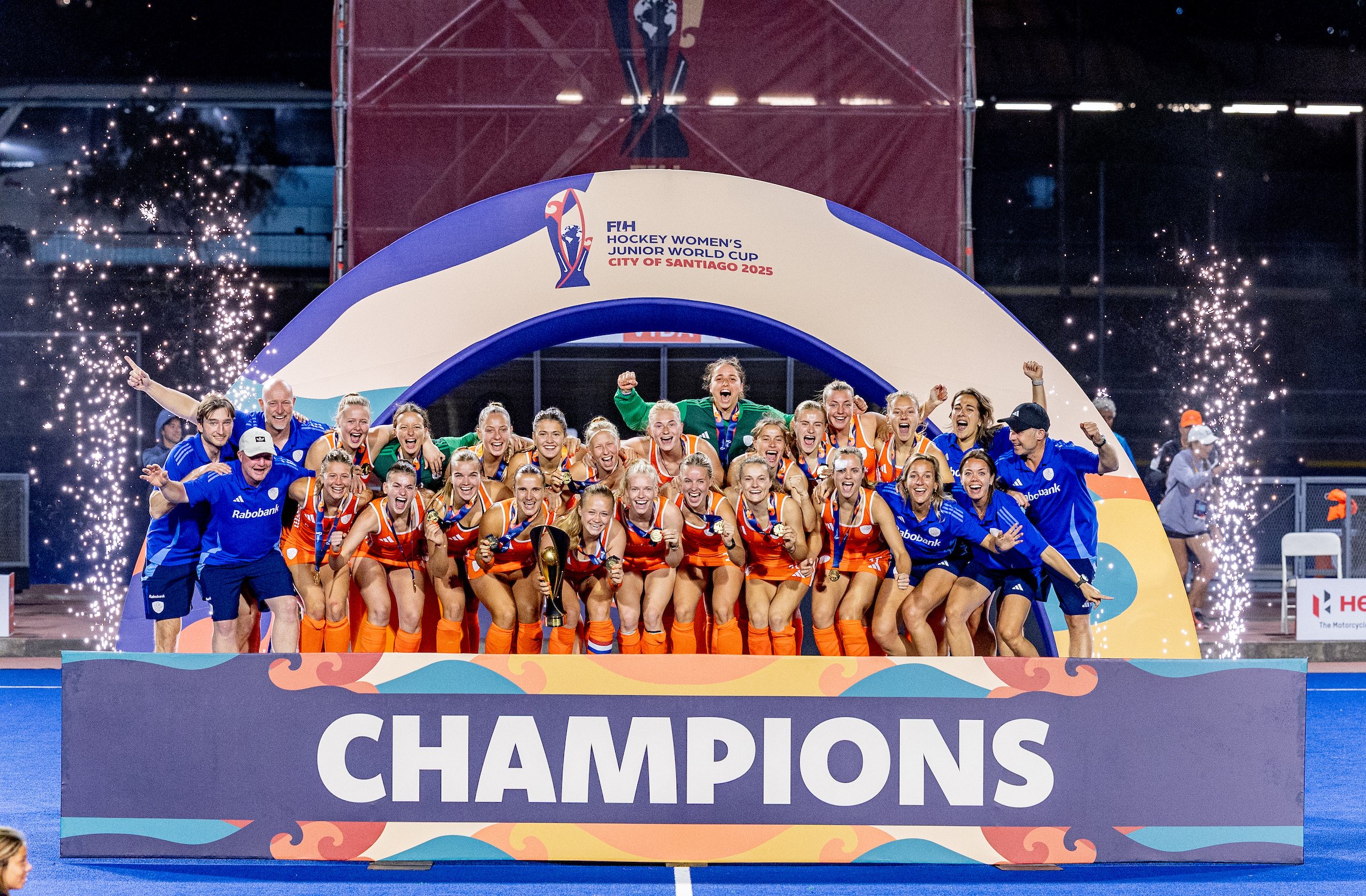
A similar pattern emerged in the Junior Women’s World Cup held in Santiago, Chile. The Netherlands’ march to a third consecutive title was rarely in doubt. The Dutch defeated Argentina 2-1 in the final to secure their sixth world crown, completing a hat-trick of titles following victories in 2022, 2023, and 2025. They settled the final in the first half with one goal from a penalty corner and another from open play, then defended resolutely to withstand sustained Argentine pressure at the Estadio Nacional.
Belgium claimed the bronze medal with a convincing 5-1 win over China in the third-place playoff. China finished as the highest-placed Asian team in the tournament, its campaign highlighted by consistency, including a shootout loss in the semi-finals and a group-stage draw against Argentina. In the lower classification matches, Austria finished twenty-first with a 3-1 win over Malaysia, while Zimbabwe edged Namibia 2-1 in the playoff for twenty-third and twenty-fourth places.
India, meanwhile, endured a disappointing campaign, finishing tenth after failing to qualify for the quarterfinals. The hosts of several lopsided encounters, the tournament again underscored the disparity in standards. India opened with a 13-0 win over Namibia but missed the last eight following a 1-3 defeat to Germany. Elsewhere, Belgium’s 21-0 victory over Zimbabwe and the Netherlands’ 13-0 win against Malaysia further illustrated the imbalance.
The final women’s standings saw the Netherlands finish first, followed by Argentina, Belgium, China, Germany, the United States, Australia, England, Spain, India, Japan, and Uruguay.
Related posts:
 Argentina Dominates Pan American Cup, Books Double Berth for 2026 Hockey World Cups
 India Clinches Asia Cup Hockey 2025, Secures Spot in FIH Hockey World Cup 2026
 India Edge Belgium in Thrilling Shootout as Semi-final Line-up Set at FIH Junior Men’s Hockey World Cup
 FIH Junior World Cup Hockey: India to Play Pakistan on November 29