Join WhatsApp Channel


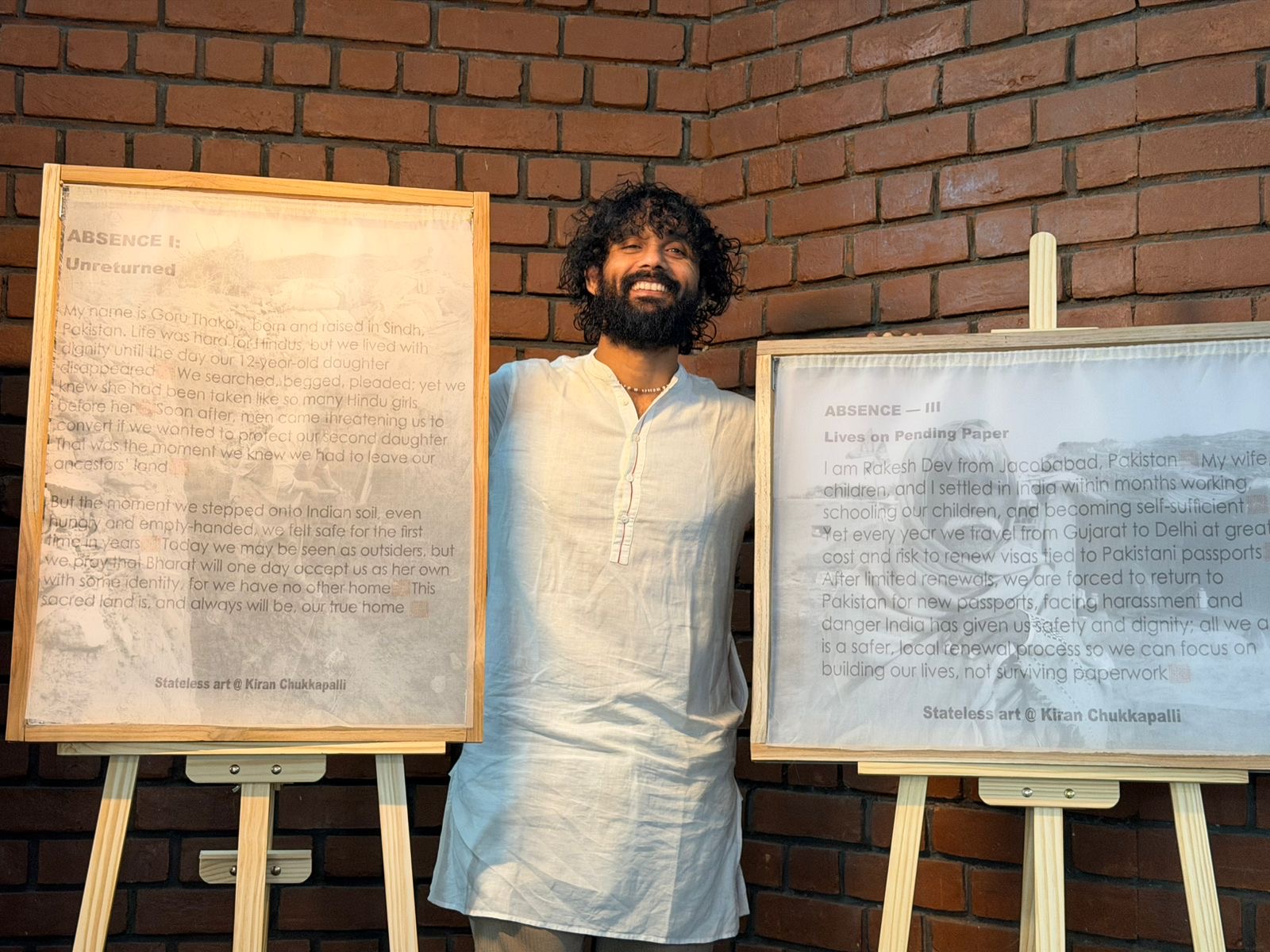
7 Decades: A Silent Refugee Crisis, an immersive art exhibition curated by human rights advocate and artist Kiran Chukkapalli, will be presented on January 16, 2026, at the Rayburn House Office Building in Washington DC.
“This exhibition is not merely a collection of artworks. It is a living archive of displacement, resilience, faith, and survival,” said Chukkapalli, noting that for more than seven decades, millions of refugees, particularly persecuted Hindu and Sikh minorities from the Indian subcontinent, have lived on the margins of geopolitical narratives, often reduced to footnotes or statistics when acknowledged at all.
“7 Decades seeks to reverse that erasure by centering human experience over policy language, faces over numbers, and dignity over sympathy,” he added.
Chukkapalli’s work is deeply personal. His engagement with refugee communities is neither observational nor distant, but lived. Over the years, he has traveled extensively through refugee camps across India, often staying with families, sharing meals, and enduring the same rains, floods, and fragile living conditions. His approach is grounded in presence rather than charity, and in listening rather than speaking for others. This ethos forms the backbone of the exhibition.
“Each black and white photograph in 7 Decades emerges from real encounters. Children navigating muddy canal paths to reach makeshift schools, women rebuilding kitchens after storms, elders carrying memories of a homeland they may never return to,” he added. “These are not images of helplessness, but of quiet and extraordinary resilience. People who continue to live, laugh, worship, and hope despite being stateless for generations.”
At the heart of the exhibition is the Goddess Quilt, one of its most evocative works. Composed of layered textiles, fragments of worn cloth, and symbolic motifs, the piece draws from the lived realities of refugee women as caretakers of culture, faith, and continuity.
“The quilt is both shelter and scripture, invoking the feminine divine while reflecting the everyday labor of women who rebuild life repeatedly with limited resources. In refugee camps where homes are stitched together from sacks and tarpaulin, the Goddess Quilt stands as a sacred reclamation, reminding us that divinity often survives in the most fragile forms,” he said.
Equally compelling is The Absence Series, a body of work that communicates through what is missing rather than what is shown. Empty spaces, interrupted forms, and deliberate voids reflect the erasure experienced by stateless communities.
Missing names on citizenship registers, missing homes on maps, and missing acknowledgment in global discourse confront viewers with an unsettling truth. Absence is not emptiness, but evidence. It is what remains when people are displaced, histories are denied, and belonging is indefinitely postponed.
According to the artist, the exhibition deliberately avoids spectacle. “Instead, it creates a contemplative environment where viewers are invited to slow down, reflect, and sit with discomfort,” he said, adding, “Materials such as cloth, thread, ash, and negative space recur throughout the show, mirroring the limited yet resourceful means through which refugee life is often sustained. These are not decorative choices. They are political ones.”
Bringing 7 Decades to Capitol Hill is a “symbolic intervention,” Chukkapalli emphasized, placing a long-ignored humanitarian reality within the seat of American policymaking. Here, art becomes a quiet form of diplomacy.
“One that does not demand answers, but insists on acknowledgment,” he said.
He noted that the exhibition challenges selective empathy and questions why some refugee crises become global causes while others remain invisible for generations. It poses a simple yet uncomfortable question. What does it mean when a refugee crisis lasts longer than most human lifetimes?
“7 Decades: A Silent Refugee Crisis is ultimately an invitation,” he asserted. “To see differently, to listen beyond noise, and to recognize endurance as a form of resistance. As visitors move through the exhibition on January 16, they are not simply encountering art. They are encountering a truth that has waited seven decades to be seen.”