 Join WhatsApp Channel


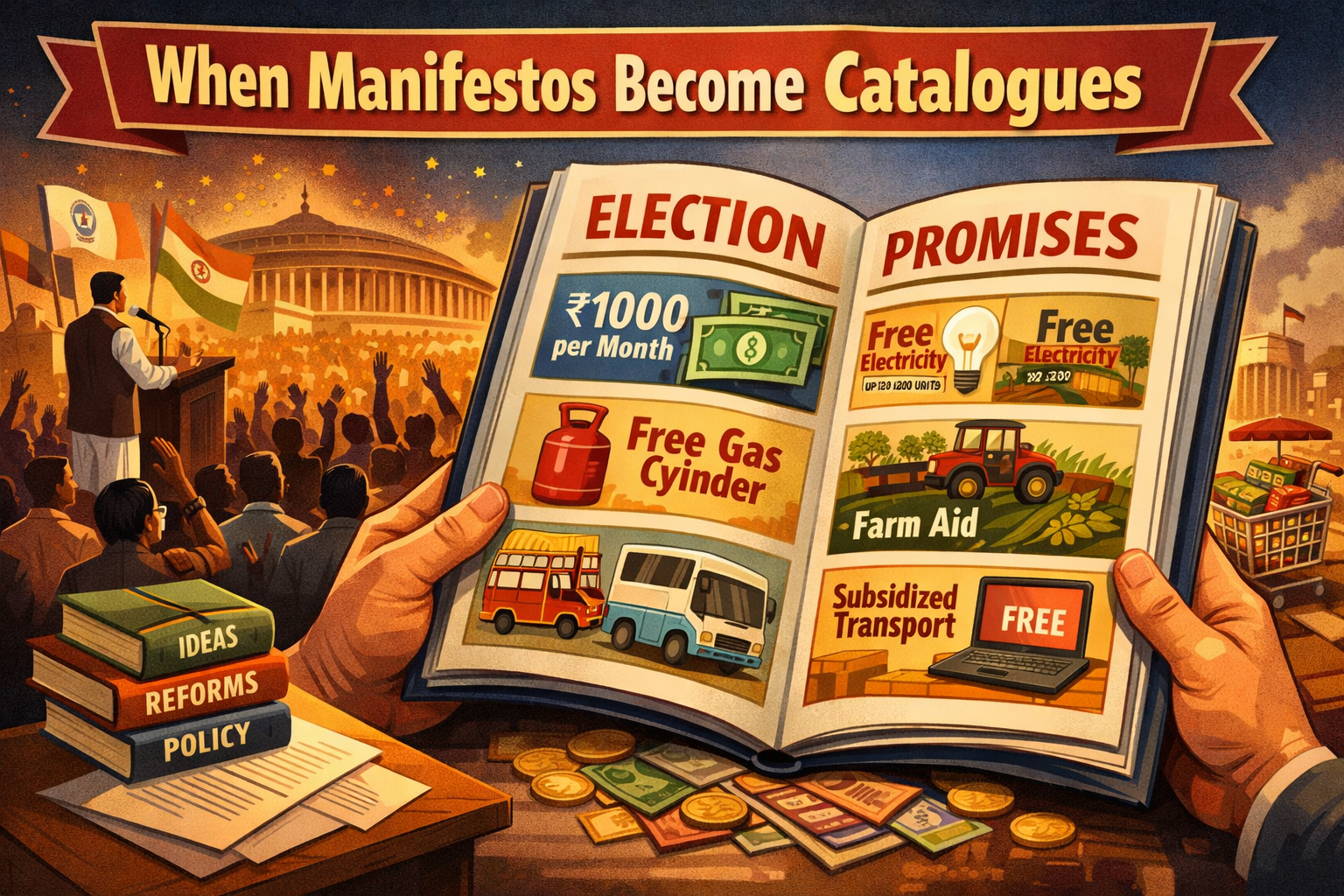
As a student of law who always found political science interesting, I was taught how elections in India, more often than not, were battles of ideology, of competing visions of statecraft, of economic philosophy, and of constitutional direction. Increasingly, however, they resemble something else, what increasingly resembles catalogues.
Not metaphors in passing, but itemized lists: ₹1,000 per month for women, free electricity up to fixed units, farm income support, subsidized gas cylinders, transport waivers, and unemployment stipends. The language of governance has shifted from structural reform to distributive precision. Policies once debated in terms of reform are now presented as deliverables.
This shift did not occur in isolation. India remains deeply unequal across class and caste, and welfare intervention in such a situation becomes indispensable. For millions, direct benefit transfers are not abstractions but lifelines. Yet what deserves scrutiny is not welfare per se, but its political timing and competitive escalation. When manifestos evolve into catalogues, they reshape not only electoral incentives but also the broader machinery of democratic engagement.
The Logic and Timing of Distribution
Across party lines, national and regional alike, elections increasingly pivot around named schemes calibrated for visibility and immediacy. In Maharashtra, the Mukhyamantri Majhi Ladki Bahin Yojana promised monthly transfers to women in the months preceding elections. In Madhya Pradesh, the Mukhyamantri Ladli Behana Yojana expanded cash assistance for women beneficiaries in proximity to polling. In another state, Haryana saw the Deen Dayal Lado Lakshmi Yojana positioned prominently in its electoral discourse. In yet another, Bihar witnessed the articulation of women-centric employment guarantees under the Mukhyamantri Mahila Rozgar Yojana and the list continues across states. Similarly, at the Union level, the PM-KISAN Samman Nidhi Scheme was announced weeks before the general elections of 2019, with its first instalment disbursed days before voting commenced.
These measures are not illegal, they are not constitutionally impermissible in principle. But their proximity to elections has repeatedly raised questions before courts and commentators alike. The Supreme Court has acknowledged that distribution of “freebies” can influence voters and directed the Election Commission to frame guidelines governing manifesto promises. More recently, litigation and public debate have focused on the timing of direct cash transfers, asking whether last-minute disbursements risk blurring the line between welfare and inducement.
The issue is not whether the poor should receive support. It is whether the structure of this support is being synchronized with electoral calendars. Welfare is policy. Timing is politics. When transfers are clustered around polling cycles, citizens are left to evaluate not just the benefit but the intent behind it.
This competitive escalation has produced a strange symmetry. The Bharatiya Janata Party (currently the ruling party at the Union level), the Indian National Congress, and major regional formations such as the Aam Aadmi Party, the Trinamool Congress, and various other prominent parties of various states, all deploy versions of targeted distributive schemes. What emerges is not unilateral populism but competitive populism, an arms race of catalogues in which each manifesto must outbid the last.
As a result, the electoral apparatus also adapts accordingly. Campaigns then become more data-driven, demographic-specific, and algorithmically tuned. Beneficiary databases double as political intelligence. Direct benefit transfer mechanisms become not merely administrative channels but instruments of political recall: the state appears tangible, personalized, and immediate.
Competitive Populism, “Vote Chori”, and Democratic Anxiety
Dr. B. R. Ambedkar, Father of Indian Constitution, once described political power as the “master key” that opens all doors. At the time, the remark may have appeared rhetorical; today, it reads as structurally prophetic, a reminder that control over the state determines the shape of opportunity itself. The question now is whether that master key is being used primarily to unlock temporary relief rather than institutional transformation.
In this environment, rhetoric has intensified. The phrase “vote chori”, literally translated as “theft of votes”, has entered mainstream political vocabulary in tightly contested elections. The current Leader of the Opposition, Rahul Gandhi, has in his press conferences alleged discrepancies in turnout data, displayed booth-wise spreadsheets, pointed to last-hour surges in voting percentages, and questioned delays in releasing granular documentation. He and other opposition leaders have referred to missing or delayed statutory forms, inconsistencies between constituency-level aggregates and polling station records, and a lack of machine-wise disclosure sufficient for independent scrutiny.
The Election Commission, in response, rejected all the allegations pertaining to systemic manipulation, maintaining procedural compliance. For many citizens, there was a sense of dissatisfaction which lay not only in the alleged irregularities but in the perceived opacity of responses. In a democracy where electoral stakes are materially high, where governments preside over vast distributive schemes affecting millions, transparency must be proportionately expansive. Formal assurances are often insufficient when political trust is already strained.
“Vote chori” thus operates less as a proven charge and more as a symptom of democratic anxiety. When elections are revolved around large-scale distribution, suspicion tends to escalate. As the scale of distribution expands further, institutions face increasing pressure to demonstrate unimpeachable neutrality.
Beyond Campaign Craft
The recent political turn of Prashant Kishor reveals another dimension of this narrowed political horizon. Long known as the strategist behind multiple electoral victories across ideological divides, Kishor eventually sought to pivot from campaign engineering to structural reform through his Jan Suraaj initiative, in his home state of Bihar. His emphasis was on bureaucratic accountability, education reform, healthcare and governance restructuring rather than transactional promises. Yet reform lacks the immediate visibility of cash transfers. It cannot be itemized in a manifesto catalogue with the same clarity as a monthly stipend. But systemic reform rarely translates into the immediacy voters are asked to recognize. Structural diagnostics are harder to campaign on than a visible monthly transfer.
None of this an argument against welfare per se. Redistribution remains essential in a developing democracy. But redistribution without structural reform risks managing inequality rather than dismantling it. Free electricity does not substitute for long-term energy reform. Income support cannot replace employment generation. Subsidized consumption does not build institutional capacity.
The concern is not that democracy is shrinking, but that its ambitions may be. Citizens are increasingly encouraged to evaluate governments through immediate benefit flows rather than institutional change; parties compete to refine delivery mechanisms rather than reimagine structural reform. The master key opens the nearest door, while the more complex locks- judicial reform, regulatory coherence, public sector accountability- remain comparatively undisturbed. And yet Indian democracy retains its vitality: governments are voted out, mandates shift, and public debate remains fierce. The electorate is neither passive nor easily deceived. But the grammar of politics has changed. When manifestos become catalogues, elections risk turning into exercises in incremental escalation rather than serious deliberations on institutional futures.
The challenge, therefore, is not to abandon welfare nor to romanticize austerity, but to re-expand political imagination beyond distributive arithmetic. Relief can secure consent; only reform secures resilience. Dr. Ambedkar’s master key was meant to reconstruct the architecture of power, not merely to administer its monthly instalments.
Disclaimer: The opinions and views expressed in this article/column are those of the author(s) and do not necessarily reflect the views or positions of South Asian Herald.
Related posts:
 Bihar 2025: How the NDA Engineered a Near-Sweep — and Why the RJD-Congress Flame Flickered Out
 How the Modi-Nitish Alliance Crushed Bihar: A Lesson in Coalition, Caste, and Confidence
 The Bangladesh February 12 Election: A Societal Verdict Beyond Power
 Tamil Nadu 2026: When Silence Becomes a Verdict
