Join WhatsApp Channel


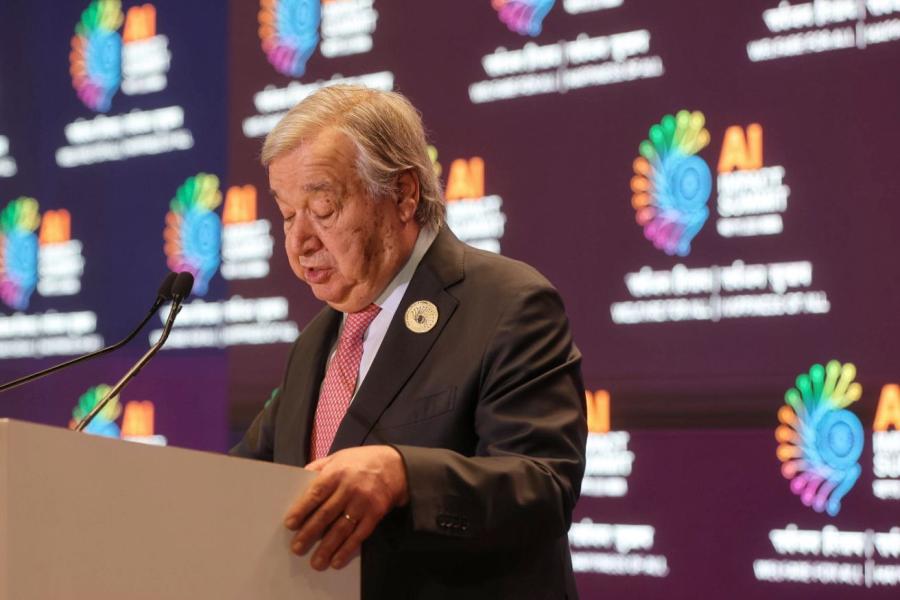
United Nations Secretary-General António Guterres said discussions at the India-AI Impact Summit 2026 would help shape global dialogue on artificial intelligence, as he called for greater investment to ensure AI is accessible to all.
Delivering the opening remarks at the India-AI Impact Summit 2026 in New Delhi on February 19, Guterres emphasized that the deliberations would culminate in a broader global process. “Your discussions here will culminate in the Global Dialogue,” he said, cautioning that without sufficient investment, many countries risk being excluded from the AI era.
He stressed the importance of inclusion, stating, “AI must be accessible to everyone.”
The Secretary-General thanked Prime Minister Narendra Modi for the invitation and commended India’s leadership in hosting what he described as the first AI summit in the Global South. He noted that convening the summit in India carries “special meaning,” bringing the conversation closer to the “realities” shaping much of the world.
At the same time, SG Guterres warned that decisions about the future of artificial intelligence cannot be made by a “handful of countries” or left to the “whims” of a few billionaires.
Recalling actions taken by the United Nations General Assembly last year, he highlighted two key steps.
First, the establishment of an Independent International Scientific Panel on AI. “And I am happy to announce that the Panel has now been appointed. These 40 leading experts from across regions and disciplines embody a clear message: ‘AI must belong to everyone. We must replace hype and fear with shared evidence – and close knowledge gaps. I urge Member States, industry and civil society to contribute to the Panel’s work,’” he said.
Second, the launch of a Global Dialogue on AI Governance within the United Nations framework, aimed at providing all countries, along with the private sector, academia and civil society, a platform to participate.
“We need guardrails that preserve human agency, human oversight – and human accountability,” Guterres noted, adding that the first session of the dialogue, scheduled for July in Geneva, would ensure that every country and stakeholder has a voice.
He outlined the objectives of the dialogue as aligning global efforts, upholding human rights, preventing misuse, and advancing common safety measures to support interoperability. Such measures, he said, would build trust across borders and create opportunities for regulators and businesses alike.
Encouraged by the General Assembly, SG Guterres also called for the creation of a Global Fund on AI to strengthen foundational capacities in developing countries, including skills development, access to data, affordable computing power, and inclusive innovation ecosystems.
“Our target is 3 billion US dollars,” he said, noting that the amount represents less than one percent of the annual revenue of a single technology company. He described it as a modest investment for broad AI diffusion that benefits all stakeholders, including technology firms.
“I am pleased that Member States have responded to my call to form a Global Network for Exchange and Cooperation on AI Capacity Building in the developing world,” he added.
SG Guterres said that when developed and deployed responsibly, AI can accelerate progress toward the Sustainable Development Goals by advancing medical breakthroughs, expanding educational access, strengthening food security, enhancing climate action and disaster preparedness, and improving access to essential public services.
However, he cautioned that artificial intelligence also carries risks. It can deepen “inequality, amplify bias, and fuel harm.” He further warned that as AI’s energy and water demands increase, data centers and supply chains must transition to clean power and avoid shifting environmental and economic costs onto vulnerable communities.
“We must invest in workers so AI augments human potential – not replaces it,” the Secretary-General said. “And AI must be safe for everyone. We must protect people from exploitation, manipulation, and abuse. No child should be a test subject for unregulated AI.”
Addressing global leaders and participants at the summit, SG Guterres said the message of the gathering was clear: “Real impact means technology that improves lives and protects the planet,” adding “So, let’s build AI for everyone – with dignity as the default setting.”
Related posts:
 Exclusive: United Nations Leadership to Join India-AI Impact Summit 2026 as Global South Shapes AI Governance Dialogue
 “Show the world what we can achieve when we work together” UNSG António Guterres urges Member States to adopt the Pact for the Future
 India and France Host United Nations Event to Set Stage for AI Impact Summit 2026 in New Delhi
 India-AI Impact Summit 2026 to Focus on “People, Planet, and Progress,” says Ambassador Vinay Kwatra