 Join WhatsApp Channel

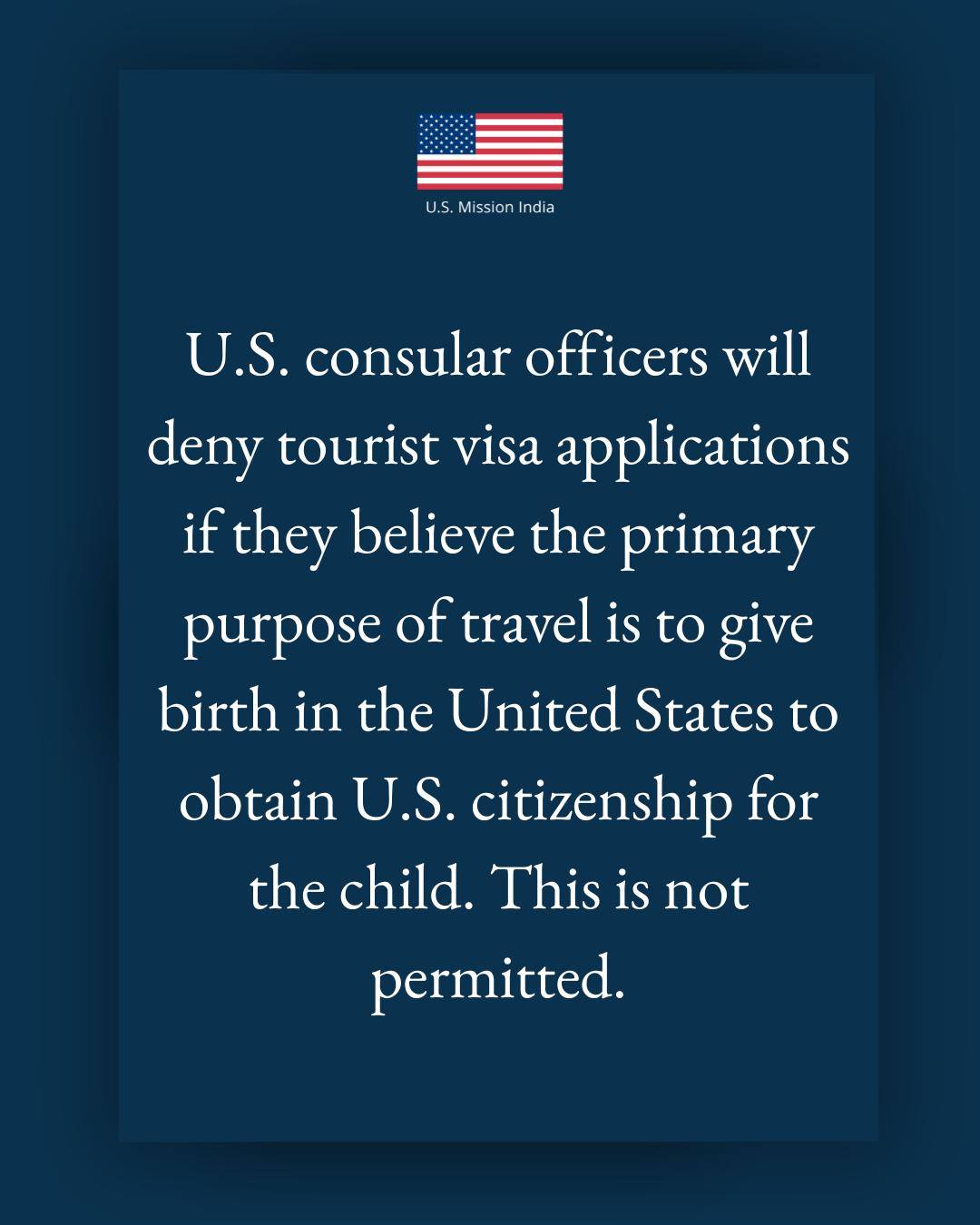
The United States has issued an unusually blunt warning to travelers attempting to use tourist visas as a pathway for securing American citizenship for newborns, signaling a broader tightening of immigration vetting that is now rippling across India’s visa-dependent workforce and families.
In a sharply worded post on social media, the U.S. Embassy in India said consular officers will deny B-1/B-2 tourist visa applications if they believe the traveler’s primary intention is to give birth in the country. “This is not permitted,” the embassy said—leaving little ambiguity about the consequences.
The move coincides with a parallel expansion of digital background checks. Beginning mid-December, U.S. authorities will scrutinize the online and social-media presence of all H-1B specialty-occupation workers and their H-4 dependents. This review, previously confined to student and exchange-visitor categories, has triggered unease among Indian workers who already face long waits, shifting interview schedules and unpredictable adjudication standards.
A spokesperson for the U.S. mission framed the changes as part of a standard security review. Each case, the spokesperson said, is assessed to ensure the applicant poses no safety threat and intends to engage only in activities permitted under the visa category. But the broader context signals something more structured: a deliberate narrowing of discretionary gateways through which travelers, including those from India, have historically slipped with relative ease.
Birth Tourism Under New Pressure
The flashpoint is “birth tourism,” a practice in which pregnant women travel to the U.S. on tourist visas to secure automatic citizenship for their children under the 14th Amendment. The act itself is legal; misrepresenting one’s purpose to obtain a visa is not. Washington is now drawing a firmer line between the two.
Under rules introduced several years ago and still firmly in place, consular officers may deny a tourist visa if they have “reason to believe” that giving birth is a primary motive. The threshold is intentionally low and heavily reliant on officer discretion, which makes the process unpredictable for travelers whose pregnancies are visible or who lack clear documentation showing they intend to return home before delivery.
While birth tourism is not tracked officially, U.S. estimates over the past decade suggest it remains a small but persistent activity. Travel-industry patterns show that the practice is more common among nationals of a few countries that have long sustained a commercial sub-sector built around short-term maternity stays. India was not historically part of that trend. But with rising incomes, more aggressive marketing and the enduring appeal of a U.S. passport for education, mobility and long-term security, the number of Indian applicants exploring the option has grown enough to draw the embassy’s attention.
A Wider Net of Scrutiny
What makes the new warning more consequential for India is the timing. The U.S. shift toward intensive digital vetting, combined with stricter reviews of travel intent, effectively raises the bar for multiple categories of Indian applicants at once.
Visitor visas will now face more probing questions on itinerary, financial transparency and timing. Pregnant travelers who are not planning to give birth in the U.S. must show more documentation—such as medical notes confirming due dates and fitness to travel—to avoid suspicion. Even those with legitimate plans may encounter delays if their digital footprints show ambiguous signals.
For H-1B and H-4 applicants, the expanded online review represents a structural shift. Consular officers increasingly examine public posts, professional profiles, employment histories and travel patterns to detect discrepancies. This can flag concerns unrelated to the applicant’s stated purpose—sometimes resulting in sudden interview rescheduling, requests for additional evidence or extended administrative processing.
The underlying U.S. rationale is straightforward: a belief that digital footprints can reveal intent more accurately than paper documents. But for applicants, particularly from India—the largest pool of H-1B recipients worldwide—the outcome is a system that feels more opaque, more discretionary and less predictable.
Policy Driven by Politics
The renewed crackdown is also shaped by the political climate in Washington, where birthright citizenship and visa integrity remain highly charged issues. Although attempts to end birthright citizenship face legal challenges, the debate continues to influence administrative enforcement, especially during election cycles.
Birth tourism, in particular, has become a symbolic proxy for wider concerns about immigration control. Despite its relatively small scale, the practice is seen by U.S. policymakers as an avoidable loophole that undermines the intent of visitor visas. That perception has translated into a more muscular enforcement approach—one that merges security screening, intent analysis and digital monitoring.
What It Means for Indian Travelers
For most travelers, the new U.S. posture does not close the door. But it does shift more responsibility onto applicants to demonstrate intent with clarity and precision. Ambiguity—once survivable—is now a liability.
Pregnant travelers face the highest scrutiny. Those with legitimate plans must pre-empt doubts with detailed medical and travel documentation. H-1B and H-4 applicants must ensure online profiles are consistent with application materials. And all applicants, across categories, must prepare for longer processing times and more probing interviews.
The message from Washington is unambiguous: the margin for error is shrinking. The U.S. is keen to welcome travelers—but only after satisfying itself that the purpose is credible, verifiable and strictly aligned with the visa sought.
Related posts:
 Securing India’s Welcome: Why Tourist Police Reform Can’t Wait
 New $250 Visa Integrity Fee to Increase U.S. Travel Costs for Foreign Nationals and Employers
 VFS Global and Indian Embassy Host Consular Camp at FeTNA Convention in Raleigh, NC
 New Social Media Vetting Rules Spark Major Travel and Processing Delay Concerns for H-1B/H-4 Workers
