Join WhatsApp Channel


When Finance Minister Nirmala Sitharaman tabled the Economic Survey 2025-26 in Parliament on January 29, the document was ostensibly a review of the past year and a roadmap for the next. However, placed within the context of imminent elections in five states, the Survey serves as a case study in the tension between political signaling and economic diagnosis.
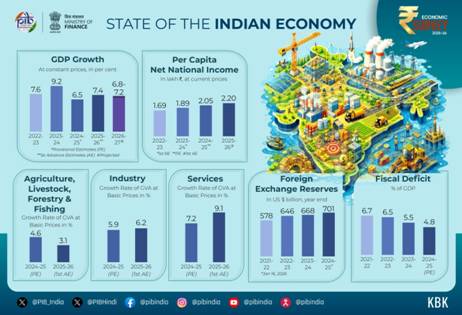
Chief Economic Advisor Anantha Nageswaran described the Indian economy as an “oasis of macro stability,” projecting real GDP growth of 6.8-7.2% for the coming fiscal year, following a robust 7.4% in the current fiscal. Yet, a rigorous analysis of the underlying data reveals a troubling divergence between these aggregate headline metrics and the granular realities of household distress.
The resulting document appears less like a sober policy analysis and more like a manifesto of competence, raising serious questions about the integrity of statistical methodology in a politically charged environment.
The Aggregates: A Triumphalist Narrative
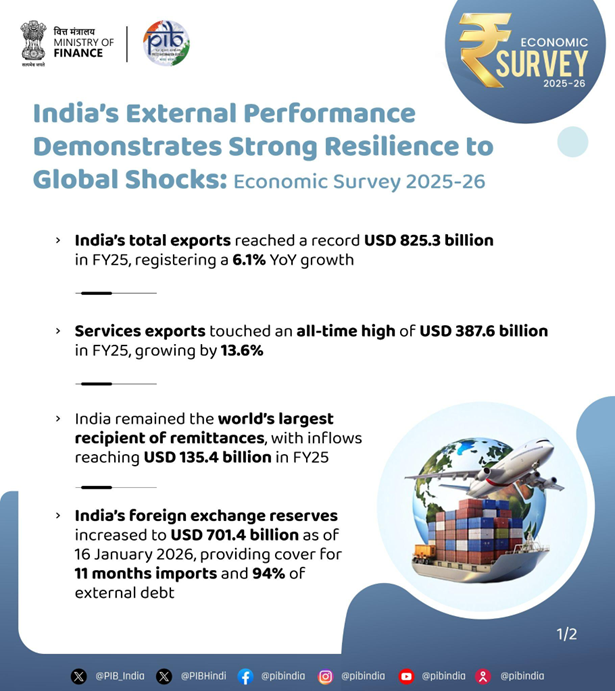
The Survey’s macroeconomic fundamentals, taken at face value, are undeniably impressive. The government claims to have tamed inflation to a historic low of 1.7%—a figure that would be the envy of most developed economies. Simultaneously, the fiscal deficit has been disciplined to 4.4% of GDP, signaling a commitment to consolidation that has rightly earned nods from global credit rating agencies.
Fiscal Deficit is the index of the gap between governments borrowing and its expenditure, if the gap is large , it means the government is exceeding borrowing limits to sustain it populist schemes.
Perhaps most bullish is the revision of India’s medium-term potential growth rate. The CEA has upgraded this metric from 6.5% to 7%, a modification predicated on the belief that structural reforms have permanently elevated the economy’s capacity. The Survey further highlights that private consumption now constitutes 61.5% of GDP, its highest share in a decade.
If these numbers represented the totality of the economic picture, the government’s narrative of a “Viksit Bharat” (Developed India) would be unassailable. However, economic health cannot be measured solely by the ceiling; one must also inspect the floor.
The Consumption-Savings Paradox
The most glaring analytical flaw in the Survey is its treatment of consumption. While celebrating private consumption growth, the document glides over a simultaneous, alarming trend: the cratering of net financial savings to historic lows.
When household consumption rises while savings collapse, it suggests that growth is not being fueled by rising real incomes, but rather by debt accumulation and the liquidation of assets. This “distress consumption” is symptomatic of a K-shaped recovery where the gains are aggressively concentrated.
Current data indicates that the top 10% of earners now capture over 50% of national income. Meanwhile, the bottom 50% has seen income shares stagnate or decline.
By ignoring this distribution crisis, the Survey treats inequality as an externality rather than a structural impediment to sustainable growth. The reliance on a “trickle-down” theory—where aggregate growth eventually solves micro-level distress—contradicts the empirical evidence of the last five years.
Sectoral Dissonance: Manufacturing and Employment
The credibility of the Survey is further strained by sectoral inconsistencies. The document claims a surge in manufacturing growth, yet this sits uneasily alongside data from core industries which show sputtering output. If the Index of Industrial Production (IIP) and core sector data do not correlate with the manufacturing value-added figures in the GDP estimates, we are witnessing a statistical decoupling that warrants explanation, not celebration.
Similarly, the employment narrative is fraught with contradictions. The Survey points to improved headline employment numbers, but a deeper dive reveals that much of this “job creation” is essentially churn within the informal sector. An increase in self-employment and unpaid family labor is often a sign of labor market distress, not health. When the labor force participation rate rises without a commensurate rise in formal wage employment, it indicates that the workforce is expanding out of necessity rather than opportunity.
The Structural Shift: From Rights to Norms
Perhaps the most significant policy pivot detailed in the Survey—and one that illustrates the ideological shift of the current administration—is the restructuring of the rural safety net. The Mahatma Gandhi National Rural Employment Guarantee Act (MGNREGA), a demand-driven right to work, is being replaced by the Viksit Bharat – Guarantee for Rozgar and Ajivika Mission (Gramin) Act 2025 (VB-GRAM G).
On the surface, VB-GRAM G appears expansive, offering 125 guaranteed work days compared to MGNREGA 100. However, the structural mechanism has been fundamentally altered.
Funding Model: The demand-driven model, where the center was legally obligated to fund work whenever requested, has been replaced by “normative” budget allocations. Once a state exhausts its fixed envelope, the central guarantee effectively evaporates.
Fiscal Federalism: Under MGNREGA, the Central government bore nearly 100% of the wage bill. Under the new regime, the burden sharing shifts to a 60-40 split (90-10 for the Northeast). This places immense strain on state exchequers, likely disincentivizing states from promoting the scheme.
Labor Supply Constraints: The introduction of “peak agriculture pause” days—up to 60 days where work is suspended—presumes that rural unemployment is purely frictional and that labor must be “freed up” for agriculture. This ignores the reality that MGNREGA has historically functioned as a lifeline during agrarian distress, regardless of the sowing calendar.
The Survey frames this as “diversification,” noting a decline in MGNREGA dependency. However, critics, including the Congress party’s rebuttal document, “Real State of the Economy 2026,” argue that this decline is artificial—caused by systematic underfunding rather than a reduction in rural distress.
The Danger of Politicized Data
The Opposition’s critique, termed a “partisan food fight” by casual observers, actually highlights a profound risk to institutional integrity. When economic data becomes a function of electoral cycles, the feedback loop required for effective policy making is broken.
The “Real State of the Economy 2026” report accuses the government of “statistical sleight-of-hand.” While opposition rebuttals are expected, the specific charges—that manufacturing growth is a statistical fiction and that inflation figures do not reflect the consumption basket of the poor—resonate with independent analyses of India’s statistical ecosystem.
If policymakers believe their own “massaged” data, they cannot correct the course. If they believe the labor market is robust, they will not intervene to support wages. If they believe consumption is healthy, they will not address the savings crisis.
Conclusion
The Economic Survey 2025-26 presents a vision of an economy that is structurally sound and globally competitive. It is a vision that will undoubtedly serve as an effective campaign brochure for the ruling party. However, as an economic document, it suffers from a critical lack of introspection.
India’s growth is respectable by global standards, but it is increasingly unequal and debt-fueled. By choosing triumphalism over truth-telling, the government risks eroding the credibility of official statistics. When the gap between the “oasis of macro stability” and the micro-reality of household budgets becomes too wide, the resulting policy failures are inevitable.
For the sake of long-term economic health, the government must move beyond the “mirage of growth” and confront the structural fragility that lies beneath the headline numbers. Evidence-based policymaking requires, first and foremost, an honest acceptance of the evidence.
Disclaimer: The opinions and views expressed in this article/column are those of the author(s) and do not necessarily reflect the views or positions of South Asian Herald.
Related posts:
 India’s 2026 Income Survey Aims to Fill Critical Data Void After Decades of Inaction
 India’s Blockbuster GDP Masks a Tightening Fiscal Squeeze as Tax Revenues Lag Ambitious Targets
 Dragon and Elephant’s Dance: China’s Consumer as India’s Next Big Opportunity
 Pakistan Wins Rating Upgrade on Easing Default Risks, Fiscal Gains