Join WhatsApp Channel


A small shipment of fragrant rice from India’s northeastern state of Assam has quietly entered European markets this week — and with it, a broader ambition: to position a traditional grain alongside the country’s most recognizable origin-branded agricultural exports.
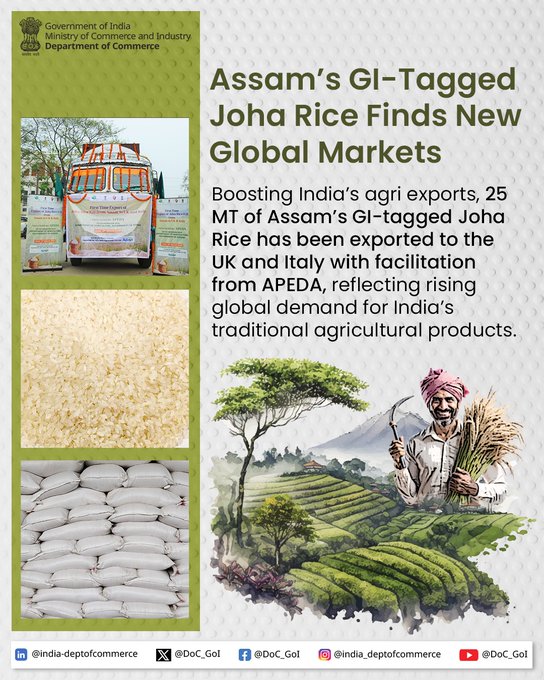
The 25-metric-tonne consignment of GI-tagged Joha rice, dispatched to the United Kingdom and Italy, was facilitated by the Agricultural and Processed Food Products Export Development Authority under India’s Ministry of Commerce and Industry. On paper, the shipment is tiny when compared with India’s vast rice trade. Yet policymakers and exporters say it signals something more consequential — the attempt to turn a regional staple into a global specialty.
In many ways, the strategy echoes the trajectory of Darjeeling Tea, a Himalayan product whose name became synonymous with premium quality in international markets. Indian officials believe Joha rice could gradually occupy a similar niche in the global trade of heritage grains.
A rice rooted in place
Joha rice is a traditional aromatic variety grown in the flood-prone plains of the Brahmaputra Valley. Known locally for its distinctive fragrance and soft texture when cooked, the grain received a Geographical Indication (GI) tag in 2017, legally linking its identity to Assam’s unique agro-ecological conditions.
The variety is cultivated across roughly 21,600 hectares in districts such as Nagaon, Baksa, Goalpara, Sivasagar, Majuli, Chirang and Golaghat. Annual production stands at about 43,000 metric tons — small by global standards but large enough to support niche export markets.
For decades, Joha remained largely a local delicacy, consumed within Assam and nearby states. But the GI tag — a certification used worldwide to protect products tied to specific regions — has given exporters a new marketing tool.
Rather than competing directly in the commodity rice trade, Joha can now be positioned as a heritage product linked to geography, culture and traditional farming practices.
India’s push for premium agricultural exports
India dominates the global rice market, exporting tens of millions of tons annually, primarily to Africa, the Middle East and parts of Asia. Much of that trade revolves around bulk varieties sold at competitive prices.
But agricultural policymakers are increasingly looking beyond volume toward value.
Products protected under geographical indication systems often command significant premiums in international markets. The best-known example is Darjeeling Tea, sometimes called the “Champagne of teas,” which sells at prices several times higher than conventional tea because of strict origin certification and limited production.
Similarly, Basmati Rice — grown across the Indo-Gangetic plains — has built a powerful brand identity tied to aroma, long grains and geographic heritage.
Research by trade bodies and development agencies suggests GI-tagged agricultural products frequently earn farmers price premiums of 20% to 40%, and sometimes more in specialty food markets.
For India, which now has more than 600 registered GI products, expanding exports of such items offers a way to increase agricultural revenue without dramatically increasing production.
Spotlight on India’s northeast
The Joha export also reflects a policy effort to integrate India’s northeastern region into global agricultural supply chains.
Despite rich biodiversity and unique crop varieties, the region has historically struggled to access international markets due to logistical challenges and limited export infrastructure.
Assam alone produces several distinctive agricultural goods. These include Assam Tea, one of the world’s most widely consumed black teas, as well as region-specific crops such as Karbi Anglong Ginger and Tezpur Litchi.
In recent years, government agencies have tried to build export linkages by supporting farmer cooperatives, improving packaging standards and connecting producers with overseas buyers.
The Joha shipment follows a series of smaller trial exports — one ton sent to Vietnam and another two tons distributed across Gulf markets including Kuwait, Bahrain, Qatar, Oman and Saudi Arabia.
Rising global demand for heritage grains
The timing of Joha’s international debut may be favorable.
Across North America and Europe, consumers have shown growing interest in specialty grains that emphasize traceability, traditional cultivation methods and unique flavor profiles. In upscale grocery stores and restaurant kitchens, heritage grains are increasingly marketed as alternatives to mass-produced staples.
Aromatic rice varieties have gained traction among chefs and specialty retailers seeking distinctive textures and flavors.
That shift in consumer preferences has encouraged exporters to promote Joha not as a bulk commodity but as a niche product suited for gourmet cooking and specialty retail shelves.
A long road to global recognition
Still, turning a traditional crop into a globally recognized brand rarely happens overnight.
Darjeeling tea took decades of careful branding, legal protection and marketing before its name became internationally synonymous with premium tea. Basmati rice followed a similar trajectory.
Joha rice now enters that long process — starting with modest shipments but carrying the ambition of a larger agricultural narrative.
For farmers in Assam, the stakes are clear. If the grain can establish a foothold in overseas specialty markets, it could bring higher prices and renewed interest in traditional varieties that have long remained outside global trade.
And for India’s agricultural export strategy, the message is equally straightforward: the future of farm trade may not lie only in selling more commodities, but in selling the stories — and landscapes — behind them.