Join WhatsApp Channel


The world seemed fixated on ways to settle a conflict in Ukraine that will soon be entering its fourth year, one that started off as a “Special Military Operation” by the President of Russia, Vladimir Putin. And just when things seemed to fall in place with a 28-point peace plan put forth by President Donald Trump, word came from Asia of Japan and China starting a new war of words that many still hope will remain that way.
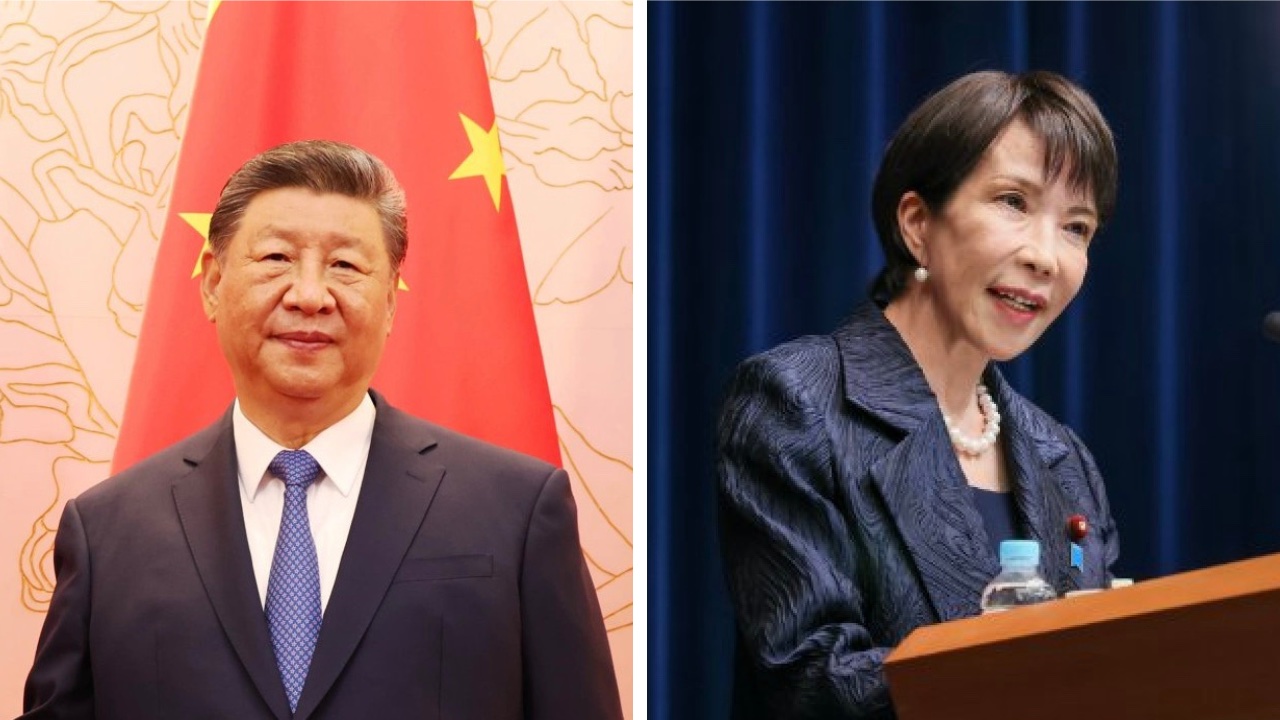
The row between the two East Asian giants kicked off when the right-wing Prime Minister of Japan, Sanae Takaichi, suggested that Tokyo could be involved militarily if Taiwan came under attack. Putting her ultra-conservative credentials aside, the Japanese leader should have known better about the sensitivities involving Taiwan and the People’s Republic of China. It is not something that Beijing has been fussing about only in the recent past but an issue ingrained in its foreign policy since independence.
A mere seventy miles is the closest point of Japan to Taiwan, but what has not been missed is that it was the first time that a Prime Minister had made any explicit references to Taiwan, let alone wading into hypotheticals of conflict and Tokyo’s response. Taking cue from her past Prime Ministers as well as from Washington, Prime Minister Takaichi should have stayed vague or not broached the subject at all.
But the issue did not end there, for two telephone calls have added to the sense of urgency and unease in the Indo Pacific. First, between President Xi Jinping and President Trump, when, according to a media report, the Chinese leader raised the historic claim to Taiwan and the Washington-China “responsibility” of managing the world order. The latter was perhaps President Xi’s allusion to the G-2 formulation of President Trump during his recent Asia visit and in his summit meeting with President Xi on the sidelines of the Asia Pacific Economic Cooperation forum in South Korea.
It is not clear who initiated the call, but President Trump made no mention of Taiwan in his conversation, only saying in a social media post that he had a “very good” call that covered many topics including Ukraine, fentanyl, and American farm products. “Our relationship with China is extremely strong! This call was a follow up to our highly successful meeting in South Korea, three weeks ago. Since then, there has been significant progress on both sides in keeping our agreements current and accurate,” Trump said on Truth Social. But according to China’s foreign ministry, quoted in the media, President Xi told his American counterpart that the return of Taiwan to China is a key part of the post-World War Two international order.

The second telephone call was President Trump dialing Prime Minister Takaichi and asking her not to provoke Beijing over Taiwan. Official Japan disputes not the call but the content of President Trump’s advice to the Japanese Prime Minister. According to the Japanese leader, “President Trump said we are very close friends, and he offered that I should feel free to call him anytime.” China, for its part, continues to insist that Prime Minister Takaichi should retract her comments, and there are no indications that President Trump had either subscribed to this view or asked Prime Minister Takaichi to do so.
What has worried many in the Indo Pacific, officials and analysts, is not who called whom or the reading between the lines of a readout, but an apprehension that in order to draw more out of China on trade, Washington could be softening its strategic posture, which in turn could heighten military tensions in East Asia. In the context of the ongoing Taiwan row, an argument has been made that President Trump has not been forceful on Taiwan or on Japan with China. It has been reported that some Japanese lawmakers were expecting more vocal support from Washington, over and beyond the American envoy in Tokyo saying that the United States supports Japan in the face of Chinese “coercion.”
Apprehensions will remain in the Asia Pacific, especially in democracies, over the Trump administration’s security and strategic policies in the Indo Pacific that go beyond addressing two-way trade imbalances. China has been calling on the United States to rein in Japanese militarism, but it is Washington that has long been pressuring Tokyo to cast aside its self-imposed defense ceiling and come up to the levels of what European allies are spending. And the conservative leader in Japan has lived up to expectations or more: the 2 percent of GDP spending on defense, which was going to kick in by 2028, has been advanced to 2026.
For those anxious that President Trump may be softening his stance on Taiwan, there will be others who will make the point that the American leader will not be eager to rock the boat ahead of his visit to China in April 2026 and an anticipated return trip of the Chinese leader to the United States. Furthermore, all the talk of Taiwan losing sheen in Washington will be checked by the fact that, in a span of just a week, the Trump administration announced a huge arms package to Taiwan of about US$1 billion by way of missile systems, fighter jets, and spares.
It is not just the Asia Pacific that is closely watching the goings-on in East Asia between the principals; Europe will be perked up as well, as it will be looking for pointers on Washington’s commitments to strategic arrangements. And within the Indo Pacific, all nations, especially the United States, China, Japan, and Taiwan, know full well that pushing limits will be detrimental to all, for a military confrontation across the Taiwan Straits is a losing proposition.
Disclaimer: The opinions and views expressed in this article/column are those of the author(s) and do not necessarily reflect the views or positions of South Asian Herald.