
Indian astronomers have unveiled the complex origins of a powerful solar storm that triggered rare northern lights visible in Ladakh in May 2024, an event they describe as unlike any witnessed in the past two decades.
The research, led by Wageesh Mishra of the Indian Institute of Astrophysics (IIA), sheds new light on the behavior of Coronal Mass Ejections (CMEs) – colossal expulsions of magnetized plasma from the Sun’s atmosphere. When directed toward Earth, these CMEs can cause geomagnetic storms, capable of disrupting satellites, communication systems, and power grids.
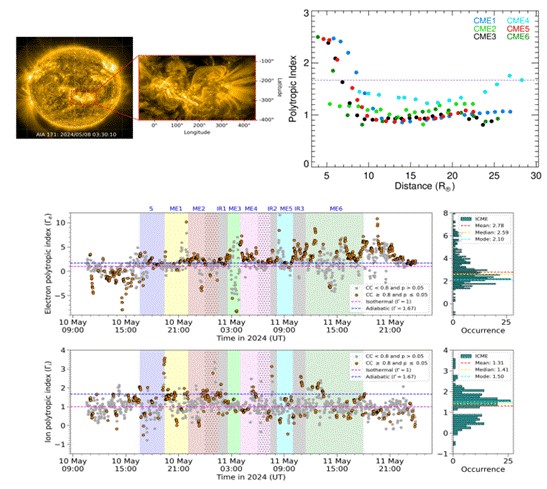
The May 10, 2024, geomagnetic storm was linked to an unprecedented sequence of six distinct CMEs erupting in succession from an interacting, complex active region on the Sun.
Unraveling the Journey from Sun to Earth
Advertisement
Understanding the thermodynamic evolution of CMEs as they travel from the Sun to Earth has historically been challenging due to limited observational data. To address this, Dr. Mishra’s team utilized observations from NASA and ESA space missions and developed a model to investigate how this rare chain of solar blasts interacted and evolved en route to Earth. The initial observations of the storm were reported from IIA’s Indian Astronomical Observatory in Hanle, Ladakh.
“Using wide-field coronagraphic data and an analytical framework known as the Flux Rope Internal State (FRIS) model, we tracked the thermodynamic evolution of six CMEs and their mutual interactions in interplanetary space,” said Soumyaranjan Khuntia, the lead author and a doctoral scholar at IIA, an autonomous institute under the Department of Science and Technology (DST).
The study revealed a surprising thermal behavior: while CMEs initially release heat, they later transition into a state where they absorb and retain it, often reaching a near-constant temperature as they expand further from the Sun.
Dual Magnetic Structures and Thermal Shifts
Upon reaching Earth, data from the Wind spacecraft showed that the final storm cloud contained two intertwined magnetic structures, or “double flux ropes,” characterized by compressed fields and unusual patterns of heating and cooling between electrons and ions.
“Our analysis demonstrates that CME-CME interactions lead to significant thermal restructuring within,” Khuntia added. “By the time they reach the Earth, the electrons in the complex ejecta were found to be in the heat-releasing state, while ions displayed a mix of heating and cooling behavior, with the heating state being the dominant mode overall.”
Mishra highlighted the pioneering nature of the research, stating, “This study is the first of its kind, both in India and internationally, to capture the continuous thermodynamic evolution of multiple interacting CMEs across such a vast distance in the heliosphere.”
Implications for Space Weather Forecasting
These findings, published in the Astronomy and Astrophysics Journal, mark a significant advancement for improving space weather forecasting models.
“This work marks an important step toward understanding the thermal signatures associated with the ability of CMEs and their evolving substructures to disturb Earth’s space environment,” said Anjali Agarwal, a co-author and doctoral scholar at IIA. “Our aim is to explore whether thermal properties can be used as precursors to forecast intense geomagnetic disturbances.”
Mishra’s team plans to incorporate observations from India’s Aditya-L1 space mission, including the Visible Emission Line Coronagraph (VELC) and the Aditya Solar Wind Particle Experiment (ASPEX), to conduct a comprehensive Sun-to-Earth study of such CME events.