Join WhatsApp Channel


India is seeking to transform its largely fragmented sports equipment industry into a global export powerhouse, with a new report from NITI Aayog laying out an ambitious pathway to expand shipments nearly 30-fold to about $8.1 billion by 2036 while generating millions of jobs.
The report, released by NITI Aayog Vice Chairman Suman Bery alongside senior policymakers including Arvind Virmani and Nidhi Chhibber, frames sports equipment manufacturing as a “high-potential but underleveraged” sector—one that sits at the intersection of export-led growth, labor-intensive industry, and India’s rising global sporting ambitions.
At a time when the government is doubling down on manufacturing under the Make in India push and aligning it with its long-term “Viksit Bharat 2047” vision, the report argues that sports goods could become a strategic export engine—if long-standing structural constraints are addressed.
A $700 billion global market—and India’s marginal share
Globally, the sports goods market—spanning apparel, footwear, equipment and accessories—was valued at roughly $700 billion in 2024 and is projected to exceed $1 trillion by 2036, according to the report. Within this, sports equipment alone accounts for about $140 billion, expected to nearly double to around $280 billion over the next decade.
Despite this scale, India’s presence remains limited. The country exported just about $275 million worth of sports equipment in 2024, accounting for roughly 0.5% of global exports.
This modest footprint persists even as global demand is being driven by expanding professional leagues, rising recreational sports participation, and a growing fitness economy—trends that policymakers believe India is well positioned to tap into.
Legacy clusters, untapped potential
India’s sports equipment manufacturing ecosystem is rooted in legacy clusters such as Jalandhar in Punjab and Meerut in Uttar Pradesh—regions that together house thousands of small-scale units, exporters and household enterprises.
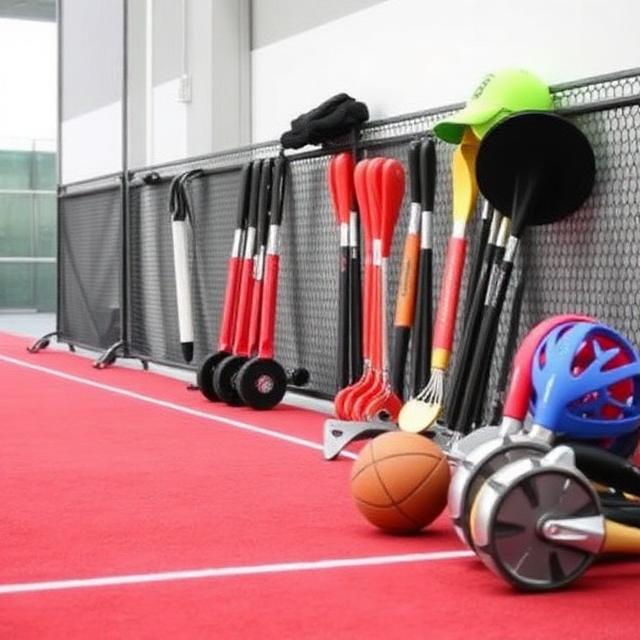
These clusters, built on artisanal skills and decades of manufacturing experience, dominate production in segments like cricket gear, inflatable balls, and boxing equipment. Nearly 90% of the sector is driven by micro, small and medium enterprises (MSMEs), making it a key source of employment and local economic activity.
Yet, the report notes that this very structure—fragmented, small-scale, and slow to modernize—has limited India’s ability to scale up, adopt advanced technologies, and integrate into global supply chains.
A widening gap with global competitors
While India has stagnated, countries such as Vietnam have surged ahead by building integrated manufacturing ecosystems and forging deep ties with global brands. China continues to dominate, controlling nearly half of global exports in several categories.
Indian manufacturers face a cost disadvantage of roughly 15–20% compared to competitors like China and Pakistan, driven by high raw material costs, logistics inefficiencies, and limited access to advanced machinery and technology.
Critical inputs such as carbon fibre, EVA foam and polyurethane—essential for modern sports equipment—are either imported at high duties or not produced domestically at scale. Certification costs for global standards, often requiring testing in overseas labs, further erode competitiveness.
The result is a sector that has capability but lacks scale, visibility and cost efficiency.
A decade of sporting events as catalyst
The report identifies a unique window of opportunity over the next decade, driven by a packed global sporting calendar—including the Los Angeles Olympics in 2028, Brisbane in 2032, and India’s own bid to host the 2036 Olympic Games.
Such mega-events generate sustained demand for sporting goods, infrastructure and training ecosystems, offering Indian manufacturers a chance to plug into global procurement networks.
Past Olympic hosts have leveraged these opportunities to boost domestic industries, with local firms capturing the bulk of contracts. India, the report suggests, could replicate this model—provided it builds capacity in advance.
The $8.1 billion export ambition
At the core of the report is a bold projection: India’s sports equipment exports could grow from $275 million to $8.1 billion by 2036, raising its global market share to about 11%.
This expansion could generate roughly 5.4 million (54 lakh) additional jobs, largely within MSME-led clusters, making the sector a significant contributor to employment.
The opportunity extends beyond equipment. A broader push across apparel, footwear and accessories could lift India’s total sports goods exports to around $24 billion over the same period.
Policy blueprint: clusters, costs and “Brand India”
To achieve this transformation, the report proposes a multi-layered strategy combining structural reforms, fiscal support and ecosystem development.
Key recommendations include:
- Lowering input costs: Rationalizing duties on raw materials and easing import barriers for machinery
- Cluster-led expansion: Developing four new manufacturing hubs in port-proximate states such as Gujarat, Tamil Nadu and Andhra Pradesh, while upgrading existing clusters
- Technology and testing: Establishing globally accredited testing labs within India to cut certification costs and timelines
- MSME support: Providing capital subsidies and facilitating technology adoption
- Supply chain localization: Encouraging domestic production of advanced materials like carbon fibre
- Global branding: Creating a unified “Brand India” framework to improve visibility and credibility
The roadmap envisages a total investment of about ₹7,500 crore ($900 million approximately) between 2027 and 2031 to build competitiveness and scale.
Beyond manufacturing: a strategic economic lever
More than just an industrial policy exercise, the report positions sports equipment manufacturing as a broader economic lever—capable of driving exports, generating employment, and strengthening adjacent industries such as textiles, footwear and plastics.
It also reflects a shift in how India views sport—not only as a cultural or competitive pursuit, but as an economic sector with global linkages.
“Sports equipment is one of the few manufacturing segments where performance, safety and brand perception are as critical as cost,” the report notes, underscoring the need for quality, innovation and long-term brand-building.
The road ahead
The challenge now lies in execution. Industry stakeholders say that without coordinated action across central and state governments, manufacturers, global brands and sports federations, the sector risks remaining stuck in a low-value, contract-manufacturing cycle.
But with global supply chains shifting, demand rising, and policy momentum building, the report suggests India may be at an inflection point.
If the proposed reforms take hold, the cricket bats, footballs and training gear used across the world could increasingly carry a new label—Made in India.