Join WhatsApp Channel


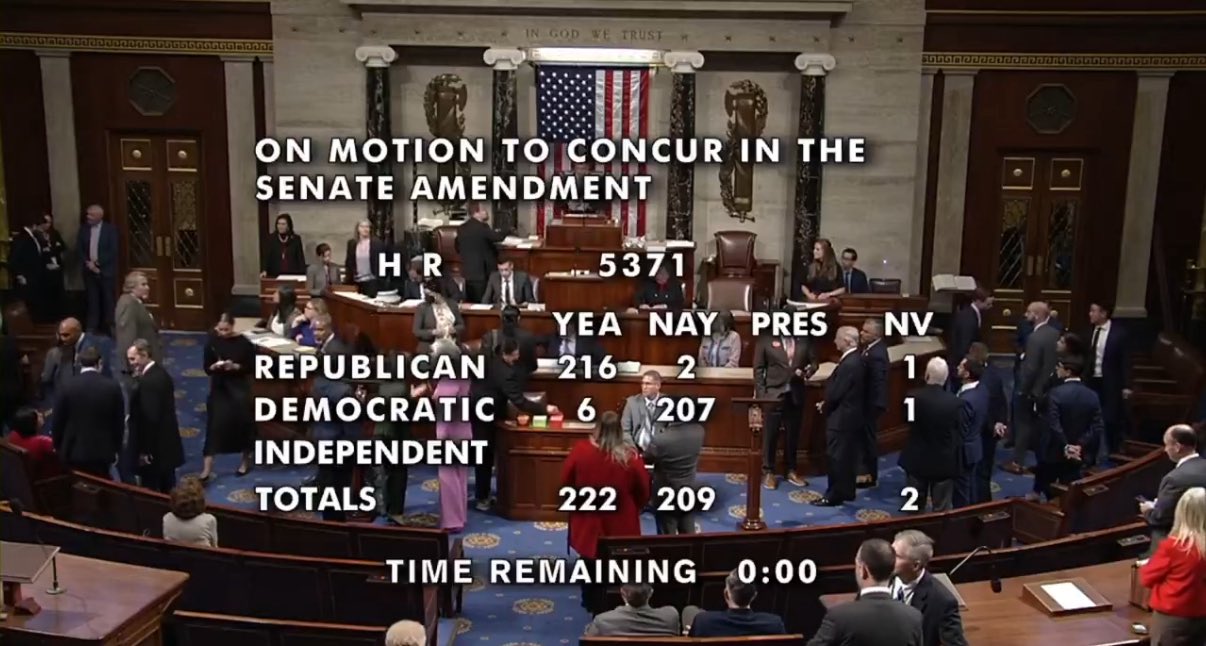
The longest ever 42-day US government shutdown ended today with congress approving a bipartisan package to reopen the government when a deal was struck after several weeks of stalemate: the Senate Republicans, a handful of centrist Democrats and the House GOP Leadership negotiated a funding package.
The key steps:
- The Senate approved the deal on Monday (November 10) after days of negotiations.
- The House then passed the measure on Wednesday night (November 12) by a 222–209 vote, with six Democrats joining nearly all Republicans.
- President Donald Trump signed the bill later that evening, officially ending the shutdown.
- The deal funds the government through January 30, 2026, while providing full‐year funding for some agencies (e.g., Agriculture, military construction, legislative branch) and reversing mass layoffs that had been triggered during the shutdown.
In short: the shutdown ended after 43 days — the longest in U.S. history.
Fall
The federal government entered a full funding lapse at midnight EDT on October 1, 2025, because Congress failed to pass the necessary appropriations bills or a continuing resolution to fund government operations for fiscal year 2026 (which began October 1).
Key factors leading to the impasse included:
- Republicans controlled the House and pushed their spending proposals; Senate Democrats opposed the bills because they lacked an extension of enhanced health-insurance tax credits under the ACA.
- The ACA subsidies had been expanded in prior years and were set to expire at the end of 2025; Democrats insisted on extending them as part of a funding deal, while Republicans argued that reopening the government must come first.
- Because of filibuster rules in the Senate, even with a Republican majority the GOP needed some Democratic votes to break the deadlock. That made the negotiation more complex.
- As the lapse dragged on, the consequences began to stack up — federal employees furloughed or working without pay, contractors paused, agencies unable to carry out normal operations.
By early November the shutdown had entered record territory: on November 4 it surpassed the previous longest shutdown in U.S. history (35 days) and became the longest ever.
Thus, we had a classic appropriations stalemate magnified by the policy overlay of the ACA subsidy fight. The government funding simply lagged out, affecting many services.
How it Ended – Out and Sectoral Impact
The shutdown’s length and breadth caused substantial disruption across government operations, the economy and particular sectors. Some of the main effects:
Federal workforce & contractors
- Hundreds of thousands of federal employees were either furloughed (i.e., sent home without pay) or required to work without immediate pay. For example, estimates put the number of impacted workers at around 900,000 furloughed plus millions more working without pay.
- Federal contractors suffered too — unlike direct federal employees they are not always guaranteed back pay under shutdown law, meaning permanent losses for many firms and workers.
Travel, tourism, and aviation
- Because agencies such as the Transportation Security Administration (TSA) and the Federal Aviation Administration (FAA) faced staffing strains, flight cancellations and delays mounted — the travel industry lost billions in revenue.
- National parks, museums and other federally managed heritage/visitor facilities were either closed or operating in a degraded state, curtailing tourism.
Regulatory, health & approvals
- Agencies responsible for drug approvals, safety inspections, environmental permits and other regulatory functions had slowed or paused operations. For example, the Food and Drug Administration (FDA) was unable to carry out the full set of functions, delaying new therapies and devices.
- Small businesses and individuals awaiting federal loan guarantees, permits or inspections were impacted — e.g., mortgage lenders faced delays of approvals, which stalled home purchases.
Economic & data effects
- The shutdown cost the U.S. economy billions of dollars. Estimates varied but the nonpartisan Congressional Budget Office (CBO) and other sources projected that Q4 2025 growth could be reduced by up to 1.5 percentage points, with perhaps around US$11 billion or more in permanent economic output loss.
- Consumer sentiment dropped, federal data releases were delayed (creating uncertainty for markets and policy-makers), and many purchases or travel plans were deferred and not recouped.
Social programs, food aid
- The shutdown threatened major social-safety-net programs. For example, the Supplemental Nutrition Assistance Program (SNAP) risked interruption, which would have affected tens of millions of Americans. The deal that ended the shutdown specifically protected SNAP and also provided an 8% funding increase for the Women, Infants, Children (WIC) program.
In short: the shutdown had wide-ranging effects on federal workers, contractors, travel/tourism, regulatory approvals, consumer behavior and key assistance programs. While many costs will be recouped (for instance back pay for furloughed employees), some damage is irreversible (for example cancelled flights or lost orders).
What happens next: the ACA subsidies and healthcare fight
One of the central causes of the impasse was the dispute over the expiring ACA tax credits (the “premium subsidies”) that help millions of Americans afford insurance plans purchased through the exchanges. Here’s where things stood:
- Democrats conditioned reopening the government on extending those subsidies. Republicans insisted on reopening first and negotiating healthcare later.
- The deal to end the shutdown does not include an extension of those subsidies. Rather, it promises a vote in early December in the Senate on the subsidies — but no guarantee that such a vote will pass.
- The concern among Democrats is that if the subsidies expire at the end of 2025, insurance premiums for many Americans purchasing plans under the ACA could rise sharply — reports suggested premiums could go up by an average of ~26 %.
- The unfolding health-care battle thus becomes the next major showdown: Republicans signal they’ll revamp the law rather than simply extend the subsidies; Democrats say abandoning the subsidies harms tens of millions of people. As one House Democrat put it: “This fight is not over. We’re just getting started.”
So although the shutdown ended, the healthcare subsidies remain unresolved — the clock is still ticking toward end-of-year deadlines.
Why this shutdown was different / why it dragged on
Several features made the 2025 shutdown particularly difficult to resolve:
- It was purely policy-driven rather than a purely procedural appropriations dispute: the premium subsidies added a strong policy component, raising the stakes for millions of Americans.
- The Senate’s filibuster rules meant that the GOP could not simply push through a funding bill without Democratic support — so they were forced into a compromise.
- The House leadership under Speaker Mike Johnson kept the chamber in recess (not in session) for much of the shutdown, as a tactic to raise pressure. This delayed legislative movement.
- The longer a shutdown goes on the harder it becomes politically: public frustration mounts, economic effects accumulate, and agencies begin to malfunction, all contributing to increasing pressure. In this case, by early November the shutdown was already breaking the previous record and the cost kept mounting.
- The mix of major policy fight (healthcare), funding stalemate, and the timing (October/November leading into holiday travel season) created urgency.
What the deal provides / key provisions
According to multiple sources, the funding bill that ended the shutdown includes:
- Government funding at current levels through January 30, 2026, giving Congress more time to craft full-year appropriations.
- Full-year funding (through September 2026) for some agencies: the Department of Agriculture, the Food and Drug Administration, military construction, the Department of Veterans Affairs, and the legislative branch.
- Reversal of mass layoffs that the Trump administration had attempted to implement during the shutdown and forbidding such broad dismissals of federal workers through January.
- Protection of the SNAP food-assistance programme through the rest of the fiscal year, alleviating immediate hunger-aid concerns.
- Back pay for federal workers and reversal of some of the unilateral actions taken during the shutdown.
- A controversial clause giving senators the ability to sue the Department of Justice if their phone records were obtained without their knowledge — a measure that drew conservative complaints.
Thus, the deal is a temporary fix (through late January) rather than a comprehensive resolution of all spending and policy fights — the healthcare subsidies, full appropriation bills for many agencies and other policy fights remain.
Political and public consequences
- Politically, the stalemate reinforced perceptions of dysfunction in Washington. Public polls showed declining confidence in the government, and both parties faced criticism. Republican leadership bore much of the blame because they controlled the House and led the funding push.
- For workers and contractors, while back pay is forthcoming for many federal employees, contractors may not be fully compensated for lost work — some of those losses may be irreversible.
- For the economy, while some of the lost economic activity can be recovered, some cannot: e.g., cancelled travel or events, delayed contracts, lost momentum in some industries. The shadow of the disruption may linger beyond the shutdown’s end.
- For agency morale and operations, longer term delays (in approvals, regulatory backlogs, permit delays) may ripple into 2026.
- The healthcare fight looming over the subsidies may become a major political issue in 2026 mid-terms and beyond, as millions of Americans face rising premiums if no deal is reached.
- What remains and what to watch
With government funding restored for now, several things remain on the radar:
- Will Congress and the White House strike a longer-term deal extending the ACA subsidies before the end of the year? That remains uncertain and is now a political flashpoint.
- Will the full appropriations bills for fiscal 2026 (covering all agencies) be passed before the January 30 deadline? If not, another stop-gap or shutdown risk remains.
- Will the policy stand-offs (e.g., healthcare, regulatory priorities, federal workforce reform) that underpinned this shutdown be resolved or merely kicked down the road?
- What will be the long-term effects on sectors that were disrupted — travel, aviation, regulatory markets, federal contracting?
- How will public opinion shift and how will it affect upcoming elections and the broader partisan dynamics in Congress?
In summary
The October–November 2025 federal shutdown entered the annals as the longest in U.S. history, lasting 43 days. It began because Congress failed to fund the government for FY 2026 and because of a contentious fight over expiring ACA subsidies. The shutdown affected hundreds of thousands of federal employees and contractors, disrupted travel, regulatory approvals and social-aid programs, and inflicted billions of dollars of economic damage.
The impasse ended when a bipartisan deal was reached, the House passed it, and President Trump signed it. The deal restored funding through January 30, 2026, reversed layoffs, safeguarded food-aid, and provided some full-year funding for key agencies — but left the healthcare-subsidy issue unsettled and set the stage for fresh fights in the months ahead.
Disclaimer: The opinions and views expressed in this article/column are those of the author(s) and do not necessarily reflect the views or positions of South Asian Herald.
Related posts:
 Democrats End 43-Day Shutdown Battle as Political Blame Game Shifts to the House
 Opinion: The Biggest Challenge for Democrats
 White House Blames Democrats as Federal Shutdown Enters Sixth Day, Warns of Delayed Paychecks for Workers and Troops
 Rep. Suhas Subramanyam Commends Banks and Credit Unions for Supporting Federal Workers Amid Shutdown