Join WhatsApp Channel


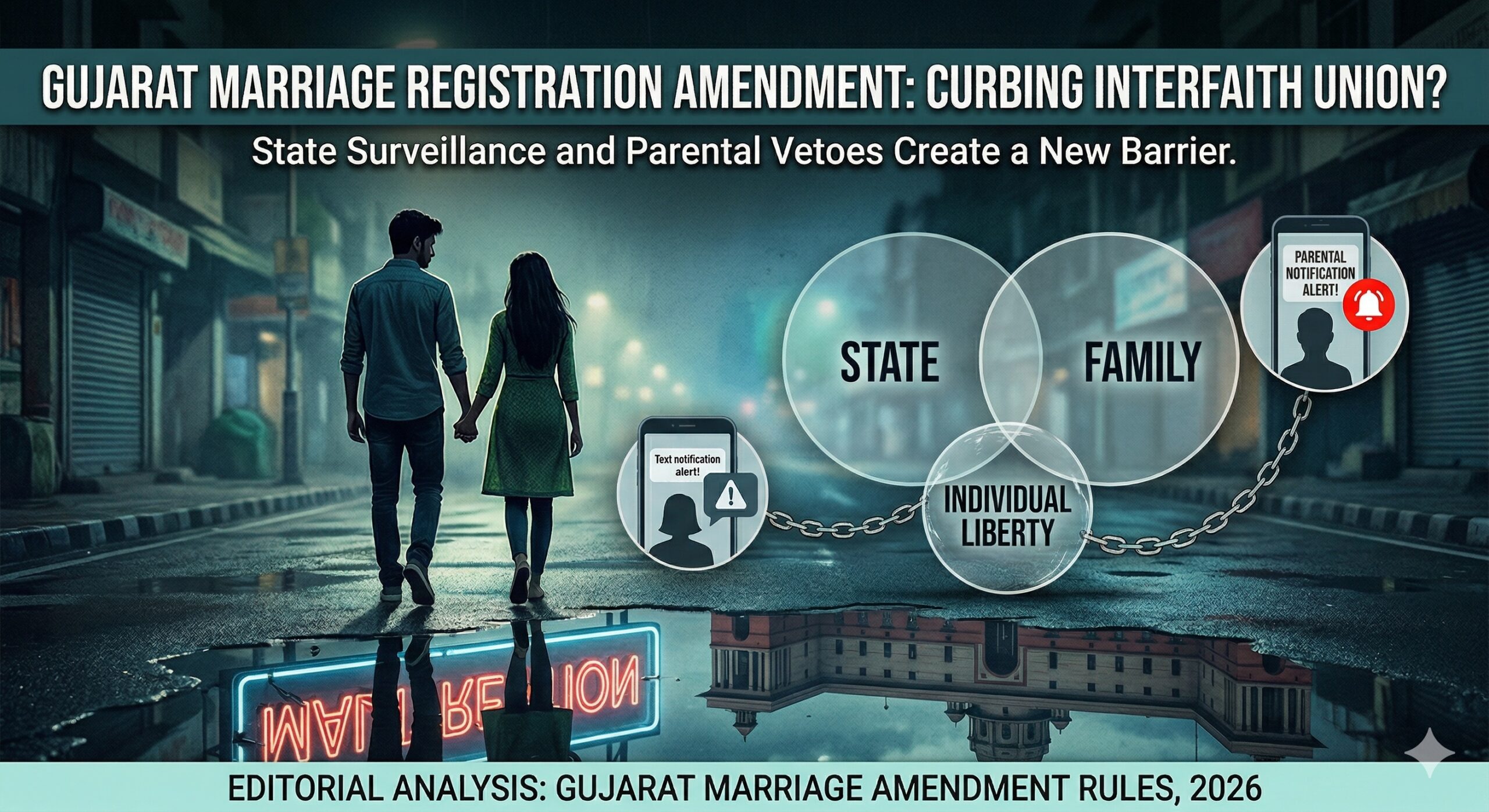
In a complex democracy like India, the right to marry is a core expression of personal liberty. Yet, the Gujarat government’s enacted amendments to the Registration of Marriages Rules, 2026, have turned this right into a publicly exposed process. Maharashtra has followed suit, passing the Freedom of Religion Act, 2026, which mandates a 60-day prior notice and registration, codifying a trend of state-sponsored surveillance across several states.
Though political leaders across parties in Gujarat have welcomed it, the amendment shifts the enforcement of social orthodoxy to the bureaucracy, at the cost of constitutional morality.
State Disclosure Risks
The amendment ignores social realities. By mandating Rule 44, which requires the Registrar to notify parents via digital intimation (SMS and WhatsApp) and registered post within 10 working days, the state effectively tips off those most likely to obstruct an interfaith marriage. This automated ‘alert system’ bypasses the protections established in Shakti Vahini v. Union of India in which it issued directives to protect inter-caste and inter-faith couples from extralegal diktats, such as those issued by Khap Panchayats.
When the State compels disclosure, it removes the anonymity that often protects couples from retaliation. The 2026 Rules formalize a 30-day ‘objection window’ where the couple’s personal details are uploaded to a public portal. This creates a period of extreme vulnerability. While personal laws and the Special Marriage Act prioritize adult consent, Gujarat’s new framework effectively grants a ‘parental veto’ by making notification a prerequisite for the issuance of a marriage certificate.
Gujarat’s move follows a troubled path already trodden by the states of Uttar Pradesh and Madhya Pradesh. They passed ‘anti-conversion’ laws said to curb forced conversions linked to marriage, but in practice, these have often enabled harassment. The Supreme Court in Rajendra Bihari Lal v. State of UP highlighted the dangers of these laws, noting that they allow even strangers to file a complaint against the concerned individual for alleged conversion. Maharashtra’s 2026 Act goes further, allowing police to file suo motu FIRs even without a family complaint, significantly lowering the threshold for state intervention in private faith and marital choices.
The legislative shift toward mandatory disclosure strikes at the heart of the constitutional vision championed by Dr. B.R. Ambedkar. As the principal architect of our Constitution, Ambedkar viewed state-enforced endogamy as the bedrock of the caste system and a primary obstacle to social integration. In his rigorous defense of the Hindu Code Bill, he insisted that marriage must remain a secular contract between two equals, free from the shackles of community sanction or a parental veto. By subjecting intimate bonds to the scrutiny of the District Magistrate and the police, modern anti-conversion laws effectively resurrect the very gatekeeping Ambedkar sought to dismantle. To allow the State and the family to override the choice of a competent adult is not merely a legal overreach; it is a direct betrayal of Ambedkar’s vision of individual autonomy over religious and caste dictates.
The Court also criticized the “onerous” or “exhausting” procedures that require a person to declare their private beliefs to the District Magistrate for a police inquiry. In Uttar Pradesh, despite over 800 cases and nearly 1,700 arrests, almost none have resulted in actual convictions for fraud. The conviction rate reveals the true nature and efficacy of the law, and it means the law was framed to demoralize couples from marrying outside their religion rather than controlling forced conversion.
The Interplay of Liberty and Conscience
The constitutional infirmity of this move lies at the intersection of Articles 21 and 25. Article 21 guarantees the right to life and personal liberty, as affirmed in Lata Singh v. State of Uttar Pradesh & Anr, including the absolute right to marry without parental consent.
Mandatory parental intimation also burdens adults’ freedom of conscience under Article 25, by treating faith and marital choice as matters for family oversight rather than personal belief.
When the State demands parental Aadhaar details, it is resurrecting the “notice and clearance” regime that the judiciary has been steadily dismantling in the Special Marriage Act 1954.
The legality of such a move remains shaky. In the landmark Hadiya case (Shafin Jahan v. Asokan K.M.), the Supreme Court unequivocally held that the right to choose a spouse is central to the right to life and liberty under Article 21. The Court reminded us that the State cannot substitute its judgment for that of competent adults. The Gujarat government’s justification, protecting the “dignity of girls”, is a paternalistic trope that fails the test of proportionality. If the aim is to prevent fraud, identity verification and targeted inquiry in specific cases are sufficient. Mandating parental notification serves no purpose other than to appease the forces of endogamy and communal segregation.
India’s criminal code already prosecutes impersonation and coercion. Gujarat’s overbroad surveillance burdens all marriages despite unproven ‘love jihad’ claims. The larger question is whether intimate bonds should require state-family clearance, risking constitutional morality itself.
Disclaimer: The opinions and views expressed in this article/column are those of the author(s) and do not necessarily reflect the views or positions of South Asian Herald.