Join WhatsApp Channel


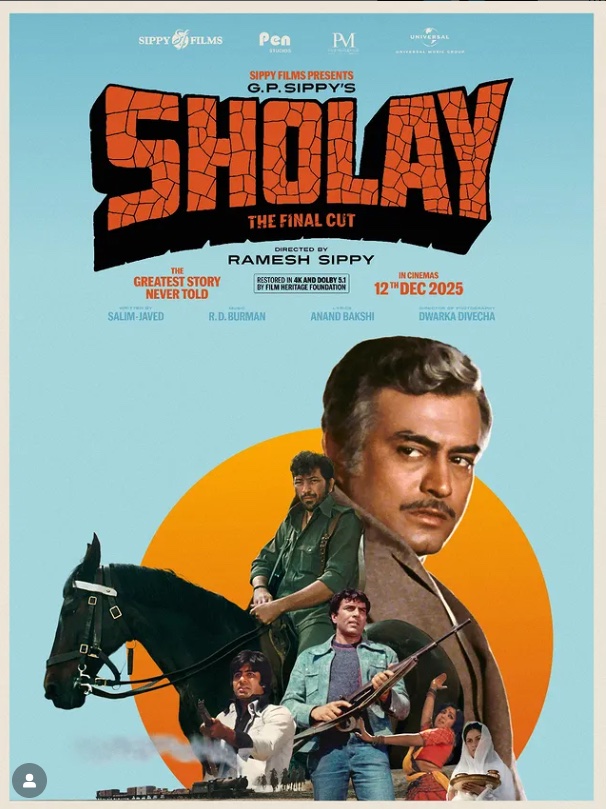
A perennial remains a perennial.
Not for nothing is Sholay the biggest-ever hit in Indian cinema. This was a film that ran for 250 weeks continuously in Mumbai, beginning August 15, 1975. The current booking windows opened well past the ‘Daily 3 shows’ run of 75 weeks, and it was shifted to ‘Matinee shows’ (beginning around 11 a.m. in those simple days of single-screens) only after 150 weeks.
What’s more, it was said in the early millennium that the film had set yet another record: for 25 years or more, the film was running continuously at some theatre or the other in the country without a break! It had countless runs on television and even saw a 3-D version released some years ago.
On its Golden Jubilee on August 15, 2025, reams of print and airspace were full of this Ramesh Sippy classic, produced by his father G.P. Sippy and written by Salim-Javed.
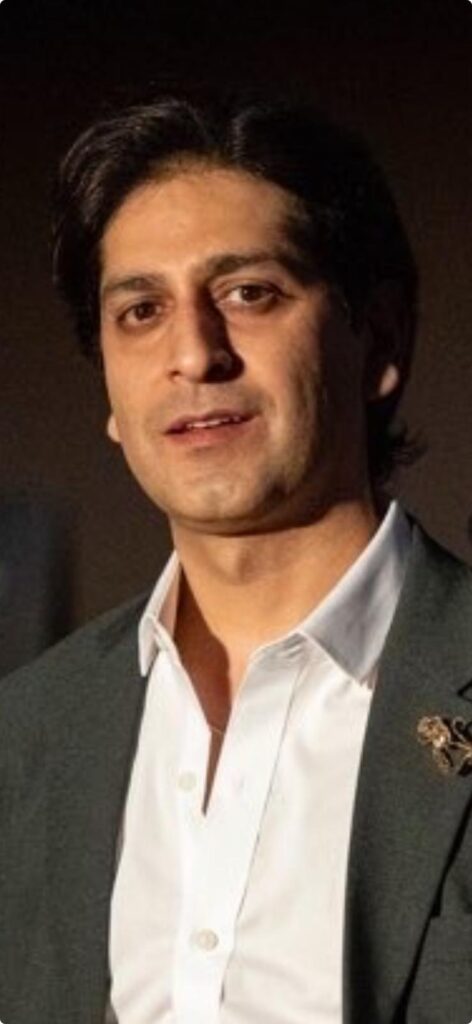
However, it was the mission of Shehzad Sippy, the son of the late Suresh Sippy, Ramesh Sippy’s brother, to revive the magic not just for fans but also for themselves. And the best part was that the original version, with all the sequences that had been cut by the censors back then, now included.
In an exclusive interview with South Asian Herald, Sippy Films’ Managing Director, Sippy, speaks candidly on his family’s classic.
What made you release Sholay again as Sholay—The Final Cut?
When I took charge of Sippy Films about two years ago, I thought of re-launching Sholay. My father had passed away, but had told me that the original copy of the film was lying with Technicolor Lab in London as the original had been processed in 70 mm. About 500 cans of Sholay were there with them, and we sent them to the British Film Institute to be examined.
Then Shivendra Singh Dungarpur, the Founder-Director of Film Heritage Foundation came on board and helped us get the material back and sourced whatever material was available in Mumbai. We then sent the film to L’Immagine Ritrovata, said to be the finest film restoration laboratory in the world, in Bologne, Italy. The material was 50 years old, and we wanted to preserve the classic original version, which had all the scenes cut by the censors back then.
Like the much-publicized original version of Thakur killing Gabbar Singh and also a couple of other sequences that have now been included. Did you have to re-censor the film now?
Of course! The political climate then was different, and Emergency had been declared in India. So the concept of private citizens taking revenge, especially an ex-police officer, was not acceptable to them. After 50 years, the censors have become more understanding and liberal. Ragendra Singh, the CEO of the Censor Board of Film Certification, was very, very helpful. We got a U/A certificate. We were thus able to give the best to Sholay fans!
When I watched the film, initially the audio, especially of the iconic title-music, sounded a bit flat considering the original Stereophonic Sound.
Yes, the audio was a challenge as the print quality we had was not good. But we were lucky enough to find the original magnetic tapes preserved with crystal- clear sound in 4-track in our office. We then mixed the sound in Dolby 5.1. Since the original was in 4-track Stereo, they told me that it could not be done in Dolby 7.1 or Dolby Atmos. That is why you felt the sound was not so impactful. But we had decided not to touch anything in R.D. Burman’s music.
Why did you not include the qawwali that had been recorded in the voices of Kishore Kumar, Manna Dey, Bhupinder Singh and lyricist Anand Bakshi?
The song had never been shot because of length issues, I think.
The standout performance I noticed in the film was of Dharmendra, though Sanjeev Kumar and Amjad Khan had the meatiest roles and even Amitabh Bachchan’s character was nuanced. He was clearly sincere, unruffled and completely natural. Did he get to watch this final cut?
Sadly, he did not. Though Bobby Deol attended the screening at the Toronto Film Festival. We have included a kind of Roll of Honor in the film’s credits for key people who are no more, and Dharam-ji’s passing was a sad and shocking thing. We decided not to hold the Grand Premiere we were planning because of this.
Your film could have fared better had Dhurandhar not had such a blazing run.
Yes, but timings cannot be predicted. But we are still faring quite well, and we are looking at a long and steady run.
The restoration makes Sholay—The Final Cut look like a 2025 film.
Thank you. It was a mission for everyone who had loved and still love the film. And that means that our hard work of 18-24 months has been worth it!