Join WhatsApp Channel


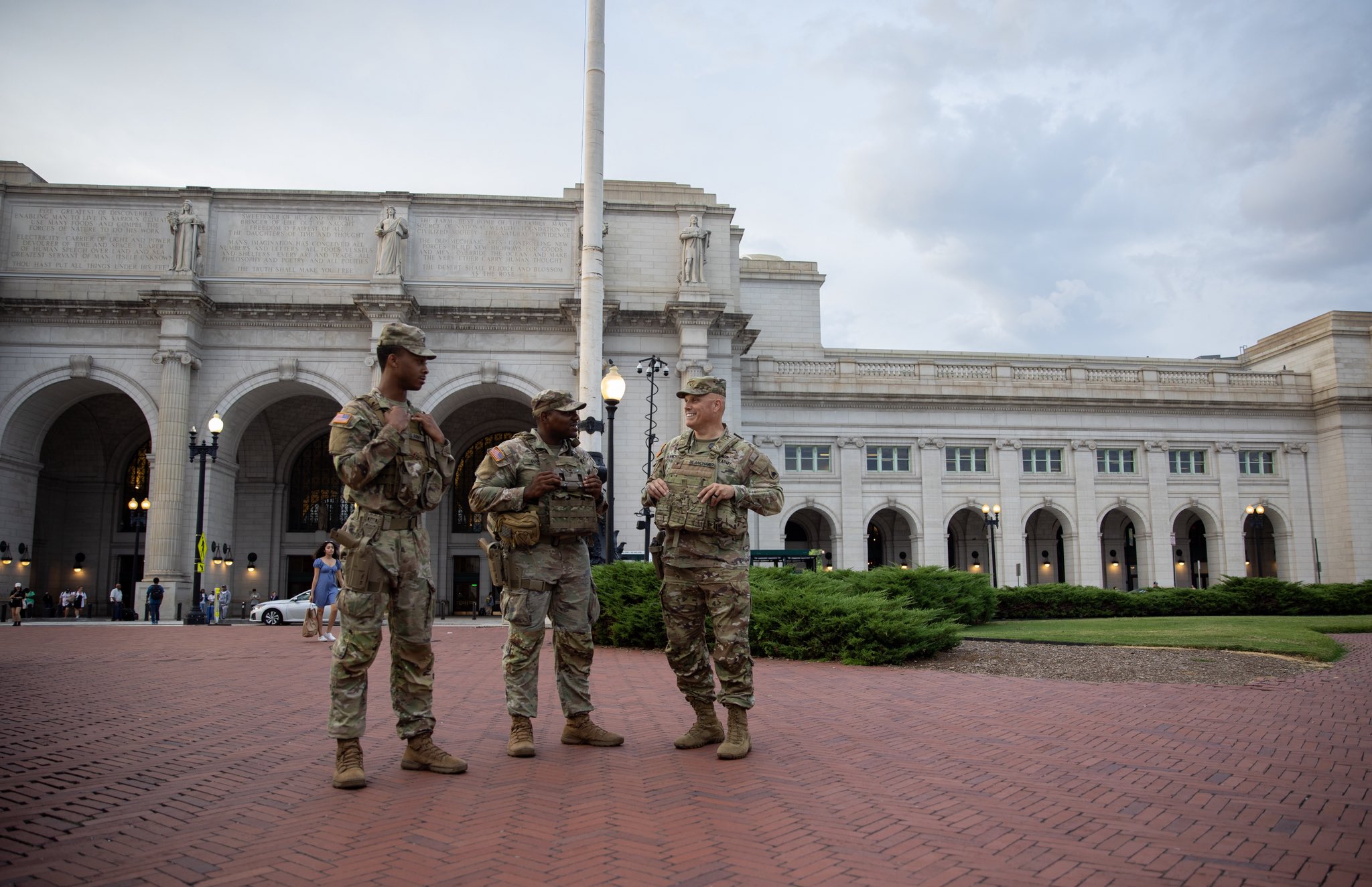
The gunfire came just after daybreak, echoing across the quiet federal enclave near the White House on the eve of Thanksgiving. Two members of the West Virginia National Guard, standing post as part of a controversial expanded security cordon ordered by President Donald J. Trump, were struck by bullets fired from what investigators are calling a “targeted ambush.” Both soldiers remain hospitalized in critical condition.
The attack—now being investigated as a possible act of terrorism—has jolted Washington and thrust the president’s aggressive, months-long nationwide deployment of National Guard troops back into the center of a constitutional and political storm. It has also reignited questions from governors, civil liberties groups and some military leaders about the expanding domestic role of a force traditionally trained for disaster response and foreign threats, not urban policing.
For Trump, the attack was further justification. Within hours, Defense Secretary Pete Hegseth announced the deployment of 500 additional Guard members to the nation’s capital, calling it “an urgent escalation in the fight to secure our cities.”
But in cities from Los Angeles to Memphis, Portland to Chicago, where thousands of Guard troops have been deployed over the past six months—often against the objections of governors—the presence of soldiers carrying assault rifles on street corners, in subway stations, and outside schools has become a flashpoint of local resentment.
A Force Out of Place
The heart of the controversy lies in the president’s insistence that the National Guard is the country’s “last line of defense” in what he calls a new wave of “urban crime and chaos” in Democratic-led cities. “We’re not going to have people killed in our cities,” Trump said in October during a visit to Asia. “Whether people like that or not, that’s what we’re doing.”
But crime statistics paint a more complicated picture, and local leaders say the deployments are as unnecessary as they are provocative.
In Washington, Mayor Muriel Bowser called the president’s intervention “unsettling and unprecedented,” pointing to city police data showing violent crime has trended downward since 2023. Yet Guard units, some armed with long guns, have been spotted patrolling federal monuments and Metro stations—frequently observed performing tasks unrelated to public safety, such as picking up trash and removing graffiti.
“People are confused,” said Elijah Greene, a commuter who passes Guard patrols daily at Union Station. “It feels like a show of force for political reasons, not a response to actual danger.”
The shooting near the White House, he added, has only deepened anxieties: “These are young soldiers who aren’t trained to walk into ambushes on American streets.”
Clashes With Governors—Especially in Blue States
The fiercest disputes have unfolded across states whose governors say the federal government is trampling long-standing norms about when the National Guard can be federalized.
In Los Angeles, Trump sent 2,000 Guard members in June following protests over federal immigration raids. California Gov. Gavin Newsom, a Democrat, argued the city’s police faced no “unmet need” and warned that the deployment would “only escalate tensions.” Local officials agreed. Weeks of protests followed, with residents saying the military uniforms blurred the line between policing and political intimidation.
In Memphis, Trump’s September announcement that he would send troops was initially welcomed by Tennessee’s Republican governor—but blocked by a state judge who ruled military involvement in local law enforcement unconstitutional.
In Portland, the confrontation became a direct constitutional test. After Trump attempted to send both Oregon and California Guard units to support immigration enforcement, U.S. District Judge Karin Immergut—herself a Trump appointee—issued a sweeping ruling declaring the president had “overstepped his authority” and blocking all deployments to the state.
“The evidence demonstrates that these deployments exceeded the President’s authority,” she wrote.
Oregon’s governor, Tina Kotek, was blunt: “Oregon does not want or need military intervention.”
In Chicago, 300 Guard members arrived as part of what Trump billed as “Operation Midway Blitz.” Illinois Gov. J.B. Pritzker denounced the move as a “manufactured performance,” and a federal court quickly imposed a temporary block. The White House has asked the Supreme Court to overturn it.
Public Resentment Grows
While the president argues that cities are “war zones,” many residents say the military posture has created the very fear it claims to address.
In Los Angeles, activists painted giant murals reading “We’re Not Your Enemy.” In Portland, cyclists staged a “World Naked Bike Ride” in protest of potential Guard deployment. In Chicago, demonstrations escalated after federal agents accompanying Guard personnel fired tear gas and pepper balls into crowds, injuries later documented in a lawsuit.
“They’re not trained for crowd control, de-escalation, or urban community policing,” said Mia Rodriguez, a Chicago pastor who was struck by a pepper ball during a protest. “They’re trained for battlefields. That’s the difference.”
Guard members themselves express uncertainty. In private conversations, several described feeling out of place, undertrained, and politically exposed. “Our mission is foreign adversaries and natural disasters,” one senior National Guard officer said, requesting anonymity to avoid reprisal.
“We’re overstretched already. Moving troops from flood response, cyber defense, and border surveillance to patrol city streets leaves gaps the public never sees—until something goes wrong.”
Strain on National Security
Military analysts warn that diverting tens of thousands of National Guard troops from national defense undermines readiness at a time of increasing global volatility.
Units specializing in cyber defense, drone surveillance, and emergency response have had their training cycles disrupted. Some border protection tasks, officials say privately, are now understaffed.
“The Guard is the backbone of America’s emergency response infrastructure,” said Michael O’Hanlon of the Brookings Institution. “When you take engineers away from levee reinforcement, when you take cyber units away from defending hospitals or airports, the country becomes more vulnerable. These deployments have real costs.”
The ambush near the White House may be one such cost. Investigators say the two Guard members were assigned to a perimeter detail usually handled by specialized federal officers. They were not wearing body armor designed for urban ambushes.
“These young soldiers were placed in a situation they weren’t trained for,” one former DHS official said. “Now they’re fighting for their lives.”
Is Crime Actually Falling?
Despite Trump’s assertion that violent crime has “exploded,” many of the targeted cities show mixed or improving trends.
Trump recently claimed Washington had not seen a murder in six months—though police records show more than 60 homicides since late May. According to newly released FBI data, Memphis did have the nation’s highest violent-crime rate among large cities in 2024—but Los Angeles, Portland, Chicago, and Washington all registered declines or stable trends over the past two years.
“The president is using a blunt instrument for a problem that requires data-driven, community-centered approaches,” said Seema Patel, a criminologist at Columbia University. She added that there is little evidence showing National Guard presence lowers crime: “In fact, we often see the opposite—fear, confusion, and strained community relations.”
A Nation Debating Its Identity
As the nation grapples with the shooting and its consequences, Americans are asking deeper questions: What is the National Guard for? Who controls its deployment? And how much military presence is acceptable in a democratic society?
The Thanksgiving-eve attack has only sharpened those concerns.
“It’s tragic and horrifying,” Mayor Bowser said Wednesday night. “But the solution is not more troops. It’s fewer soldiers being put into situations they should never be in.”
Outside the hospital where the two wounded Guard members are being treated, a handwritten sign captures a sentiment echoed across the country: “Bring Them Home. Let Them Serve Where They’re Needed.”
Disclaimer: The opinions and views expressed in this article/column are those of the author(s) and do not necessarily reflect the views or positions of South Asian Herald.
Related posts:
 Reps. Krishnamoorthi and Stevens Introduce Amendment to Curb Presidential Power Over National Guard Deployments
 Italian Village Honors Sikh Soldiers’ Sacrifice on 81st Independence Day
 White House Says Indian American Store Owner Praises Trump’s Law and Order Measures
 Canada Post to Honor Sikh Soldiers with Special Remembrance Day Stamp