Join WhatsApp Channel

North Korea’s strongman Kim Jong Un does not have to try hard to be in the news. Normally on any given day of the week, he is either threatening South Korea, Japan, and the United States or busy firing missiles into the Sea of Japan.
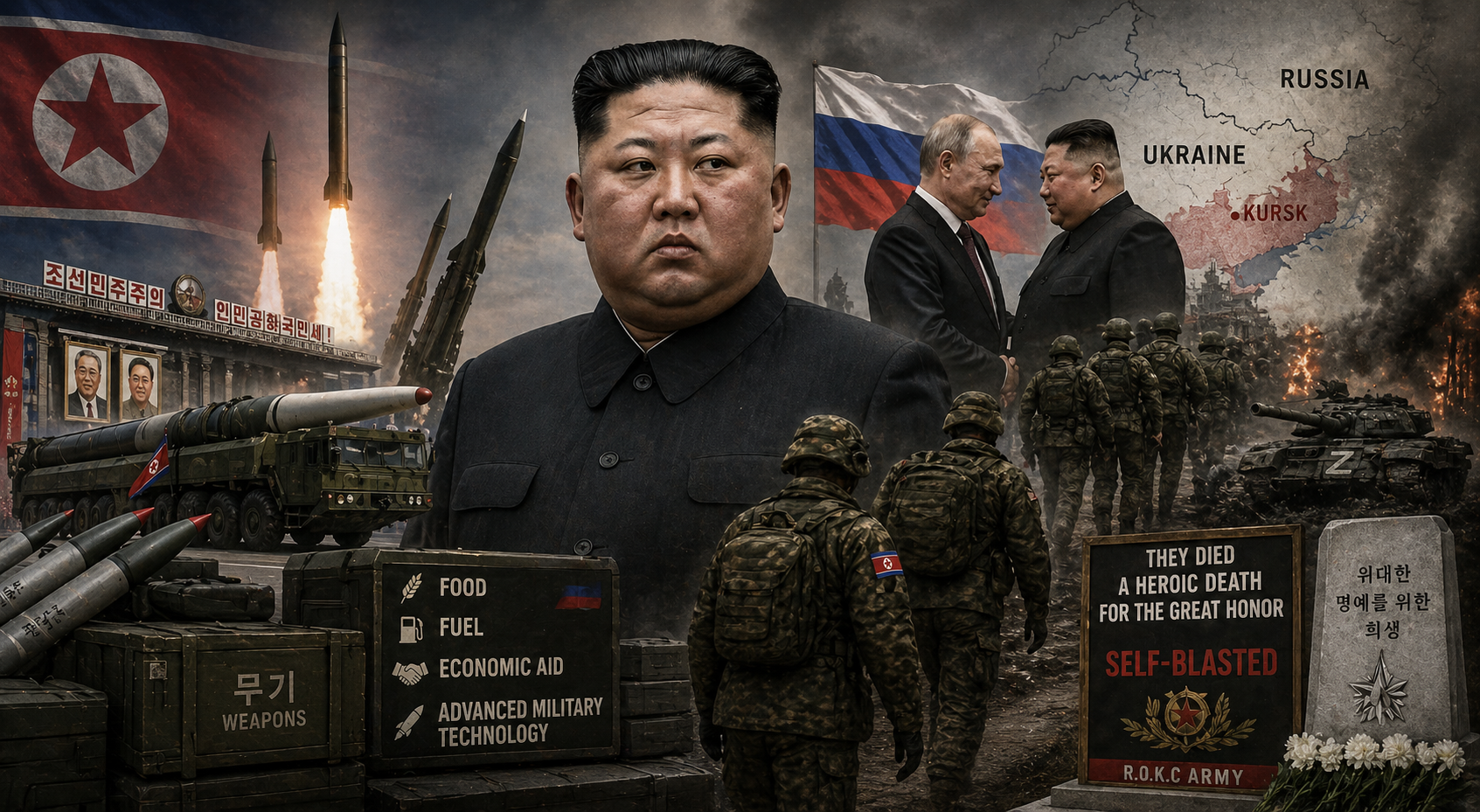
Or he is busy inspecting some missile manufacturing plant and testing ranges often with the boast how his latest technology could reach the United States or its bases overseas. But in the last year or so Chairman Kim has found other ways of keeping busy: he has injected himself into the Russia-Ukraine war by sending troops to fight in the frontlines and against Kyiv.
Even as late 2024 North Korea went on the offensive denying reports of its forces fighting for Russia going to the extent of calling the accusations “groundless stereotyped rumors” and a “smear” campaign intended to tarnish its reputation and undermine its good relations with Moscow. But intelligence from South Korea and the West continued to maintain that Pyongyang had sent as many as 15,000 troops to fight for Russia especially in the Kursk region.
The boots on the ground aside, there were also reports of North Korea sending armaments including missiles to Moscow to bolster its war efforts. And in return Moscow is supposed to have returned the favor with generous economic assistance including food and fuel as well as advanced military technology.
But by the start of the year, the Pyongyang narrative changed—from denial to honoring soldiers who had died for Russia and going to the extent of holding memorial events and building monuments. The latest in the series is that of Chairman Kim publicly confirming a policy that required his troops to blow themselves up to avoid capture.
According to the official Korean Central News Agency Chairman Kim spoke of the soldiers who had “self-blasted” in order to defend the “great” honor. “They did not expect any compensation, though they performed distinguished feats. They died a heroic death.” Chairman Kim is reported to have remarked. North Korea is said to have suffered heavy casualties in the course of its involvement in the Ukraine war.
Independent analysts and organizations take the view that “self- blasting” has little to do with anything in the North Korean army manual. Rather these are seen as “ordered suicides” to avoid getting captured and in the glorification of suicide by a leader who sees this as the “height of loyalty.”
And with this comes the fear of a soldier returning home from a Prisoner of War status to face a future of severe punishment that would include torture, forced labor and perhaps even death. Neither Pyongyang nor Moscow have confirmed if Chairman Kim had sent his forces to enable re-capture parts of western Kursk; but South Korean intelligence believes that as many as 2000 North Korean soldiers may have died in the conflict.
For a reclusive regime whose economy is said to be in the doldrums and tottering, the governing elites and those in the top echelons of the military are said to be spared of hardships and generally live in a state of opulence. But a country like North Korea which has been hit repeatedly with sanctions by the United States, United Nations and Europe primarily for its nuclear and missile programs is undoubtedly hurting but is able to get by illicit measures to evade the punitive measures and through generous assistance of its friends in the international system like China and Russia, besides exploiting loopholes.
It is not merely the news that Chairman Kim makes that raises questions of human rights abuse; it is in his actions that create concern in the region of East Asia and beyond. Instead of finding ways to mend fences that would assist Pyongyang to get out of a difficult economic situation, Chairman Kim’s rhetoric and actions have actually created a situation that is making Japan to re-think not only its Indo Pacific strategy but also its role in global affairs. Constantly talking of how Japan behaved in the Imperial Era is not going to help much in addressing the immediate challenges of the 21st century and of a changed Japan in the post- war and post-Cold War era.
For many in the region and beyond, Japan has every right to take steps to meet the challenges of its immediate neighborhood; but many others are worried that stirring a debate within that country to jettison its pacifist constitution may unsettle the already troubled waters and lead to a more aggressive posturing by China. And there are those who are ready to start the nuclear debate in Japan. But for Chairman Kim to understand the implications would be asking for too much. In fact, this is precisely perhaps what he is looking for.
Disclaimer: The opinions and views expressed in this article/column are those of the author(s) and do not necessarily reflect the views or positions of South Asian Herald.