Join WhatsApp Channel


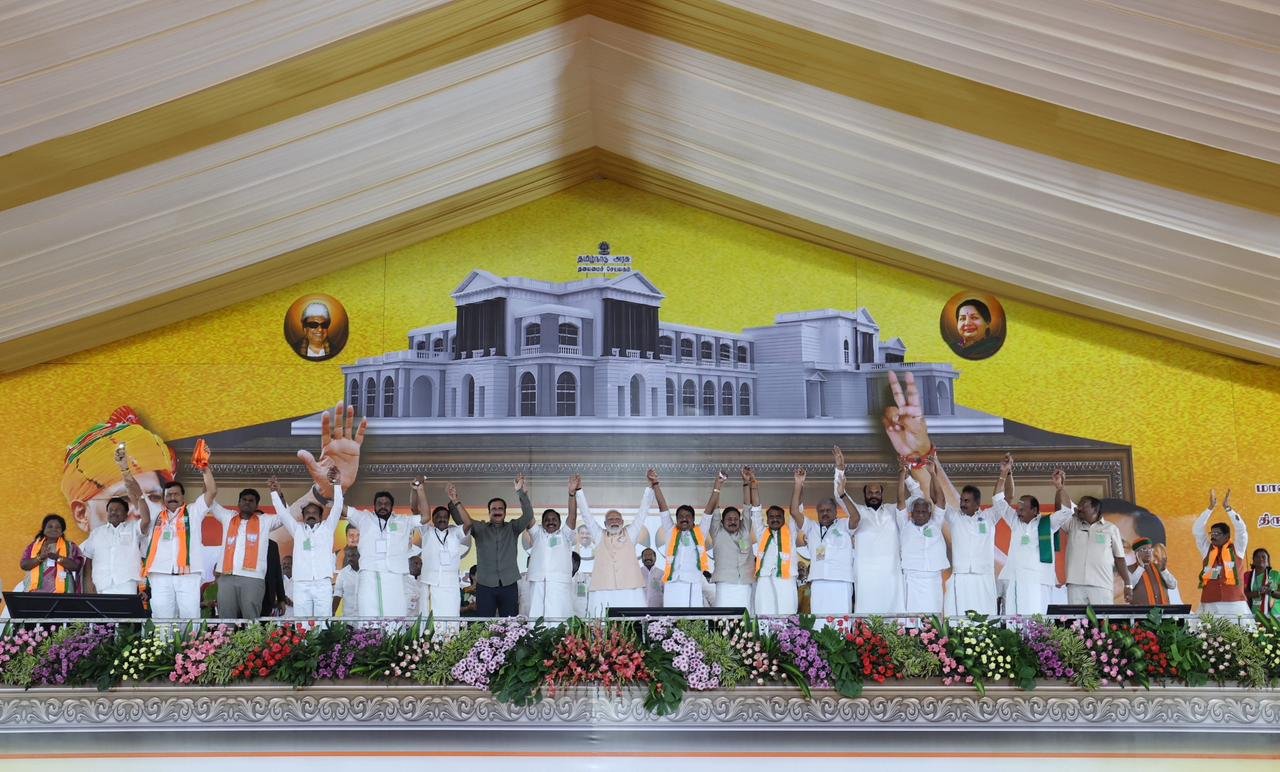
Political earthquakes in Tamil Nadu don’t arrive with thunder. They begin as whispers in tea shops, as knowing glances exchanged at bus stops, as conversations that trail off when strangers approach. The state doesn’t erupt into change—it exhales into it, releasing years of held breath in a single, decisive moment at the ballot box.
As Tamil Nadu stands weeks away from its 2026 Assembly elections, that exhalation may finally be coming. And surprisingly, the catalyst wasn’t a local leader or a grassroots movement, but a speech delivered in Madurantakam by Prime Minister Narendra Modi—a political address that didn’t just criticize a government but awakened a conscience that had gone dangerously quiet.
The Speech That Named the Unnameable
Madurantakam is not accidental geography in Tamil Nadu’s political narrative. It sits in the Chennai hinterland, close enough to power to witness its workings, far enough to feel its neglect. When Modi chose this town for what would become one of his most significant interventions in Tamil Nadu politics, he was speaking not just to a crowd, but to a state that had learned to live with disappointment.
The Prime Minister’s address did something remarkable in its directness. He didn’t dance around euphemisms or resort to abstract accusations. He spoke of what families discuss behind closed doors: the permits that require “facilitation,” the police stations where complaints gather dust unless accompanied by the right introduction, the hospital beds that mysteriously become available when the right names are dropped, the sand and granite mafias that operate with impunity under political protection.
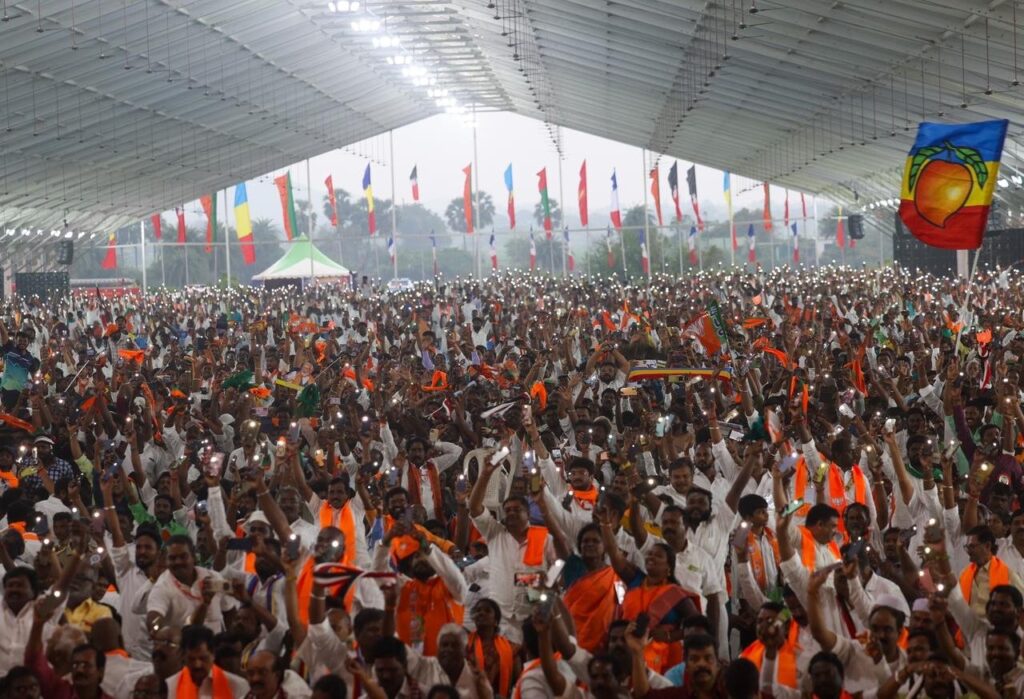
Most devastatingly, he spoke of inheritance—not of achievement, but of power. The pointed reference to a “first family” that treats governance as dynastic property resonated because it articulated what voters had been thinking but not saying: that Tamil Nadu had drifted from democracy toward a family enterprise where the state apparatus serves political lineage rather than public purpose.
From Welfare State to “Toll Nadu”
The genius of Modi’s speech lay in its recognition of a paradox that defines contemporary Tamil Nadu. This is a state where welfare schemes flow generously—free rice, subsidized goods, numerous benefits. Yet alongside this largesse runs a parallel economy of extraction, where every interaction with the state machinery requires navigation through layers of intermediaries, each collecting their unofficial toll.
Tamil Nadu voters have coined their own term for this reality: “Toll Nadu.” It’s dark humor born of experience, a sardonic acknowledgment that while basic necessities may be subsidized, basic dignity comes at a premium. Education is free, but school admissions require connections. Healthcare is subsidized, but quality treatment demands influence. Jobs are promised, but employment needs mediation.
The PM’s speech gave national voice to this local cynicism, transforming private resentment into public discourse. When he spoke of broken promises and unbridled corruption, he wasn’t revealing secrets—he was validating experiences that voters had been told to dismiss or accept as inevitable.
The Inheritance Problem
Perhaps the most potent element of Modi’s Madurantakam address was its focus on dynastic politics—a critique with particular resonance in a state that has historically valued earned leadership over inherited authority. Tamil Nadu’s political giants—MGR, Jayalalithaa, even Karunanidhi in his early years—built their power through mass connection and political skill, not family trees.
The current dispensation represents a different model: power transmitted through bloodline rather than demonstrated through political achievement. This transition from earned authority to inherited entitlement has created what many voters see as a dangerous insulation—a leadership that feels it owes its position to legacy rather than performance, to family history rather than public approval.
Modi’s speech struck at this vulnerability with precision. By repeatedly emphasizing the “first family” framework, he reminded voters that they were witnessing not democratic succession but dynastic assumption—a political model fundamentally at odds with Tamil Nadu’s self-image as a state that rewards merit and punishes arrogance.
Goons, Mafias, and the Erosion of Order
The law-and-order narrative in Modi’s speech tapped into anxieties that have been building across Tamil Nadu’s social spectrum. Parents worry about narcotics on campuses. Small business owners speak nervously about local strongmen who operate as shadow authorities. Communities watch as sand mining, granite quarrying, and liquor distribution create parallel power structures that often supersede official governance.
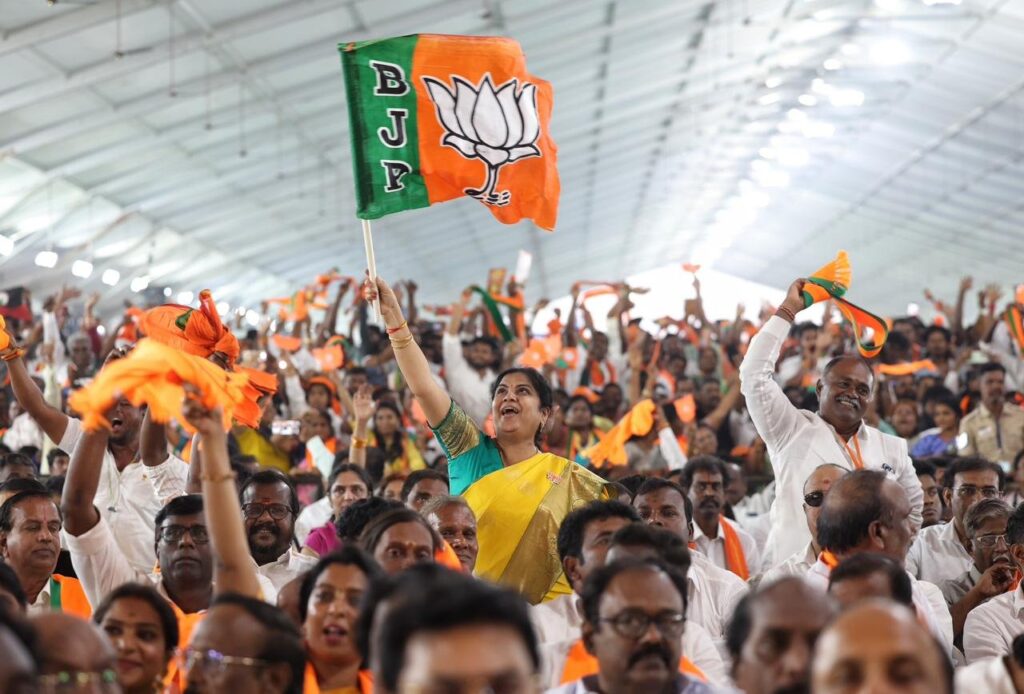
These aren’t abstract concerns or opposition propaganda—they’re lived realities that cross caste, class, and regional lines. When the PM spoke of “goons and mafias” ruling in the name of the leader, he was describing a governance failure that voters encounter daily but had learned to accept as unchangeable.
The comparison to Punjab’s Akali years and West Bengal’s syndicate politics was deliberate and damning. These are cautionary tales of states where law enforcement became selective, where protection rackets flourished under political patronage, where citizens learned to seek private security because public authority had become unreliable.
Tamil Nadu voters understood the parallel immediately. They’ve watched their state inch toward that model—not completely, not irreversibly, but enough to recognize the trajectory.
The Jayalalithaa Standard
Modi’s speech gained additional power from an implicit comparison that didn’t need to be stated explicitly: the contrast between the current administration and Jayalalithaa’s governance model. Whatever her flaws—and the corruption charges were substantial—Jayalalithaa maintained an image of command and accessibility that the current leadership has struggled to replicate.
Her welfare schemes weren’t just about distributing benefits; they carried her personal stamp and political accountability. Amma Canteens, subsidized pharmacies, fair price vegetable shops—these weren’t bureaucratic programs but visible extensions of political will. They may have been built partly on questionable finances, but they functioned with an efficiency that reflected centralized authority and personal oversight.
After her death, the model collapsed because it was built around singular command rather than institutional strength. But voters remember the contrast: welfare delivered with both generosity and effectiveness, versus welfare that arrives but feels increasingly mechanical, disconnected from political accountability.
The MGR Echo
Political observers have noted striking parallels between Modi’s Madurantakam speech and MGR’s historic Chengalpattu address in the 1970s. Then too, a political outsider—an actor turned politician who had been ostracized by the DMK leadership—stood before a massive crowd and demanded change. MGR’s speech was rambling and long, but its message was crystalline: audit the accounts, question the authority, demand accountability.
Two hundred thousand people came to listen, and Tamil Nadu politics was never the same. The AIADMK came to power and, despite its own eventual descent into corruption scandals, broke the DMK’s sense of invincibility.
Modi’s Madurantakam moment carries similar potential—not because it will automatically translate into BJP victories, but because it has punctured the ruling dispensation’s aura of inevitability. Once voters begin to seriously consider alternatives, once the conversation shifts from “whether” to “when,” political dominance begins to crack.
The Fragmented Opposition and the Coming Verdict
Unlike MGR’s era, the 2026 opposition landscape is crowded and fragmented. The AIADMK-BJP alliance brings organizational strength and national resources. Actor Vijay’s entry adds unpredictability and youth appeal, even if his organizational capacity remains untested. The Congress faces an existential question about its relevance and independence.
This fragmentation might seem like the ruling party’s advantage, but in Tamil Nadu’s first-past-the-post system, it can be devastating. Votes don’t need to consolidate behind a single alternative; they just need to scatter away from the incumbent. Margin erosion across multiple constituencies can transform dominance into defeat.
The Conscience Question
What makes Modi’s speech potentially transformative isn’t its political strategy or rhetorical brilliance—it’s its moral dimension. The PM asked Tamil Nadu voters a direct question: How long will you quietly acquiesce to what you know is wrong? How long will you accept broken promises, unbridled power, and governance by intimidation?
This wasn’t a policy debate or an ideological argument. It was a conscience check—a reminder that democratic power ultimately rests with voters, that silence enables what it fails to challenge, that resignation is a choice even when it feels like necessity.
A State Awakening
Tamil Nadu has begun to stir. The fatigue that Modi named in Madurantakam—the exhaustion of navigating corrupt systems, the weariness of accepting institutional unresponsiveness, the resignation to governance by intermediaries—has found political expression.
Elections here are rarely won on rage or revolution. They’re won when voters stop defending the indefensible, when emotional attachment gives way to pragmatic evaluation, when silence transforms from acceptance into judgment.
The 2026 verdict may not deliver a landslide or ideological realignment. But it threatens something more fundamental for entrenched power: the loss of inevitability. And in Tamil Nadu politics, once inevitability breaks, everything else follows.
Modi’s Madurantakam speech didn’t create this moment. But it named it, legitimized it, and asked voters to own it. In a state where change begins with quiet withdrawal before becoming electoral reality, that may prove to be the intervention that awakened a conscience too long dormant.
The question now is not whether Tamil Nadu is ready for change, but whether those in power understand how decisively the state has already decided.
Disclaimer: The opinions and views expressed in this article/column are those of the author(s) and do not necessarily reflect the views or positions of South Asian Herald.
Related posts:
 Bihar 2025: How the NDA Engineered a Near-Sweep — and Why the RJD-Congress Flame Flickered Out
 How the Modi-Nitish Alliance Crushed Bihar: A Lesson in Coalition, Caste, and Confidence
 US Lawmakers Honor Tamil American Heritage and Community Contributions at Capitol Hill Event
 Tamil Nadu Gears Up for FIH Junior Men’s Hockey World Cup in Chennai and Madurai; Trophy Tour and Mascot ‘Kangeyan’ Launched