 Join WhatsApp Channel



In an age of collapsing attention spans and rising tempers, of “followers” without friendship and “connection” without communion, a voice from the 19th century cuts through like a blade of light.
That voice belongs to Swami Vivekananda. And in 2026, it does not echo, it confronts.
We call ourselves a global village. Yet our streets, both digital and physical, feel more like battlefields. We scroll endlessly, but sleep restlessly. We are hyperconnected, yet starved for meaning. In this fractured moment, Swami Vivekananda’s message is not nostalgia. It is necessary. It is not a relic. It is a rescue mission.
The upcoming SETU stage play “Human Vivekananda” rises from this urgency.
“Strength is life, weakness is death.” This was not rhetoric. It was a diagnosis. In current times, weakness does not look like frailty. It looks like distraction. It looks like outrage addiction. It looks like a mind unable to hold a single thought without being hijacked by the next notification.
When Swami Vivekananda spoke of “muscles of iron and nerves of steel,” he was not building bodies. Instead, he was building beings. He was calling for mental stamina. Emotional sovereignty. The ability to stand steady when the world spins.
“Human Vivekananda” reclaims that call.
In a time when anxiety disorders are rising and identity feels like a flickering profile picture, the monk’s message is clear: reclaim your center. Focus is freedom. Character is power. Depth is rebellion.

I often ask myself and others around me: Why does hate spread faster than hope?
Swamiji answered with startling simplicity: “All love is expansion, all selfishness is contraction.”
Look around. We contract into our echo chambers. Into “my tribe,” “my ideology,” “my screen.” We measure relationships by returns. We enter partnerships asking, “What am I getting?” And then we wonder why loneliness is an epidemic.
Expansion means seeing beyond the narrow “I.” It means stepping into service, not as charity, but as recognition. His principle of “Service as Worship” was revolutionary: see the divine in the person before you. Not metaphorically. Literally.
If the same spark burns in all, then serving another is serving yourself. SETU’s “Human Vivekananda” is built on this expansion. It is a call to break the contraction in our homes, our politics, and our communities. It asks us to move from consumption to contribution.
Perhaps his boldest proclamation was this: You are not weak. You are not broken. You are not a sinner begging for validation. You are a spark of the infinite.
In an age governed by likes and algorithms, this idea is dynamite. It shifts the axis of self-worth from external applause to internal character. It dares a generation to look inward instead of upward at a screen. Imagine a world where young people measure success not by visibility, but by virtue.
That is not idealism. That is revolution.
But how do you transmit such fire to Gen Z and Gen Alpha, generations raised on 15-second clips and immersive worlds?
You do not lecture. You immerse.
This is where SETU, the Stage Ensemble Theater Unit, becomes more than a troupe. It becomes a bridge, like the name “SETU” embodies. Through live performances, SETU tears down the marble pedestal and reveals the human Vivekananda. Not just the iconic monk at the Parliament of Religions, but the young Narendranath struggling with doubt, confronting poverty, and wrestling with identity. The son who lost his father. The seeker who questioned God. The traveler who faced discrimination in the West.
Theatre does something algorithms cannot: it demands presence. In the darkness of the auditorium, phones dimmed, breath synchronized, a collective meditation unfolds. The “scrolling brain” slows. The heart opens. History becomes a mirror. When youth witness Swamiji’s journey enacted before them, strength stops being abstract. It becomes attainable. They see resilience not as hardness, but as courage. They see that “education is the manifestation of the perfection already in man” is not a slogan. It is a summons.
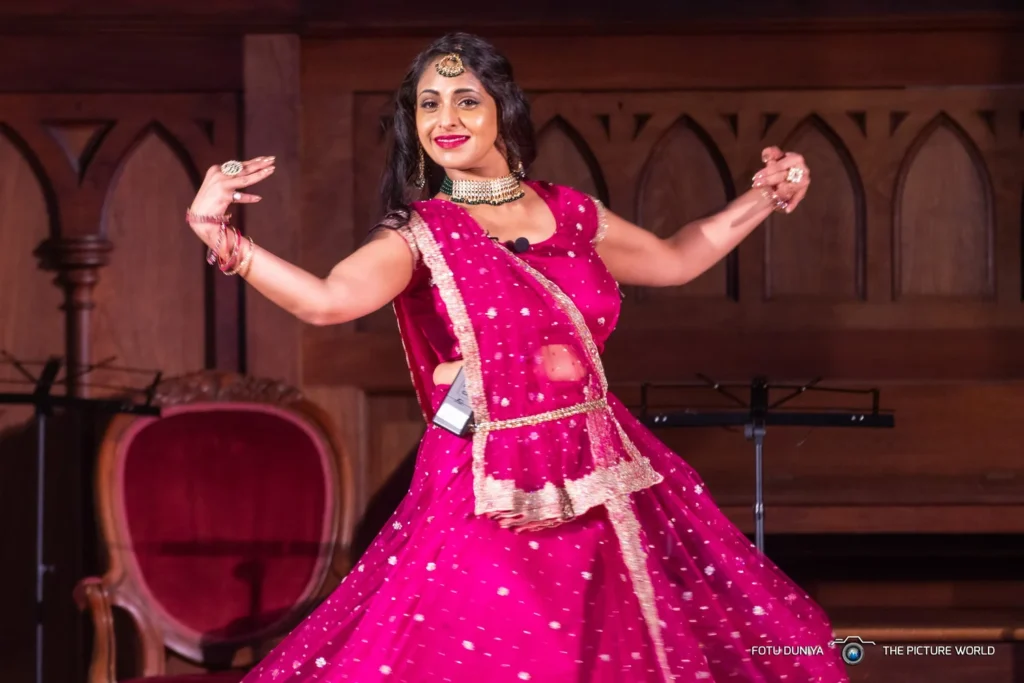
Now, that summons arrives back with renewed force.
After delivering many houseful, deeply moving readings to audiences in Lexington, Massachusetts, the production returns on popular demand to The Mosesian Center for the Arts in Watertown, Massachusetts, not merely as a play, but as a community call to awakening.
This time around, Playwright and SETU co-founder Dr. Subrata Das transforms “Human Vivekananda” from the quiet intimacy of the reading format into the electrifying immediacy of a live stage performance. Under Dr. Das’s creative vision, the script breathes. The philosophy walks. The doubts, the fire, and the thunderous clarity of Swamiji’s life unfold in vivid colors.
The SETU cast and crew do not simply perform their stage duties. They embody them. Every dialogue, every silence, every pause carries the urgency of Swamiji’s message into our present moment. It is theatre with a conscience. Art with a mission.
This is an invitation to witness brilliance, but more than that, to participate in reflection. To allow the performance to unsettle comfort, to spark conversation at dinner tables, in classrooms, and in community halls. To make us think. To make us act. Because the goal is not applause. It is alignment.
Not admiration, but implementation.
In the teachings of Swami Vivekananda, dualism affirms the devotional relationship between the individual soul and a higher divine presence, nurturing humility, love, and moral responsibility. In today’s polarized world, this perspective fosters accountability and compassionate service, while his broader vision reminds us that beneath apparent differences lies a shared spiritual unity.
We stand at a threshold. Our relationships are strained. Our discourse is deeply and ideologically divided. Our youth are anxious, brilliant, restless, searching for anchors in a storm of information. The answer is not louder noise. It is deeper roots.
“Human Vivekananda” is not just a cultural event. It is a movement toward inner reconstruction. It is an invitation to move from contraction to expansion. From distraction to discipline. From division to dignity.
As the performances arrive this March, they offer more than theatre. They offer encounter. They offer the chance to witness a life that saw tomorrow and prepared us for it.
If 2026 feels uncertain, perhaps it is because we have forgotten who we are.
And Swamiji’s philosophy reminds us: Strength is life. Expansion is love. Divinity resides within us all. The play is not asking you to look back. It is asking you to rise.
Please join us to witness Swami Vivekananda’s inspiring journey from his early struggles and meeting with Ramakrishna, to his iconic Chicago address, Vedantic teachings on non-dualism, and exchanges with disciples like Nivedita and Nikola Tesla.
Related posts:
 “The Sacred Sound Path” by Sesh Kumar to Launch at Avadhoota Datta Peetham in Mysore
 Sri Ganapathy Sachchidananda Swamiji to Lead Maha Kumbhabhisheka Celebrations at Sri Venkateswara Temple in Frisco, Texas
 New Stage Play: When Gandhi and Mohammed Meet
 Thousands Unite for Gītā Utsav 2025 in Texas, Celebrating 10 Years of the Global Bhagavad Gītā Memorization Movement
