Join WhatsApp Channel


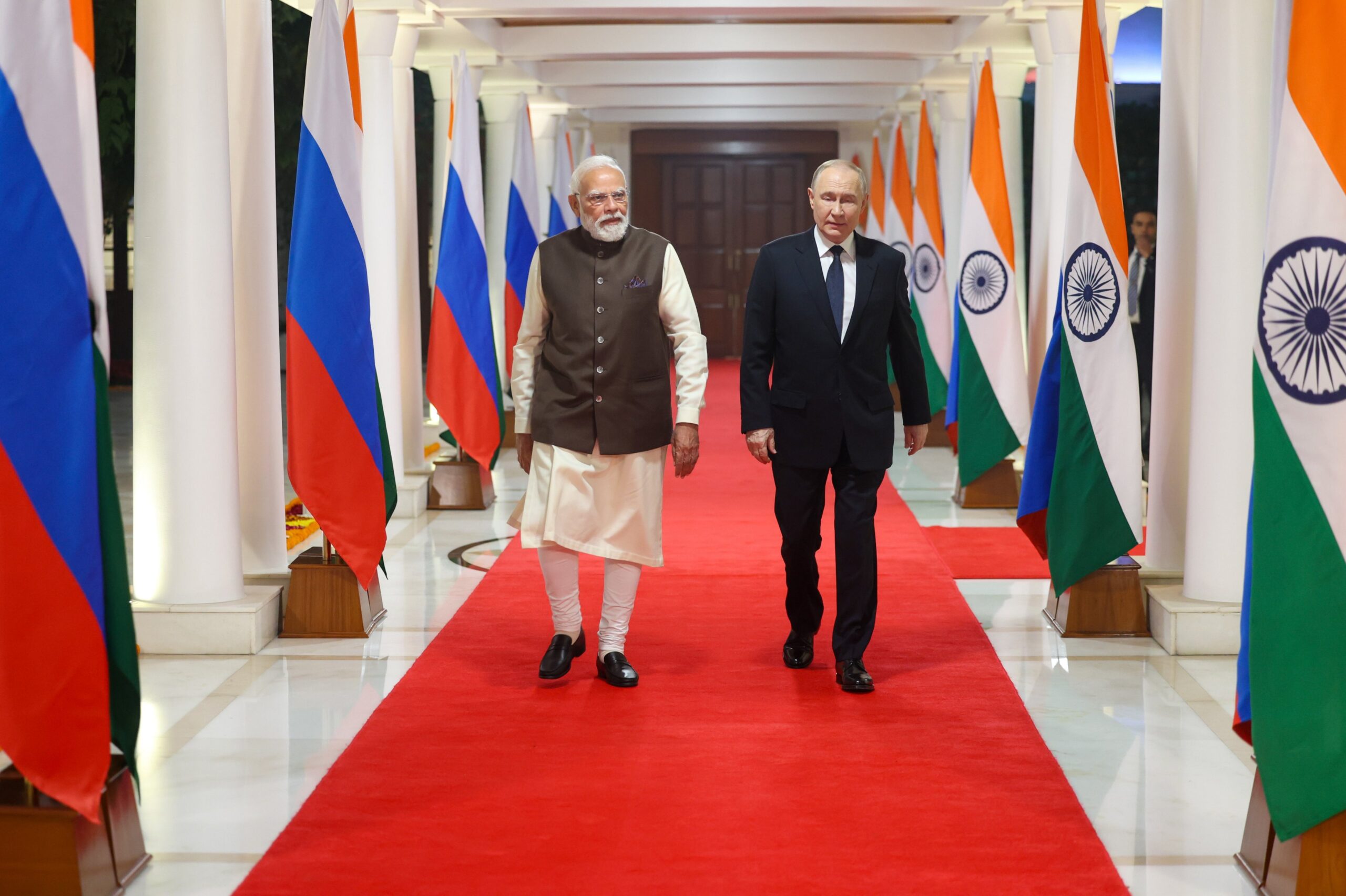
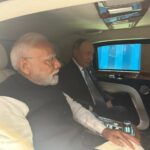
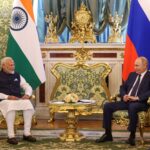
Russian President Vladimir Putin arrived in India on December 4, 2025, for a two-day state visit that is drawing unusually sharp global attention — not only because this is his first trip to the country since the Ukraine war began, but because New Delhi’s diplomatic balancing act is under renewed scrutiny from the U.S., Europe, China, and regional powers across Asia.
In a rare show of exhibitionism, people in the holy city of Ganges River, placed photos of Russian President Vladimir Putin, besmirched with vermillion and marigold flowers, and held Ganga Aarti for the guest, whose country had stood by India in every hour of crisis including the 1971 liberation of Bangladesh.
It is also the city which has continuously elected Prime Miniter Narendra Modi to the lower house of India’s bicameral legislature for three consecutive terms.
Putin’s visit comes at a moment when India’s foreign policy is in active recalibration. After months of escalating tariff and trade pressure from the Trump administration, a harder American line on technology transfers, and intensifying Western criticism over India’s continued energy partnership with Moscow, New Delhi has moved visibly to reinforce its independent strategic identity. India’s stronger embrace of the Shanghai Cooperation Organization (SCO), observers say, is one such signal — a reminder that its geopolitical options extend well beyond the Western camp.
Putin’s arrival, set against this shifting landscape, has become more than a bilateral engagement. It is a stress test of India’s longstanding ties with Russia and a live demonstration of India’s refusal to let global blocs dictate its partnerships.
A Relationship Forged in Crisis, Sustained in Transition
India–Russia relations have endured longer than most Cold War-era alignments. From Soviet support during the 1971 Bangladesh war to decades of defense collaboration that followed, Moscow has long been New Delhi’s most dependable security partner.
That reliance persisted even as India democratized its economy in the 1990s and cultivated deep ties with the United States and Europe. By the early 2000s, as Putin and then-Prime Minister Atal Bihari Vajpayee met to revive a partnership weakened by Russia’s post-Soviet economic chaos, India began a dual-track strategy: deepen trade and technology cooperation with Washington, while preserving Moscow as a cornerstone of defense procurement.

Through the following decades, the numbers remained revealing. Even in 2025, roughly 55% of India’s legacy military hardware originates from Russia, a dependency that cannot be unwound quickly. Joint production of BrahMos missiles, nuclear submarine leasing agreements, and cooperation in space and advanced aerospace have served as stabilizing pillars.
But India’s relationship with Russia has also changed. Moscow is no longer New Delhi’s dominant partner. Washington — with its tech ecosystem, capital markets, and role in balancing China — has become essential. Europe too accounts for a critical share of India’s investment and trade.
The challenge for Indian policymakers has been to modernize Western ties without abandoning a relationship that still anchors key parts of India’s defense posture.
Western Capitals Urge Delhi: “Lean on Putin to End the War”
Putin’s visit has triggered a wave of diplomatic messaging from European capitals. According to senior Indian officials, envoys from multiple European nations — including those in Eastern Europe who view the conflict as existential — have delivered quiet but pointed appeals to New Delhi.
Their request: Use your leverage with Moscow to push for an end to the war in Ukraine.
The argument, conveyed “politely” and “subtly,” hinges on the belief that Putin listens to India in ways he does not engage with Western leaders. Prime Minister Narendra Modi’s public statement in 2022 — that “today’s era is not an era of war” — is often cited in European policy circles as proof that India can influence the Kremlin.
But New Delhi has been careful to avoid the role of mediator. India maintains channels with both Moscow and Kyiv, and while it has called for diplomacy and de-escalation, it has refused to frame its outreach as pressure.
For Europe, which has watched India increase its purchases of discounted Russian crude despite Western sanctions, Putin’s welcome in Delhi is symbolically jarring. Yet most European diplomats privately acknowledge that India’s strategic equation with Moscow is fundamentally different from theirs — a legacy they neither fully share nor fully control.
The U.S. Watches Closely — and Warily
Washington’s view of Putin’s visit is more complex. India remains central to American Indo-Pacific strategy, especially as the U.S.–China rivalry intensifies. The Quad, defense interoperability, and technology partnerships have all strengthened under successive U.S. administrations.
But India’s refusal to align with Western punitive measures against Russia — from sanctions to energy embargoes — has tested Washington’s expectations. This tension was aggravated in recent months as the Trump administration imposed steep tariffs on Indian goods, tightened immigration pathways for Indian professionals, and questioned Indian digital-service trade advantages.
The result: India’s political establishment has read the tariff escalations as a warning — and a reminder of the volatility inherent in U.S. domestic politics.
Putin’s visit allows Delhi to telegraph that it will not allow economic coercion, even from partners, to shape its foreign policy.
Still, American officials insist publicly that India’s partnership with the U.S. remains “deep and durable.” Privately, analysts in Washington expect New Delhi to use the Putin visit to extract concessions from both sides — a classic play in India’s strategic-autonomy toolkit.
A Ceremony Heavy on Optics — but Substantive Deals on the Table
The Modi government has planned an elaborate state welcome: a private dinner, official talks, a state banquet, and a CEO-level address. For Moscow, this is crucial symbolism. For India, it is diplomatic choreography signaling confidence amid global pressure.
Beyond the pageantry, several agreements are expected across defense manufacturing, healthcare, and trade. Officials on both sides have been pushing to evolve the relationship from a buyer–seller dynamic into one focused on joint production, supply-chain resilience, and industrial partnership.
“We are moving from being buying partners to manufacturing partners,” said Sammy Manoj Kotwani, president of the Indian Business Alliance. The objective, he added, is to set “goals for the next 10–15 years” and ensure India remains a central pillar of Russia’s Asian strategy.
Energy remains the quiet anchor of the visit. Despite Western discomfort, India has benefited economically from Russian crude imports, which have helped tame domestic inflation. Moscow, isolated from Western markets, has relied on India as a crucial buyer that helps stabilize its export revenues.
Regional Reactions: China, ASEAN, and Middle Eastern Caution
China will view Putin’s visit with mixed interest. While Beijing and Moscow have grown closer, India’s warm ties with Russia complicate Beijing’s assumption that Moscow is firmly aligned in an anti-Western axis.
Southeast Asian nations — many wary of China and watching India’s trajectory carefully — read the visit as proof that India is pursuing an independent grand strategy rather than acting as a junior partner to the U.S. or China.
The Middle East, especially energy suppliers like Saudi Arabia and the UAE, will track the signal sent by India–Russia coordination on oil pricing and logistics. Any tightening of energy partnership between Delhi and Moscow affects global markets.
A Test of India’s New Strategic Confidence
Putin’s arrival in Delhi underscores a world in which middle powers hold greater leverage, and India — with its economic weight, demographic momentum, and geopolitical location — is using that leverage assertively.
After months of confrontation with Washington on trade, India is demonstrating that its partnerships are plural, flexible, and built around national interest rather than alignment.
For Western capitals hoping to isolate Russia diplomatically, this is an unwelcome — but increasingly unavoidable — reality.
India, as officials in Delhi often remind visiting diplomats, does not choose sides. It chooses outcomes.
And Putin’s high-profile visit is the latest reminder that New Delhi’s strategic autonomy is not a slogan — it is policy.
Disclaimer: The opinions and views expressed in this article/column are those of the author(s) and do not necessarily reflect the views or positions of South Asian Herald.