Join WhatsApp Channel


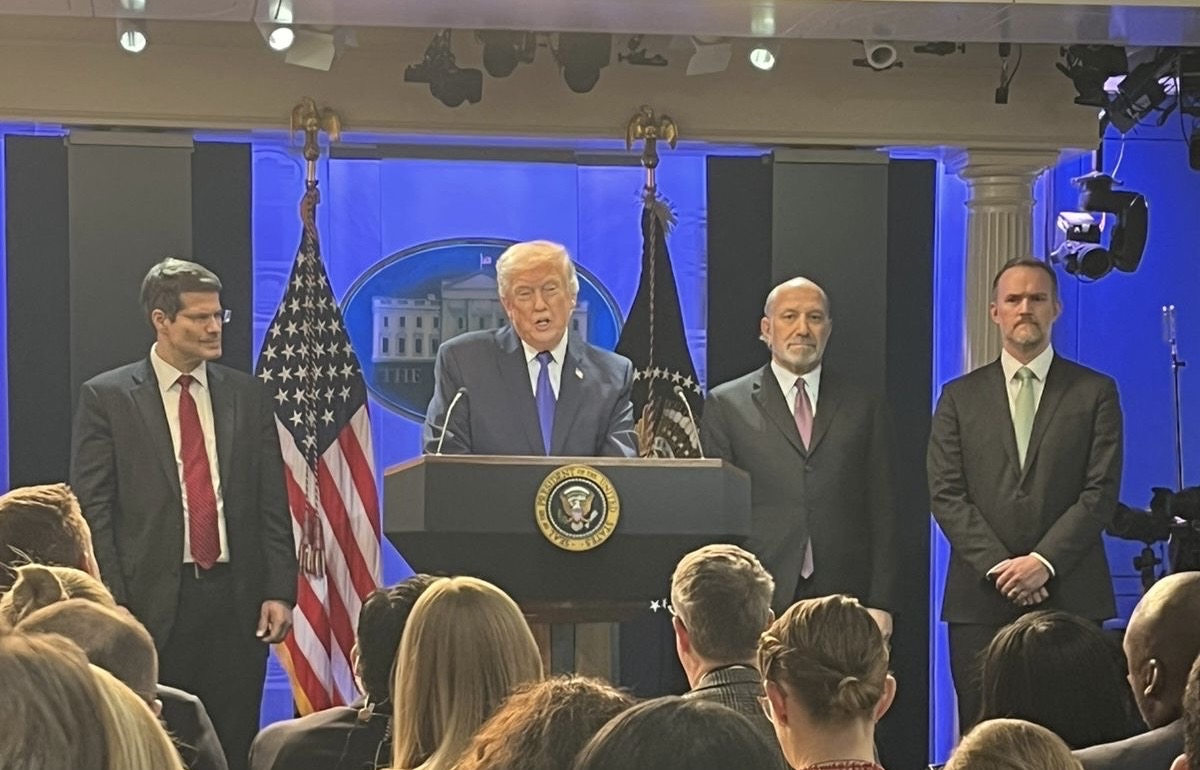
President Donald Trump said the trade agreement recently negotiated with India will remain unchanged in the wake of the Supreme Court’s decision invalidating his use of emergency powers to impose global tariffs under the International Emergency Economic Powers Act (IEEPA).
In a 6-3 ruling on February 20, 2026, the Supreme Court held that President Trump’s use of emergency authority to implement blanket tariffs was unlawful and only the Congress have the authority to impose tariffs.
Writing for the majority, Chief Justice John Roberts stated, “The President asserts the extraordinary power to unilaterally impose tariffs of unlimited amount, duration, and scope. In light of the breadth, history, and constitutional context of that asserted authority, he must identify clear congressional authorization to exercise it.”
Following the ruling, the President convened an unscheduled press conference at the White House, where he sharply criticized the Court’s decision.
Responding to a question about whether the recently negotiated trade deal with India would remain in place, he said, “Nothing changes. They’ll [India] be paying tariffs, and we will not be paying tariffs. So, we made a deal with India. It’s a fair deal. Now, we are not paying tariffs to them, and they are paying tariffs. We did a little flip… India deal is on.”
On bilateral ties, he said, “I think my relationship with India is fantastic. And we’re doing trade with India,” and added, “India pulled out of Russia. You know, India was getting its oil from Russia, right? And they pull way back at my request, because we want to settle that horrible war where 25,000 people are dying every month…”
He described his relationship with Prime Minister Narendra Modi as “great,” adding he also stopped the war between India and Pakistan.
The President further asserted that tariffs had helped prevent conflicts. “I settled eight wars, whether you like it or not, including India, Pakistan, big ones. As you know, ten planes were shot down. That war was probably going nuclear,” he said.
He added that Pakistan’s Prime Minister Shehbaz Sharif had, during a Board of Peace meeting on February 19, praised his leadership and credited him with saving 35 million lives by helping both countries halt hostilities.
“I did it [stopping the wars] largely with tariffs,” he said, referring to tensions between India and Pakistan. “I said, look, you’re going to fight that’s fine. But you’re not going to do business with the United States, and you’re going to pay a 200% tariff each country. And they called up and they said, we have made peace…”
Addressing the Court’s ruling, the President said he retains authority to impose tariffs under other statutory provisions. He stated that he could “actually charge” higher tariffs than those imposed over the past year under different legal authorities and indicated he would rely on alternative statutes that have been “confirmed” and are fully “allowed.”
“Therefore, effective immediately, all National Security Tariffs, Section 232 and existing Section 301 tariffs, remain in place, and in full force and effect.,” he said. “Today, I will sign an Order to impose a 10% Global Tariff, under Section 122, over and above our normal Tariffs already being charged, and we are also initiating several Section 301 and other Investigations to protect our Country from unfair Trading practices.”
He described the Supreme Court’s ruling as “deeply disappointing,” and said, “I’m ashamed of certain members of the court… absolutely ashamed for not having the courage to do what’s right for our country.” At the same time, he congratulated Justices Clarence Thomas, Samuel Alito, and Brett Kavanaugh for their dissent, praising their “strength and wisdom and love of our country.”
Asked about Justices Neil Gorsuch and Amy Barrett, who joined the majority opinion, he said, “I think their decision was terrible… I think it’s an embarrassment to their families. You want to know the truth?”
“When you read the dissenting opinions, there is no way that anyone can argue against them,” he said, adding, “Foreign countries that have been ripping us off for years are ecstatic. They’re so happy, and they’re dancing in the streets, but they won’t be dancing for long that I can assure you.”
He called the Justices who voted against the tariffs “frankly disgrace to our nation,” and said, “They’re very unpatriotic and disloyal to our Constitution. It’s my opinion that the court has been swayed by foreign interests and a political movement that is far smaller than people would ever think. It’s a small movement. I won by millions of votes…”
He also expressed concern about potential external influence on the Court. “I think that foreign interests are represented by people that I believe have undue influence. They have a lot of influence over the Supreme Court, whether it’s through fear or respect or friendships…”
The President said he respects Justices Thomas, Alito, and Kavanaugh because they not only dissented but offered what he described as strong legal reasoning.
He highlighted Justice Kavanaugh’s dissent, which stated, “Although I firmly disagree with the Court’s holding today, the decision might not substantially constrain a President’s ability to order tariffs going forward. That is because numerous other federal statutes authorize the President to impose tariffs and might justify most (if not all) of the tariffs issued in this case…Those statutes include, for example, the Trade Expansion Act of 1962 (Section 232); the Trade Act of 1974 (Sections 122, 201, and 301); and the Tariff Act of 1930 (Section 338).”
According to the President, the ruling ultimately clarified and strengthened executive authority on trade. He said the decision made a President’s ability to regulate trade and impose tariffs more powerful and more clearly defined. He added that revenue collection and protections for American companies would increase as a result.
He described the case as significant not only legally but symbolically for economic and national security. At the same time, he argued that alternative statutes and authorities, recognized by both the Court and Congress, provide stronger tools than IEEPA tariffs.
“I was very modest in my ‘ask’ of other Countries and Businesses because I wanted to do nothing that could sway the decision that has been rendered by the Court,” he said.
The President maintained that tariffs had strengthened national security, tightened border controls, and reduced fentanyl inflows by 30 percent when used as a penalty against countries sending what he called “poison” into the United States. “All of those tariffs remain, but other alternatives will now be used to replace the ones that the Court incorrectly rejected,” he said.
He also criticized the ruling’s interpretation of IEEPA authority, saying the Court determined that the President “can’t charge $1” under the statute. He suggested the decision was intended to “protect” other countries. “This must have been done to protect those other countries, certainly not the United States of America…”
“Their decision is incorrect. But it doesn’t matter, because we have very powerful alternatives that have been approved by this decision,” he added.
He further argued that while the Court recognized his authority to license trade, it limited his ability to impose license fees. “But I am allowed to cut off any and all trade or business with that same country. In other words, I can destroy the trade. I can destroy the country. I’m even allowed to impose a foreign country destroying embargo. I can embargo. I can do anything I want, but I can’t charge $1…”
The President emphasized that the ruling did not invalidate tariffs broadly, but rather addressed a specific application of IEEPA. “The ability to block, embargo, restrict, license, or impose any other condition on a Foreign Country’s ability to conduct Trade with the United States under IEEPA, has been fully confirmed by this decision,” he said.
Additionally, he noted that the Court’s opinion did not address whether tariff revenues collected by the United States should be retained or returned. “Wouldn’t you think they would have put one sentence in there saying that keep the money or don’t keep the money? I guess it has to get litigated for the next two years…”
On whether trade agreements negotiated under IEEPA provisions would remain valid, he said, “Many of them stand. Some of them won’t, and they’ll be replaced with the other tariffs.”
Asked if he would seek congressional approval for tariffs, he responded, “I would ask Congress, and probably get it,” reiterating, “I have the right to do tariffs, and I’ve always had the right to do tariffs, and it’s all been approved by Congress.”
Reflecting on the timing of the decision, he said, “I’ve been waiting for this decision so long,” and added, “We waited months and that gave uncertainty. Now we have certainty, and I think you’re going to see the country get much stronger because of it.”
Related posts:
 Supreme Court Showdown to Decide Fate of President Trump’s Global Tariffs
 Global Traders See Flicker of Hope as Trump’s Tariffs Head to Supreme Court
 Indian American Lawmakers Applaud Supreme Court’s 6-3 Ruling Striking Down President Trump’s Global Tariffs
 India Reassesses Trade Strategy as U.S. Tariff Ruling Alters Negotiation Dynamics