 Join WhatsApp Channel

India on December 5 warned that Washington’s sweeping new restrictions on skilled-worker and student mobility have injected a fresh layer of uncertainty into the country’s tech industry and educational pipeline, at a time when Indian exporters are simultaneously grappling with U.S. tariff actions hitting nearly USD 47.2 billion worth of merchandise shipments.
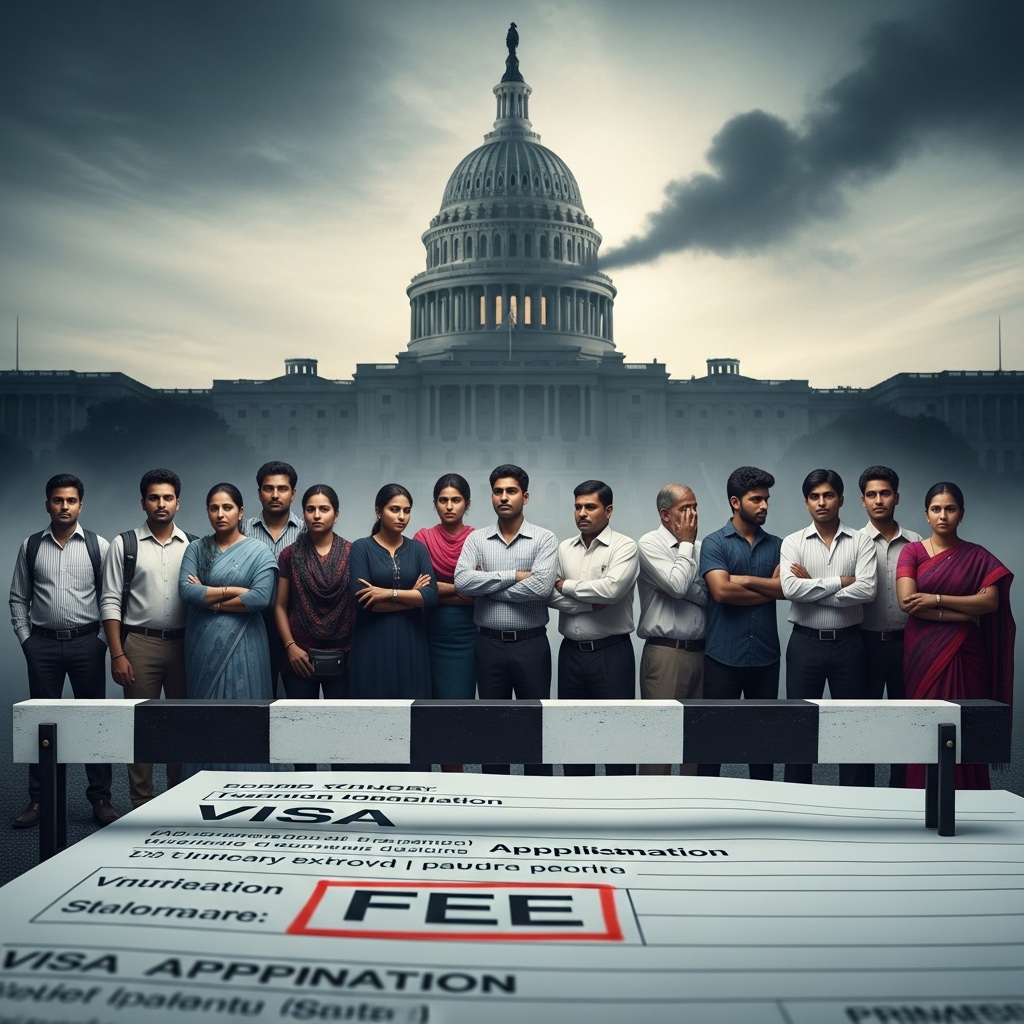
In a written reply to Parliament, the Ministry of External Affairs said the United States’ USD 100,000 supplemental fee on new H-1B visa petitions filed from outside the country — imposed under a 19 September Presidential Proclamation — has unsettled Indian professionals, IT firms and students who have long relied on the H-1B pathway as a predictable route into the American talent ecosystem.
Although U.S. immigration authorities have since clarified that applicants already inside the country and certain status-change cases will be exempt, officials and industry executives say the sudden introduction of a six-figure fee marks a step-change in the cost of economic entry into the United States.
The government said it is too early to quantify the impact, as no comparative data exist since the fee took effect only in late September. Still, recruiters and mobility consultants describe a surge in cancellations, delayed decisions and requests for alternative destinations among STEM graduates and mid-career engineers. Several companies have begun re-evaluating overseas deployment plans, with some exploring Canada, the UK and Australia as substitute mobility channels.
Adding to the uncertainty, Washington is weighing a weighted H-1B selection process that would favor higher-paid and higher-skilled applicants. While top-tier Indian tech talent may benefit marginally, officials acknowledge the change could undermine entry-level hiring and the ability of mid-tier IT and engineering firms to place young professionals abroad. The U.S. Administration has also proposed limiting F-1 student visa stays to the duration of academic programs, up to four years, meaning tens of thousands of Indian students could fall out of status if extension approvals lag — a risk that universities say will complicate doctoral research timelines and campus hiring cycles.
Proposed changes to Optional Practical Training (OPT) — the work period that forms the main bridge between F-1 and H-1B — have added a further layer of concern. U.S. officials say the changes are intended to prevent misuse and enhance monitoring, but Indian education advisers warn they could tighten pathways that have historically absorbed large cohorts of Indian STEM graduates.
The visa turbulence is unfolding just as India faces one of its sharpest trade shocks from the U.S. in recent years. On Friday, the government disclosed that nearly USD 47.2 billion of Indian exports are now covered by new and expanded U.S. tariff actions imposed under emergency economic powers and security statutes — the first official estimate of how deeply the duties could cut into India’s export engine.
Officials said India is in continuous dialogue with Washington on both trade and mobility issues, arguing that the movement of skilled workers has long driven innovation and growth in both economies. For now, the government’s stark assessment is that the simultaneous tightening of visa rules and trade access marks one of the most challenging phases in India–U.S. economic ties in years, with the next few quarters likely to reveal how hard the twin shocks hit industry, students and the wider services economy.
Related posts:
 New $250 Visa Integrity Fee to Increase U.S. Travel Costs for Foreign Nationals and Employers
 India Inc Clocks $10.6 Billion in October Deals, Led by Banking and Infrastructure Sectors
 President Trump’s Proclamation Imposes $100K H-1B Fee, Sparks Indian American Outrage
 Economic Stability Improves in Nepal as Inflation Eases, Trade Expands
