Join WhatsApp Channel


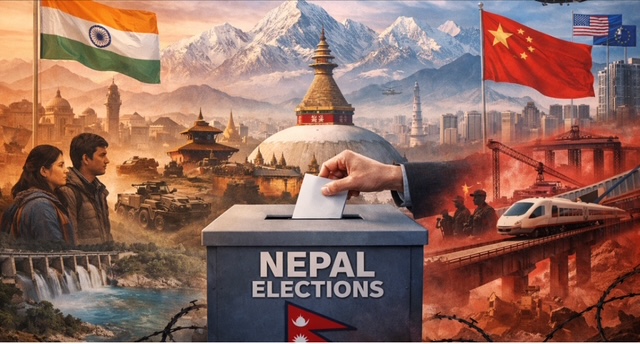
Nepal approaches its March 5 election not just as a democratic event, but also as a significant milestone that underscores the country’s important role in regional and global conversations. This election is especially meaningful as it is the first since the vibrant youth-led protests of September 2025, which significantly reshaped Nepal’s political landscape. Additionally, it arrives at a moment when regional power dynamics are becoming more fluid, making the results in Nepal likely to create ripple effects well beyond its borders.
Perched between India and China, Nepal oversees one of Asia’s most delicate corridors. Its foreign policy has historically centered on maintaining a careful balance. The country has sought to stay nonaligned, preserve its strategic independence, and practice thoughtful diplomacy. The big question today is whether this approach can hold up amid intensifying competition among major powers and rising frustration within the country.
Domestic Issues
Mostly led by young people in cities and new voters, the 2025 protests were not primarily about foreign policy. Instead, they highlighted concerns at home, such as corruption, jobs, and frustrations with the political elite. But when people feel disappointed locally, outside actors often step in and sway opinions.
Set to play a significant role in shaping this election will be the nearly a million young voters who have recently registered. Many doubt the long-standing political parties that have alternated in power since Nepal’s 2015 constitution. Challenges like high youth unemployment and ongoing labor migration still make it hard for young Nepalis to pursue their dreams. For many, the biggest hope is that this election will bring about better economic opportunities right at home.
Even this economic concern is closely tied to geopolitics. Nepal’s development depends heavily on external partnerships, including infrastructure funding, market access, energy cooperation, and connectivity projects. The new government will take on not only campaign promises but also a complex network of foreign commitments.
It is hard not to think of India whenever Nepal’s election is discussed. With its open border, shared cultural ties, and strong trade relationship, India stands out as Nepal’s closest neighbor. Approximately two-thirds of Nepal’s trade goes to India, and there has been recent progress in energy cooperation, particularly in hydropower exports.
However, past conflicts, such as the 2015-2016 border disruptions, continue to shape Nepal’s political mindset, fueling ongoing concerns about overreliance on India. Political leaders often emphasize sovereignty and dignity when discussing their relationship with New Delhi.
India insists it cares about stability in Nepal because it helps keep things smooth and secure. However, many Nepalis see India as more interested in a state of ‘controlled chaos,’ in which New Delhi would be able to call the shots.
China’s growing presence in Nepal over the past ten years, especially through infrastructure projects connected to the Belt and Road Initiative, highlights its increasing influence. Beijing sees Nepal as not only a crucial gateway to South Asia but also as a strategic buffer along the sensitive Tibetan border.
Chinese investments in roads, airports, and energy offer Nepal valuable alternatives to depending solely on India for transit. While these projects are promising, they also bring up important questions about debt sustainability, transparency, and long-term strategic interests. Nepal’s political parties have varied views on China, but so far, none have openly opposed Beijing.
China’s primary priority is stability. It hopes to keep Nepal a trusted partner, ensuring that no anti-China activities occur on its soil. China prefers a government that honors existing agreements and maintains stable policies. In a region where alliances are becoming more solid, China, like India, sees Nepal as a country that should remain within its sphere of influence.
The United States and other Western countries have been providing development aid, supporting democratic institutions, and forming new strategic partnerships. The discussion surrounding the Millennium Challenge Corporation agreement highlights how these international connections can become politicized, underscoring Nepal’s active engagement on the global stage. Many in Nepal believe the United States and the wider West have a strategic interest in positioning themselves between the Asian giants, both of which aspire to global leadership.
A small yet significant country, Nepal serves as both a democratic partner and a vital test case for Western nations. It raises a question among Nepalis: can this resilient nation maintain strong institutions while balancing pressures from global influences? Or might internal instability open the door for outside powers to step in?
It is likely that the upcoming election will produce another coalition government. Nepal’s proportional representation system and the diverse party landscape make it unlikely for any single party to secure a clear majority. Still, while coalition governments can be effective, they sometimes lead to policy inconsistencies, particularly in areas such as foreign relations.
A divided government could make Nepal’s negotiations with India and China more challenging. However, if a coalition forms around economic reforms and institutional strengthening, it can significantly boost Nepal’s confidence in managing its external relations. When there is strong domestic unity, Nepal’s credibility in maintaining strategic independence shines brightest.
The ongoing generational shift presents an opportunity. Younger politicians are generally expected to exhibit less ideological rigidity and adopt a more pragmatic approach. If this energetic shift catalyzes reforms, such as enhancing transparency, enforcing contractual obligations, and upholding financial discipline, Nepal can engage in external partnerships with confidence rather than susceptibility.
This election is not just about choosing between India and China. It is about how the country is governed. Still, governance and world politics are closely connected, especially in a nation where the economy and security are deeply affected by outside influences.
Publicly, India remains hopeful about ongoing cooperation, while China seeks to build stability and trust. Western countries appreciate resilient democracies. For everyday Nepalis, what matters most is their dignity, fresh opportunities, and leadership they can count on.
Maintaining Balance
In a world where power is often fragmented, small states can turn challenges into opportunities. Nepal’s journey is about more than avoiding becoming a battleground. It is about embracing the potential within. If the next government can tap into the energy of its youth, rebuild trust in its institutions, and pursue thoughtful foreign policies, Kathmandu can show that, even amid growing rivalries, maintaining a balanced and peaceful path is within reach.
Although this election will not immediately resolve Nepal’s longstanding problems, it will show whether the country chooses to go with the flow of global politics or to take a thoughtful, steady path through these challenges.
Disclaimer: The opinions and views expressed in this article/column are those of the author(s) and do not necessarily reflect the views or positions of South Asian Herald.