 Join WhatsApp Channel


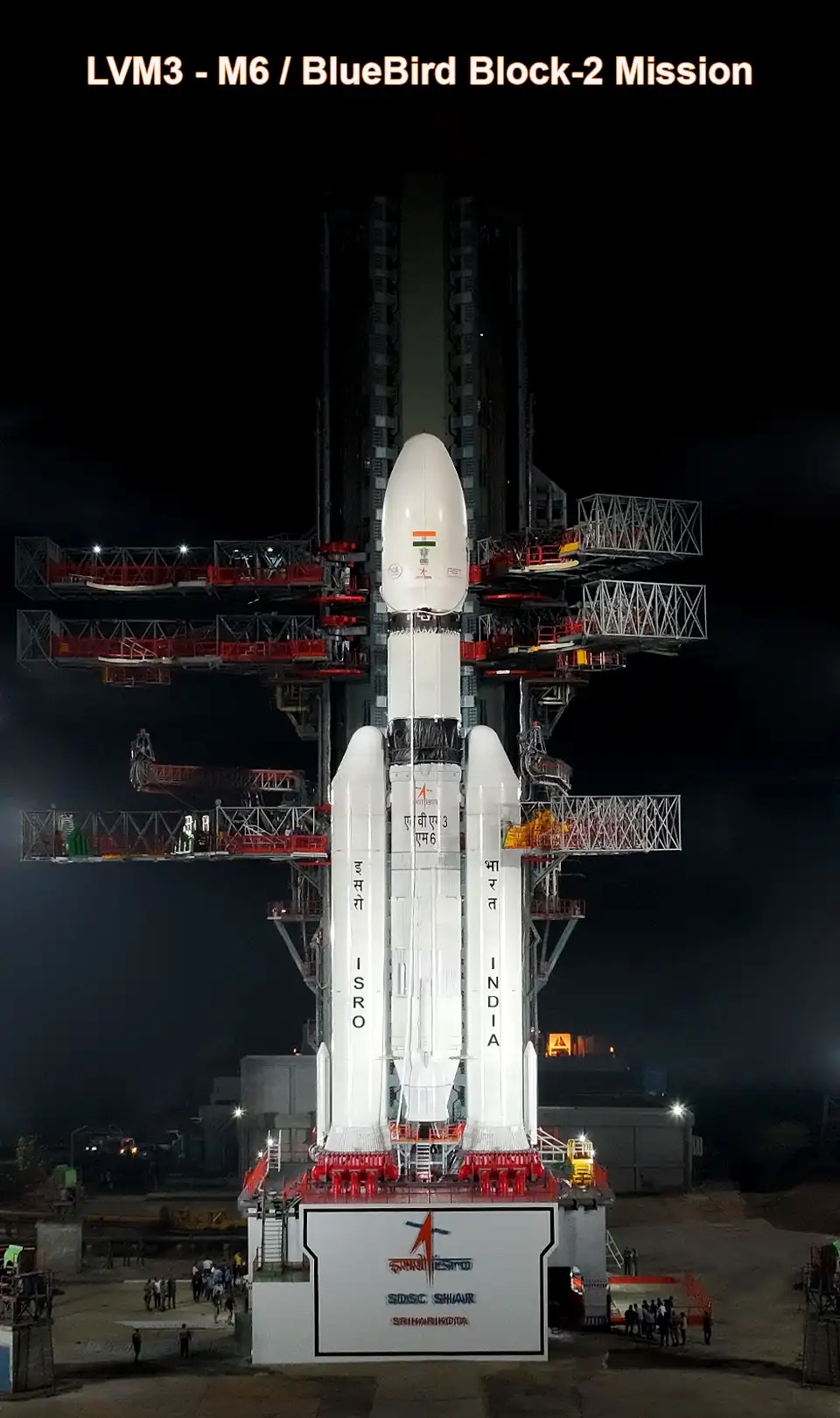
India’s space agency on Wednesday successfully placed the BlueBird Block-2 communications satellite into low Earth orbit, marking the heaviest payload ever launched by an Indian rocket and underscoring the growing commercial and strategic ambitions of the country’s space program.
The mission, designated LVM3-M6, saw ISRO’s heavy-lift Launch Vehicle Mark-3 deploy the 6,100-kg satellite for U.S.-based AST SpaceMobile into a circular orbit at an altitude of about 520 km roughly 15 minutes after liftoff from Sriharikota. ISRO said the satellite was injected “precisely into its intended orbit,” completing the sixth operational flight of the LVM3.
The launch is significant on several fronts. It is ISRO’s third fully commercial mission using the LVM3 platform, its first dedicated launch for a U.S. commercial customer, and the largest communications satellite ever deployed in low Earth orbit. The agency also said the mission completed its 100th orbital launch overall.
BlueBird Block-2 is part of AST SpaceMobile’s planned low-Earth-orbit constellation aimed at providing direct-to-mobile connectivity. Unlike conventional satellites that route signals through ground stations, the system is designed to communicate directly with standard smartphones, enabling 4G and 5G voice calls, messaging and data services, including in remote or underserved regions. The satellite carries a deployable antenna roughly the size of a tennis court, making it unusually large for an LEO platform.
For ISRO, the mission serves as a high-visibility demonstration of heavy-lift capability at a time when the global commercial launch market is dominated by SpaceX’s Falcon 9 and, to a lesser extent, Europe’s Ariane program. Indian officials have repeatedly pitched the LVM3 as a lower-cost alternative, with industry estimates placing launch prices at roughly $55–60 million, although exact commercial terms for the BlueBird mission have not been disclosed.
The LVM3 — earlier known as the GSLV Mk-III — was originally designed to carry payloads to geosynchronous transfer orbit. Its adaptation for LEO missions began with the OneWeb launches in 2022 and 2023, when India emerged as a fallback launch provider after Russia withdrew services following the Ukraine war and Europe’s Ariane-5 was retired. Wednesday’s flight was the third time the vehicle has been used for a large LEO payload.
Operationally, the mission also highlights improvements in turnaround time. The launch follows the LVM3-M5 mission that placed the CMS-03 communications satellite into orbit on November 2, making this the shortest gap between two LVM3 launches. After 2023, this is only the second year in which ISRO has flown two LVM3 missions, an indicator of improving assembly and integration capacity.
ISRO said the flight also tested incremental upgrades. For the first time on an LVM3 mission, electro-mechanical actuators were used to steer the nozzles of the S200 solid boosters, replacing hydraulic systems. The agency said the change reduces system mass and improves payload margins — a key consideration for future missions.
The LVM3 platform is central to India’s longer-term space plans, including the Gaganyaan human spaceflight program and the proposed Bharatiya Antariksh Station. ISRO is working to increase lift capacity by upgrading the cryogenic upper stage from the current C25 to a higher-thrust C32 configuration, and is evaluating a semi-cryogenic second stage that could raise LEO payload capacity to around 10 tons.
ISRO is also developing a “bootstrap reignition” capability for the cryogenic engine, which would allow the upper stage to restart without external gases, improving efficiency for multi-orbit satellite deployments — a feature increasingly important for constellation missions.
Prime Minister Narendra Modi hailed the launch as a milestone for India’s space sector, saying it strengthened the country’s heavy-lift capability, expanded commercial launch services and reinforced the government’s push for technological self-reliance.
With the BlueBird Block-2 mission, ISRO is signaling that its heavy-lift launcher is no longer limited to national prestige missions, but is being positioned as a competitive workhorse in the global commercial launch market — a shift that could shape the agency’s role in the rapidly expanding space economy over the next decade.
Related posts:
 Shubhanshu Shukla Nears Return from Space: A Strategic Prelude to India’s Gaganyaan Mission
 Shubhanshu Shukla’s Space Mission Sets Stage for Quad’s Next Strategic Leap
 NASA-ISRO’s $1.5 Billion Earth-Imaging Satellite Takes Flight
 India’s Cosmic Leap: A Billion Dreams, Will See Visits to Moon, Mars, and Venus
