 Join WhatsApp Channel


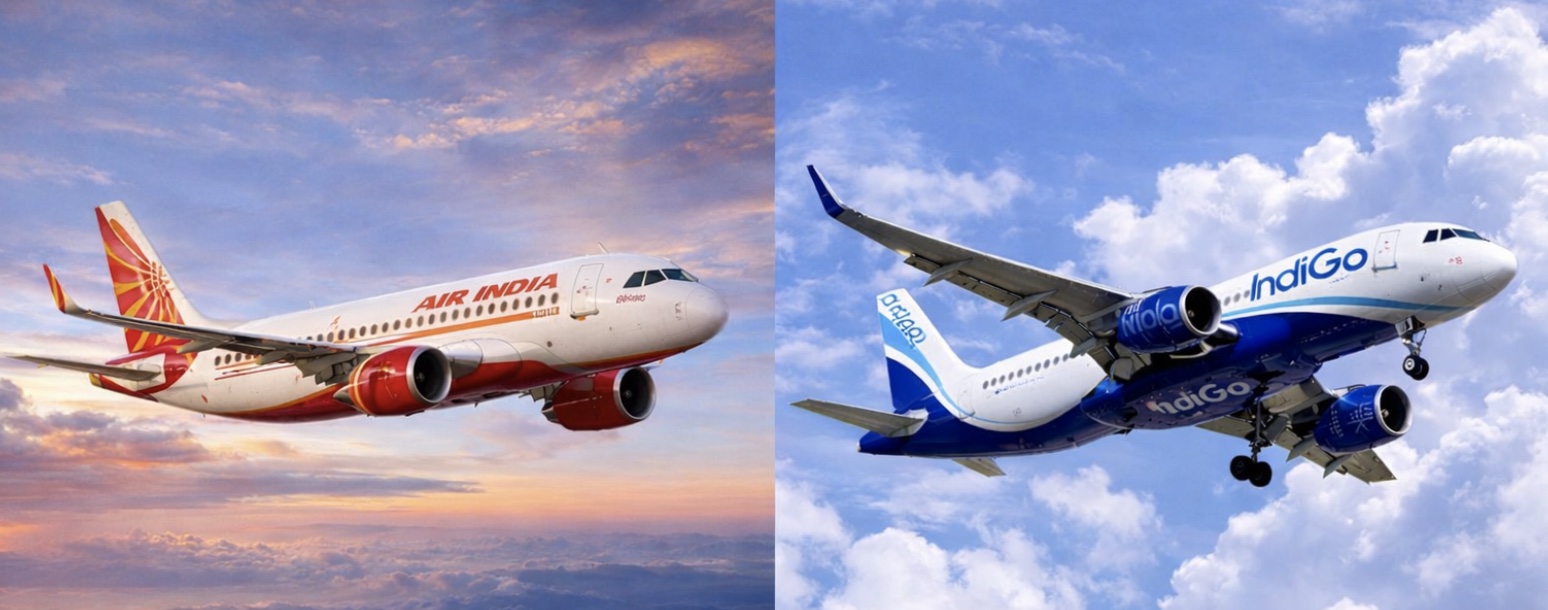
India has demand; India has aircrafts; and India has airports.
What it still lacks is systemic competitiveness.
Indian carriers have placed some of the largest bulk orders in aviation history over the last two years, amply signifying their confidence, scale, and ambition. Air India and IndiGo collectively have ordered over 970 aircraft, making India one of the world’s leading future fleet markets. Passenger demand has correspondingly risen, with India currently the third-largest domestic aviation market and one of the fastest-growing in the world, according to IATA.
Yet a few regulatory changes or seasonal surges in demand cripples capacity across the nation so far, pushing airfares sky-high during events such as Maha Kumbh Mela, when ticket prices skyrocketed under constrained supply and attracted public and regulatory interest. For a market expected to fly over 1,100 aircraft in 2027, this is not a transient perturbation but a structural frailty. The irony is an aeronautical one. Operationally, too, despite flying tens of millions of passengers each year, Indian aircraft fly to Singapore, Dubai, and Europe each year for heavy maintenance. As the planes and airlines grow bigger, they struggle to compete globally on cost, connectivity, and network depth, while foreign hubs siphon off the value of Indian transit traffic.
Recognizing this fragility, the Union Government recently cleared two new airlines, Al Hind Airlines and FlyExpress, explicitly with the stated objective of breaking the existing aviation duopoly and increasing competition into the sector. Yet, the approval of new entrants, while symbolically important, raises a deeper question, can entry alone correct a structurally skewed aviation ecosystem?
Why does the world’s fastest-growing aviation market continue to serve as a feeder to foreign hubs? Why is scale not translating into national strength? This article analyses this under performance through three structural lenses:
(i) slot allocation and regulatory design,
(ii) aviation turbine fuel pricing and MRO economics, and
(iii) market concentration and global hub strategy.
India’s aviation story is no longer about growth. It is about whether growth can finally become power.
(i) Slot Allocation & Regulation: When Growth Collides with Congestion
The term “slot” in terms of Aviation infrastructure refers to the permission to use the airport infrastructure, including runway, terminal, gate, etc., of the airport at a specific date and time by the coordinator to airlines and aircraft operators. India follows the principle of “use it or lose it” or “grandfather rights”. Under this principle, Airlines which have utilized their slots at least 80% of the time during the allocated season get to retain the slot. At airports like Delhi and Mumbai, which are highly congested, the availability of peak-hour slots determines whether an airline can operate flights that are in demand.
The principle of Grandfather rights effectively converts the past market presence of an Airline into a competitive advantage over new entrants. The slot data is not made public by the Ministry of Civil Aviation; however, one could look at the domestic seat capacity to draw an estimate, with Indigo, Air India, and Air India express collectively controlling over 70% capacity, the slot distribution has to be in a similar range. At highly congested airports, the majority of commercially viable slots are, by virtue of the grandfather rights principle, handed over to the already established airlines, leaving a few slots for the new entrants.
A more competitive slot regime, that provides a level playing field, would require publishing airport-wise slot data, limiting indefinite grandfathering at congested airports such as Delhi, Mumbai, Bangalore, and introducing regulated secondary trading or periodic auctions, which would allow airlines to buy, sell or trade slots under regulatory oversight, especially for peak-hour slots. A Policy brief by the European Transport Regulation Observer and a paper by Oxera Consulting shows that, by taking London Heathrow as an example, an efficient auction of slots would lead allocation to better utilization of the same in order to secure their own best commercial interest.
(ii) ATF & MRO Economics: Why Flying From India Costs More Than Flying Through It
One of the most persistent bottlenecks facing Indian aviation is cost, particularly for fuel and maintenance. ATF alone accounts for around 30%-40% of the operating cost of an Indian airline, well above global norms. Since ATF remains outside the GST regime, it continues to be slapped with high state-level VAT, in many cases 20-30%-which pushes India’s fuel prices a good 20%-30% above competitor hubs such as Dubai and Singapore. For airlines, the chasm in ATF price equates to dearer tickets, thinner margins, and harder competition on international routes.
The handicap is compounded by India’s historically underdeveloped MRO ecosystem. Despite boasting one of the world’s fastest-growing fleets, Indian carriers have long been forced to send aircraft offshore for heavy checks, bleeding billions of dollars, approx. $15 Billion, in foreign exchange each year. Finally, policy reforms over the last decade-GST cuts on MRO services, approval for 100% FDI, removal of lease royalties, and theBharatiya Vayuyan Adhiniyam, 2024 have started to reset the balance, but the process is not quite complete yet.
Singapore and Malaysia did not become hubs by accident; they deliberately made aviation cheap, reliable, and predictable. Not treating fuel pricing and MRO as mere revenue streams but as strategic infrastructure supporting integrated hubs. India, by contrast, generates traffic but loses value-added services, turning its airlines into price-takers rather than market-makers.
If India is serious about becoming a hub, it must stop treating aviation fuel as a revenue source and MRO as an afterthought. This requires bringing ATF under GST with input-tax credit, offering long-term tax certainty for fuel and MRO operations, building integrated airport fuel MRO clusters, and actively anchoring global OEMs within India’s aviation ecosystem.
(iii) Market Concentration & Global Comparisons: A Giant Market With a Feeder Mindset
India, despite being geographically central between Europe, Africa and East Asia, has lost to countries like the UAE, with its Dubai International (DXB), Turkey’s Istanbul, Singapore’s Changi International, to become a transit hub because of its fragmented policy. The spill over effect of it has been that India has failed to nurture any internationally competitive airline such as Emirates or Qatar Airways. India, which is set to operate 26,495 flights per week during this upcoming Winter season, has been reduced to serving primarily as a feeder market to Gulf Hubs, with over one third of India’s international traffic routed through them.
India’s aviation policy has historically favored domestic connectivity and regional expansion, as evidenced by the schemes such as UDAN over international network competition, which has contributed to market fragmentation and limited hub development. This fragmentation is further widened by acute shortages of skilled aviation personnel, including pilots, engineers, and maintenance crews. Indian immigration rules arespread across various government ministries, with Security Rules and Immigration rules under the Ministry of Home Affairs and International Flights handled by the Ministry of External Affairs.
To make India into a globally competitive market, it would need to rationalize Aviation Turbine Fuel (ATF) taxation. Indian ATF, as above-descried, remains costlier, increasing operating expenses for carriers. India also must expand aircraft financing, leasing, and workforce training to support wide-body fleets and hub-oriented networks, and improve slot transparency and coordinated connection banks at major airports such as Delhi and Mumbai. Finally, state-level VAT cuts on ATF, such as that of Bihar, demonstrate how fiscal incentives can attract more flights and reduce operational costs, leading to more competitiveness rather than feeder status.
From Chaos to Choice
India’s aviation sector demands structural correction to keep growing. Competitive performance will come with focused reforms, which involve: transparent and dynamic slot allocation at congested airports for better utilization; ATF taxation rationalization through the inclusion of GST and input-tax credit issuance to reduce operating costs; and rapid expansion of domestic MRO capacity on the back of long-term tax certainty, creation of integrated airport–MRO clusters, and deeper collaboration with original equipment manufacturers. Without which, the only thing that fleet expansion is likely to do is bring volume without value, making Indian airlines continue to be cost-disadvantaged and dependent upon foreign hubs. If these are implemented effectively, they have the potential to transform India’s underlying demand into hub capabilities and enable Indian carriers to compete on efficiency, reliability, and global connectivity.
Disclaimer: The opinions and views expressed in this article/column are those of the author(s) and do not necessarily reflect the views or positions of South Asian Herald.
Related posts:
 Air Disasters-4: Adanis, IndiGo Rule Indian Aviation as Government Agencies Get Elbowed Out
 Fuel Cutoff to Both Engines Seconds Apart May Have Caused Air India Flight 171 Crash in Ahmedabad: AAIB Preliminary Report
 Airport Tariff Watchdog Weak, Lacks Teeth, Says Parliamentary Committee
 Air Disasters-3: Opinions, Expert Comments, and Versions Galore, But Who Will Pinpoint the Real Cause?
