Join WhatsApp Channel


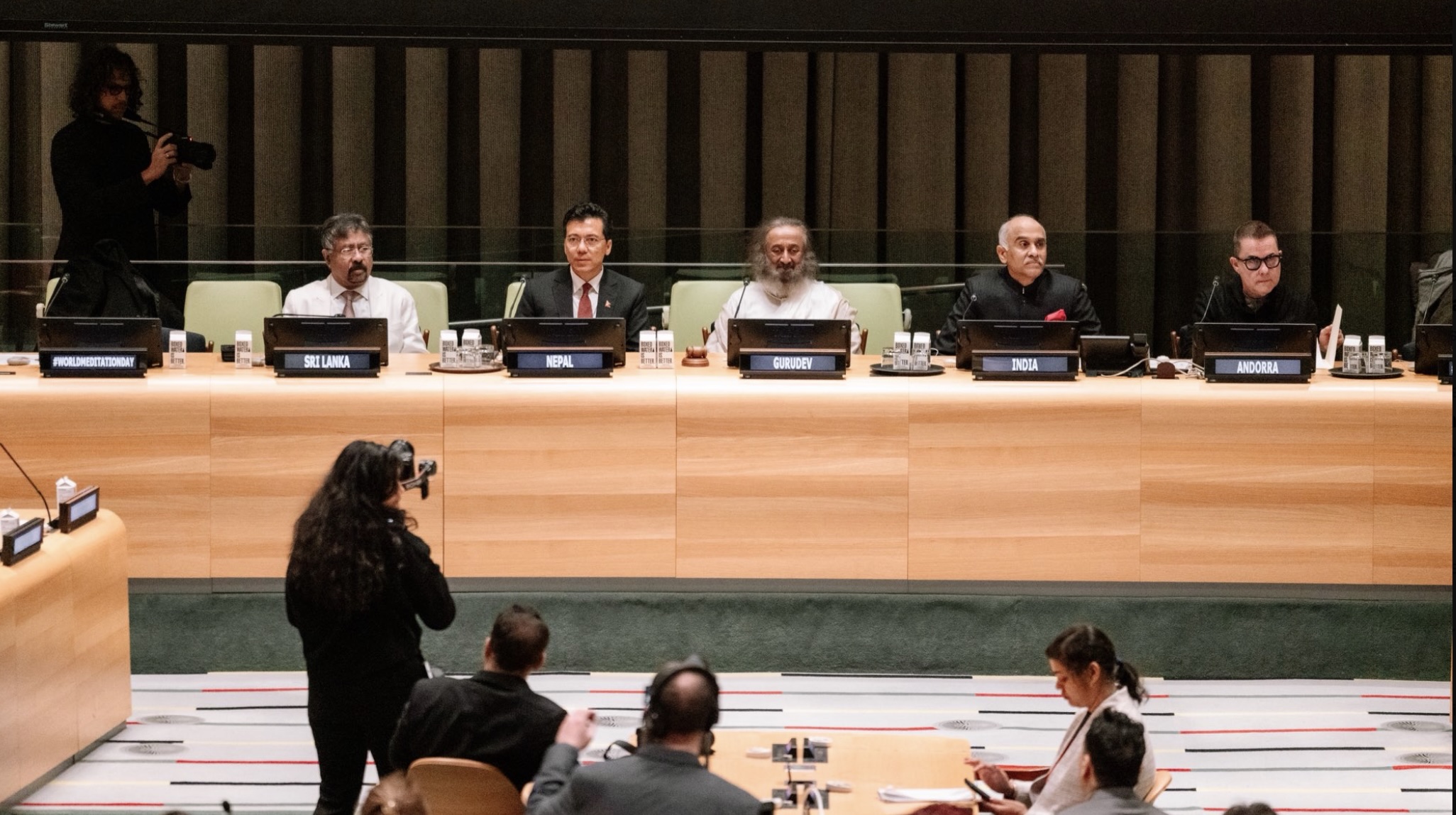
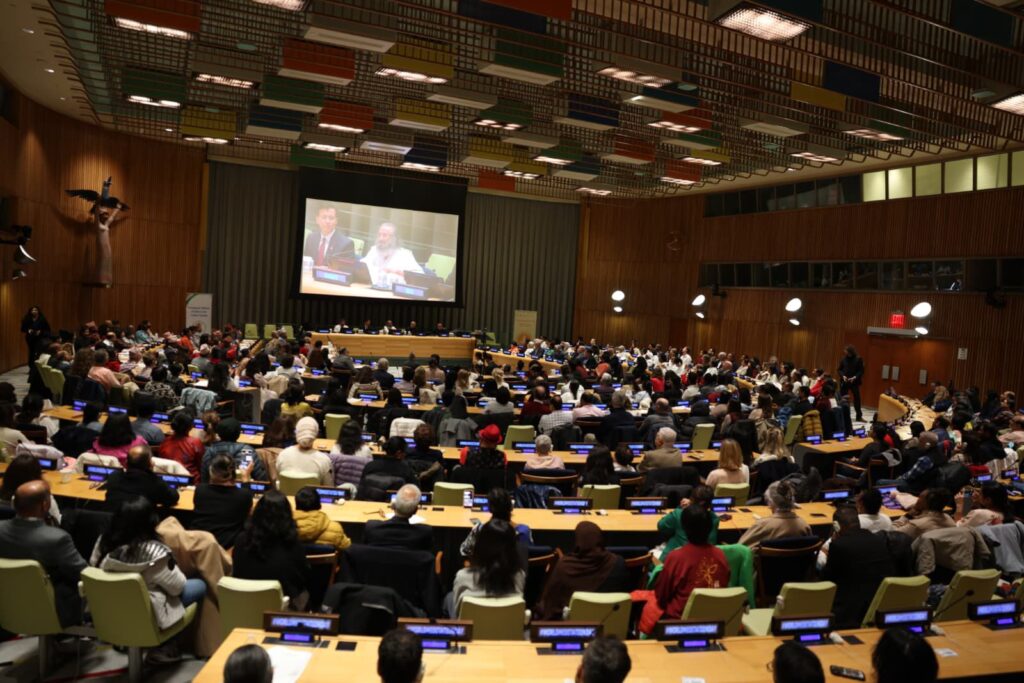
The Permanent Mission of India to the United Nations, along with members of the core group from the Permanent Missions of Nepal, Sri Lanka, Andorra, and Mexico, celebrated the second World Meditation Day on December 19, 2025, at the Trusteeship Council Chamber at United Nations Headquarters.
The high-level event brought together nearly 700 participants. Global humanitarian, spiritual leader, and peace envoy Gurudev Sri Sri Ravi Shankar delivered the keynote address and led the audience in a guided meditation session.

In his address, Gurudev noted that attention deficiency has become widespread, with many people unable to focus for more than 30 seconds. “Meditation is absolutely essential,” he said, adding that nearly 500 universities around the world have adopted meditation programs. He noted that hospitals are also incorporating meditation practices and shared that even 8000 soldiers fighting in Ukraine meditated and found peace.
For soldiers who had experienced deep darkness, lost hope, felt depressed, and were unable to sleep, meditation helped them regain their spirit, he said, pointing out that meditation was taught on the battlefield itself. He recalled that Lord Krishna taught Arjuna the Dhyana yoga right on the battlefield.
“In this conflicting situation, it is very important for us to go within,” he stressed, adding that when people attempt to meditate, they often complain of many impediments and an inability to focus due to constant thoughts.
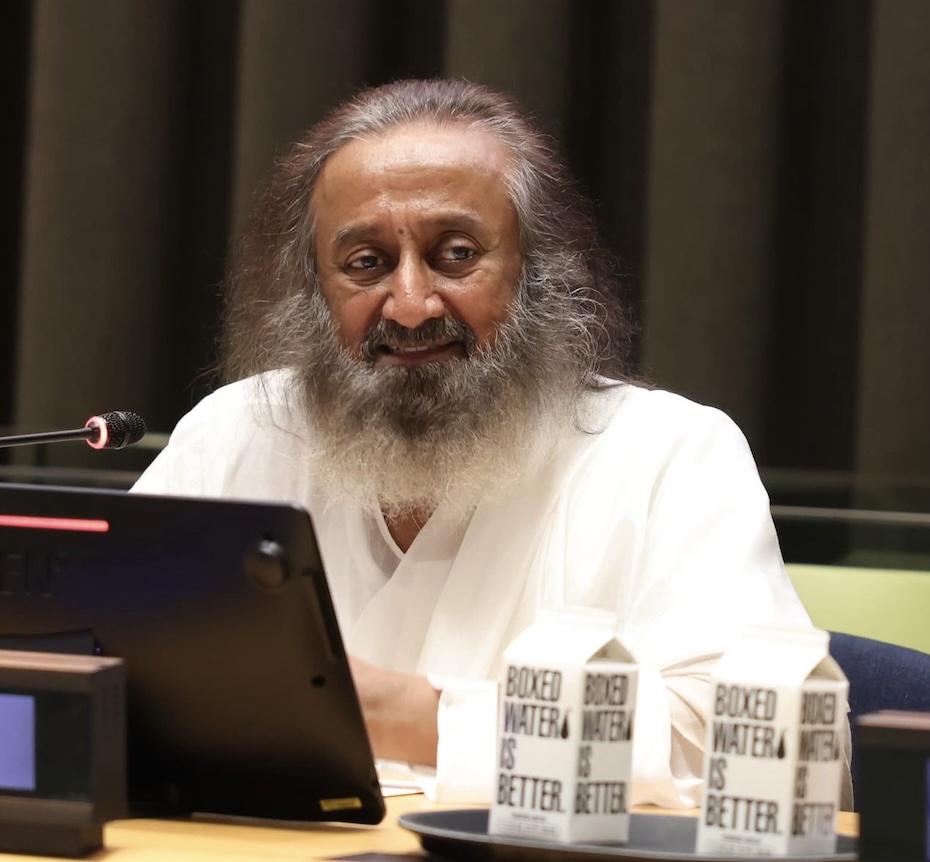
Gurudev explained that two forces, anger on one side and desire on the other, prevent the mind from settling. He said these factors not only obstruct meditation but also disturb sleep. He emphasized that everyone’s breath holds the secret. “The breath links our body and mind,” he said, adding that by attending to the breath, people can calm their emotions to a great degree. “So breathing is very helpful here,” he added. Gurudev also highlighted that he often emphasizes three important aspects of life, “passion, dispassion, and compassion.”
Permanent Representative of India to the United Nations, Ambassador Harish Parvathaneni, said, “As we celebrate the second World meditation day, we confront challenges of unprecedented complexity today, climate crisis, social polarization and technological disruption, combined with the economic uncertainties and rising interstate and intrastate conflicts,” adding, “We at the UN are most acutely aware of the stress that this brings to bear at the individual, social and global levels.”
He recalled that India was an active member of the core group that championed the resolution on World Meditation Day at the United Nations. On December 6 last year, the UN General Assembly unanimously adopted the resolution proclaiming December 21, which coincides with the winter solstice, as World Meditation Day.
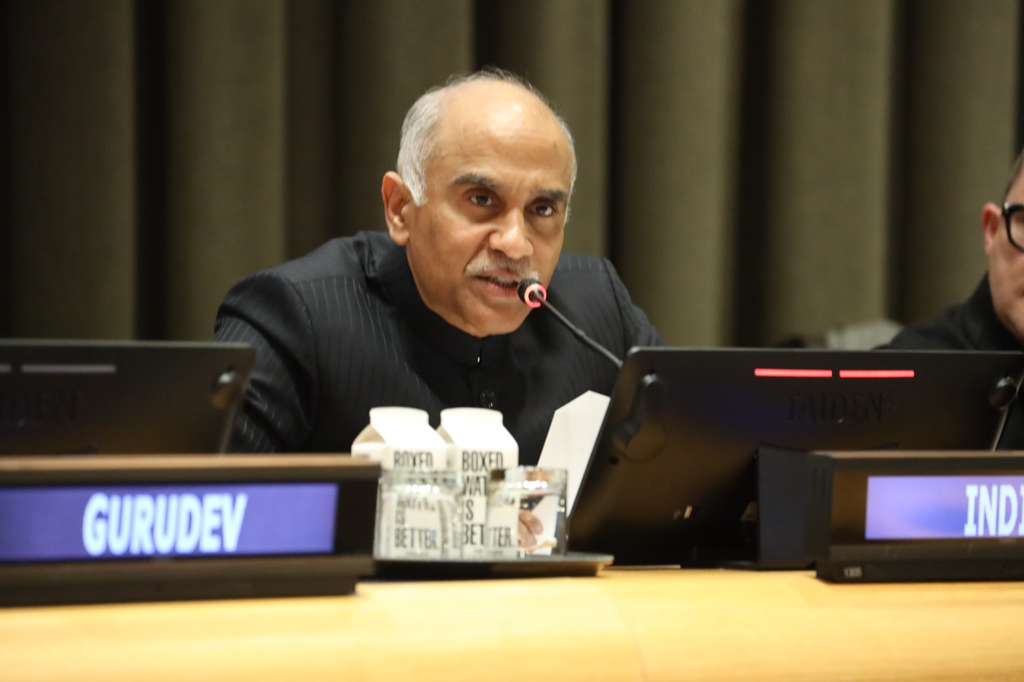
“The adoption of this resolution marks a significant milestone in acknowledging that meditation transcends cultural, religious and geographical boundaries, offering a universal template of transformation,” he added.
For India, Ambassador Harish said the recognition holds “special significance,” noting that meditation traces its roots back over 5000 years to ancient India, where Patanjali’s yoga sutra introduced the concept of Dhyana, a state of pure consciousness in which the mind’s relentless chanting subsides, giving way to “clarity and calmness.”
“India has always shared its heritage and wisdom with the world. And in the spirit of Vasudhaiva Kutumbakam, or the whole world is one family, we continue to work for the betterment of people across the globe,” Ambassador Harish said.
Permanent Representative of Nepal to the United Nations, Lok Thapa, said the day is not merely a “commemorative moment” on the calendar. “It is a moment to reflect and reconnect with our inner self for peace, harmony, and the collective well-being of humanity,” he said, adding, “It is also a moment to reaffirm a simple yet profound truth that peace begins from within and flourishes through global solidarity, harmony, peaceful co-existence, and just institutions.”
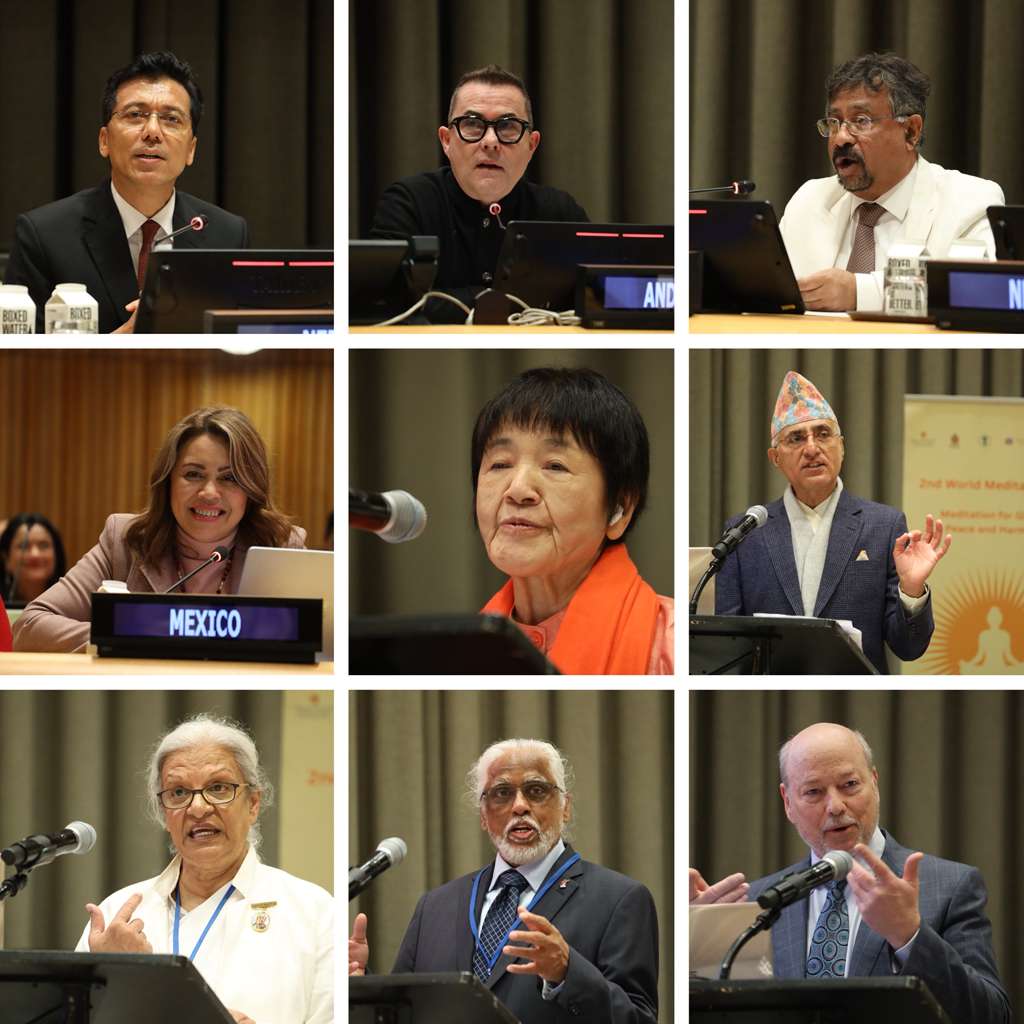
Ambassador Thapa noted that meditation is not an “abstract or distant practice,” but a “pragmatic” way of living and a pathway to “self-regulation, inner calm, and ethical clarity.”
“As Lord Buddha- the enlightened son of Nepal- preached us- meditation is a deliberate process of quitting the chaos within,” he said, adding that meditation has been embedded across cultures and civilizations for ages.
Permanent Representative of Sri Lanka to the United Nations, Jayantha Jayasuriya, said that for Sri Lanka, meditation is a “living tradition, deeply woven” into the fabric of its civilization for over 2300 years.
“From that moment in history, Sri Lanka became a sanctuary for the preservation practice and dissemination of meditation rooted in the Buddhist tradition,” he said, adding, “It is ingrained into our cultural and spiritual heritage, rooted in Buddhist teachings of mindfulness, compassion and nonviolence.”
Highlighting that meditation is practiced and embraced by many cultures and spiritual traditions around the world, he said, “Its universal nature lies in its ability to calm the mind, strengthen emotional balance and foster insight into ourselves and others.”
Permanent Representative of Andorra to the United Nations, Joan Forner Rovira, said his country is a leader in Europe in the field of education and has already seen the benefits of meditation in schools.
In today’s fast-paced world, he said, education is no longer only about “transmitting knowledge,” but also about helping students and teachers develop “focus, emotional balance and well-being.” This is why meditation is increasingly recognized as a valuable educational tool.
“Meditation is a simple practice that trains the mind to be present and attentive when introduced in schools, even for a few minutes a day. It helps students improve concentration, memory and self-awareness. By learning to pause and observe their thoughts students become better equipped to manage stress, anxiety and academic pressure,” he added.
Counselor at the Permanent Mission of Mexico to the United Nations, Gabriela Murdero, said, “In a world marked by constant struggle, uncertainty, and noise, meditation offers us a refuge of silence and reflection,” adding, “Now that we can all agree that technology and other external improvements do not lead to peace and contentment, it is when contemplation and spirituality offer us a way to live a better life.”
Several distinguished speakers also addressed the gathering, highlighting various aspects of meditation. Yogmata Keiko Aikawa and Sister BK Gayatri from the Brahma Kumaris Organization shared their experiences of practicing meditation and spreading awareness worldwide.
LP Bhanu Sharma, co-founder of the Jeevan Vigyan Foundation in Nepal, spoke about providing practical education in yoga and meditation. Dr. Lasantha Chandana Goonetilleke, Professor at Rutgers University, and Dr. John Hagelin, Physicist and International President of the Global Union of Scientists for Peace, shared insights on the potential of meditation as an instrument to enhance humanity’s ability to address contemporary challenges.
On December 6, 2024, the United Nations General Assembly unanimously adopted resolution A/RES/79/137, officially declaring December 21 as World Meditation Day. The first World Meditation Day was celebrated at United Nations Headquarters on December 20.
Related posts:
 World Meditation Day: United Nations Highlights Meditation’s Role in Mental Well-Being and Global Peace
 Gurudev Sri Sri Ravi Shankar to Lead Global Meditation for Peace on World Meditation Day, December 21
 Gurudev Sri Sri Ravi Shankar Foresees India-Pakistan Peace if Terrorism Ends, Calls for Global Harmony
 Gurudev Sri Sri Ravi Shankar Receives 2025 World Leader for Peace and Security Award