Join WhatsApp Channel


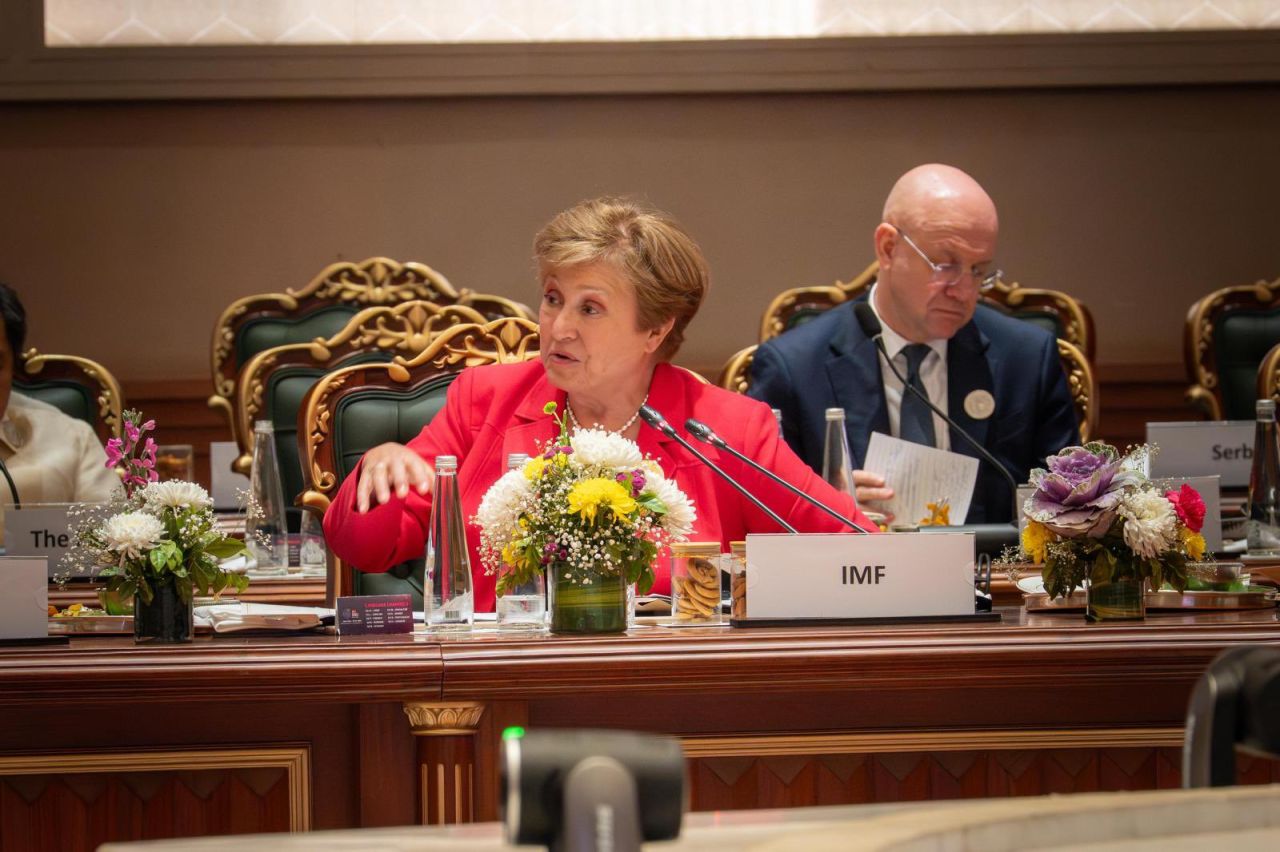
Managing Director of the International Monetary Fund, Kristalina Georgieva, said artificial intelligence has already become a defining force in the global economy, describing it as both a transformative opportunity and a profound challenge.
“AI has arrived; it is here,” she noted during her address on February 19, 2026, at the India-AI Impact Summit 2026 in New Delhi.
Congratulating Prime Minister Narendra Modi, Minister for Railways, Information & Broadcasting, Electronics & Information Technology Ashwini Vaishnaw, and other organizers, Georgieva said, “AI will bring opportunity and challenge—and it is for us to maximize the benefits.”
She observed that investment is rapidly expanding into “data centers, power plants, and neural networks,” comparing the moment to the era of railway construction, when economies were reshaped. “The old ways of doing things will be changed forever, and this time it will be much faster,” she said.
Outlining the potential gains, Georgieva said AI could significantly enhance productivity worldwide. According to IMF estimates, AI has the potential to raise global annual GDP growth by as much as 0.8 percentage points. She described this as substantial upside potential for the global economy.
“On a human level, we can expect countless small wins,” she said, citing examples of AI-driven medical and agricultural solutions. She noted that a woman in Nagaland could receive a medical diagnosis through a smartphone image, while a farmer in arid Kutch could use AI tools to determine optimal crop choices and timing. “It fires up the imagination,” she added.
Labor Market Shifts and Risks
Turning to the labor market, Georgieva cautioned that “AI will massively transform the world of work.”
She referred to new IMF research that suggests workers with complementary skills will see increased demand and higher wages in AI-enhanced roles. Increased earnings, she said, could stimulate broader economic activity, particularly in service sectors. For every one person hired directly into AI-related roles, IMF estimates indicate a net addition of 1.3 jobs overall.
However, she warned of disruptions linked to the speed of technological change. Middle-income roles that are not augmented by AI may be replaced altogether.
“I worry about a hollowing out of the middle, for young call-center workers that may be replaced by bots, for IT graduates potentially replaced by algorithms,” she said. “We must prepare, and the best preparation is to be open-eyed about the risks of AI and invest in people.”
India’s Approach to AI
Describing India as an ancient yet dynamic nation filled with optimism and creativity, Georgieva praised the country’s human-centered AI strategy.
“I want to salute an AI strategy centered on the human dimension, focused on delivering real wins for real people, never forgetting the least fortunate amongst us. How befitting for the world’s largest democracy,” she said.
She contrasted India’s approach with others that emphasize increasingly complex large language models or high user fees. Instead, she noted, India prioritizes practicality, accessibility, reach, and open-source models.
“This is the spirit that sets India apart,” she said.
Georgieva also highlighted India’s role in advancing digital public infrastructure and promoting broader access to AI tools. “I find it especially admirable that India knows the good it can do for others—with its digital interfaces and human ingenuity, it is on the forefront of making things happen, offering a unique focus on democratizing AI.”
She emphasized that India’s experience in designing practical solutions for both rural and urban communities’ position’s it to support low-income and developing countries globally.
Concluding her remarks, Georgieva cited India’s past contributions to global public health. She recalled how India’s pharmaceutical industry helped lower the cost of life-saving HIV/AIDS medications, expanding access for millions worldwide.
“So—India—let me leave you with this one earnest wish: go forth and help share the benefits of practical Indian AI,” she said.
Related posts:
 IMF Chief Praises India’s Tariff Reforms, Calls for “Clarity” in Global Trade Amid Economic Uncertainty
 Global Economy Shows Resilience Amid Tariffs and Uncertainty, Say Singapore’s Shanmugaratnam, IMF’s Georgieva, and ECB’s Lagarde
 Gita Gopinath Ends Tenure as IMF FDMD, Heads Back to Harvard
 Nandan Nilekani Champions the “Finternet” as the Future of Global Finance at IMF Panel