Join WhatsApp Channel



India is a nation whose history has always been manipulated big-time, by invaders from the Moghuls to the British and later by various elements in power. The Bengal Files is a massive wake-up call, the latest in a now-decent list of movies that expose hidden or lesser-known truths. Those with agendas even now term such films as “propaganda”, but those who have made deeper and impartial studies of history or are in the inner political circle are well-aware of what is fact and what is presented misinformation.
Vivek Ranjan Agnihotri, the director who once made vacuous thrillers like Chocolate and Zid, metamorphosed into a filmmaker with a mission with The Tashkent Files (2019). Emboldened by its success with the story revolving around the mishandled case of PM Lal Bahadur Shastri’s mystery death in the Russian city, he next took on the authentic Kashmir issue by making a story out of first-person accounts from the displaced Kashmiri Pandits. The Kashmir Files (2022) was a humongous hit.

Next came The Vaccine War (2023), the true saga of how India perfected a vaccine against Covid despite opposition from vested interests. And now, he takes on the story of the fragmentation of Bengal by fanatical Muslims with his latest expose, The Bengal Files.
This film is also based on first-person accounts and, as with The Kashmir Files, Agnihotri decides for cinematic convenience to narrate the true story around a limited set of characters. But real people like Mahatma Gandhi, Mohammed Ali Jinnah, Lord Mountbatten, the valiant Gopal Patha and Amar Singh Rathod and the arrogant separatist Surhawardy are also woven in.
Hardly any Indian is aware, thanks to the abovementioned tactics of the powers-that-be over decades, that the biggest genocide that took place in those days was not Jallianwala Bagh, but in Bengal on Direct Action Day, and lasted for a week. In this carnage, an estimated 40,000 Bengali Hindus were brutally killed. The riots also spread to other states like Bihar, Uttar Pradesh and more.
And what was Direct Action Day, which fell on August 16, 1946? It was a call by Jinnah to Muslims to go on a Hindu-killing spree as the Indian National Congress (of which he had initially been a member himself!) had opposed the creation of Pakistan when the British were to leave India. The motto, coldly, was “Divide India or Destroy India”!
Agnihotri, also the writer, tells the saga of Bharti Banerjee (Simratt Kaur Randhawa), a fierce young girl who hates both the British rule and a potential two-nation concept, as she and her parents face brutality from the Muslim mob unleashed on the above date. She befriends a Sikh revolutionary, Amar Singh Rathod (Eklavya Sood) and together, they align with her uncle, Roychowdhury (Dibyendu Bhattacharya) against the Muslim fanatics. Her parents have already been murdered.
The killers are led by a despotic maniac, Gulam (Namashi Chakraborty), who slowly begins to gain the upper hand in Noakhali, the Bengal district wherein this story is focused. Almost 80 years later (in present day), Bharti is now an aged woman with dementia (Pallavi Joshi Agnihotri), and a suspect (!!) in the disappearance of a Scheduled Caste girl who was planning to expose a Muslim politician, Sardar Husseini (Saswata Chatterjee), who is also suspected of kidnapping or getting rid of her. Bharti is on the suspect list as she was the last person to have seen her.
And the CBI assigns officer Shiva Pandit (Darshan Kumaar) to fact-find in this sordid case. Shiva meets Bharti, has a face-off with Sardar and ends up frustrated as he is helpless in the power-games. For during her clear moments, Bharti has told him about the horrendous human butchery she and the Hindus had faced in the past.
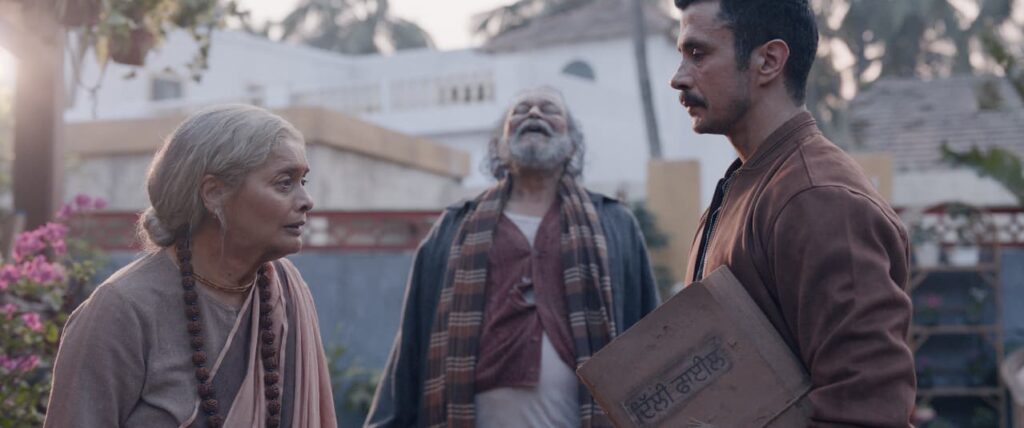
Gandhi’s dictum of non-violence too is questioned, especially when his Hindu followers had suffered rather than fighting back the lesser number of attackers due to his diktat of ahimsa.
And now the vital question arises: has India really changed after 78 years of Independence? Are we as a people and a nation truly free and without fear? And why do we think Hindu-Muslim first instead of thinking that we are all Indians?
This praiseworthy saga is told with complete and searing honesty and frankness. And that means unflinching, unbridled and unimaginable violence, brutality and gore, which as shown must be less than 10 percent of what really happened! This is what truly chills the viewer, though I must admit that for narrative purposes, the screen depiction could have been still curtailed. And I say this less for the esthetic and cinematic impact and more for the fact that the length of the film escalates to a massive 204 minutes!
Agnihotri’s splendid cast augments the impact of this story that needed to be told. His wife, Pallavi Joshi Agnihotri, is plain incredible in the way she gets all the nuances right as the dementia-afflicted older Bharti. Her blank gaze for long and the smaller details are etched to perfection. What a performance!
The second brilliant turn comes from her younger version, Simratt Kaur Randhawa. After her sketchy role in Gadar 2, Simratt comes into her own and packs a solid wallop in her fiery Durga-esque avatar. Darshan Kumaar as Shiva is alright, his sincerity diluted by some demanding sequences where he falls short.
As Amar Singh Rathod, Eklavya Sood is excellent. As Gandhi, Anupam Kher may not be the best film version of the leader but is also not the worst!
Saurav Das in the brief role as Gopal Patha is excellent and so is Rajesh Khera in a significant essay as Jinnah. Saswata Chatterjee as the amoral Husseini chills, and Divyendu Bhattacharya as Roychowdhury, Priyanshu Chatterjee as Bharti’s father, Puneet Issar as the CBI chief, Anubha Arora as Gauri, and Mohan Kapur as Surhawardy also essay their roles will skill.
Finally, we come to the family whose three members are in the main cast: Mithun Chakraborty and his son Namashi and daughter-in-law Madalsa Sharma. Mithun is fantastic as the man who once was ardently patriotic and has now become a frustrated, cynical inebriate. His shaggy look and smile should win awards for his make-up team as well.
Namashi as Gulam is outstanding with his menacing expressions and gait and this is a great comeuppance for an actor who is just one film old before this. Madalsa as Husseini’s wife does well in her limited role.
Technically, the film is upscale, and special marks are in order for the cinematography (Attar Singh Saini), production design, VFX and more. The background score (Rohit Sharma) is another asset.
With a little less reliance on formulaic tropes (yes, some are there too!) and stricter clinical editing, the film would have been a masterpiece.
Rating: ****
Abhishek Agarwal Arts’ & I Am Buddha Productions’ The Bengal Files Produced by: Abhishek Agarwal, Pallavi Joshi Agnihotri & Vivek Agnihotri Written & Directed by: Vivek Agnihotri Music: Rohit Sharma Starring: Darshan Kumaar, Mithun Chakraborty, Pallavi Joshi Agnihotri, Simratt Kaur Randhawa, Anupam Kher, Namashi Chakraborty, Rajesh Khera, Saswata Chatterjee, Dibyendu Bhattacharya, Eklavya Sood, Saurav Das, Madalsa Sharma, Priyanshu Chatterjee, Puneet Issar, Anubha Arora, Mohan Kapur & others
Related posts:
 US Premiere of “The Bengal Files” Draws Packed Audience in Virginia, Highlights Forgotten History of Partition
 Khakee: The Bengal Chapter Works Despite a Tad Lengthy Narration
 FWICE Condemns Undeclared Ban on “The Bengal Files” in West Bengal Theatres
 How Hindi Cinema Will Regale Us in the Last Four Months of 2025