Join WhatsApp Channel


Some movies are destined for great things, but with conditions applied. So is Dhurandhar.
Set for a press screening last week at 4 pm, the time was changed at the last moment to 7. But even as I was getting ready to go for the screening, I got a message that the show was canceled because of a technical glitch. It was rescheduled for the next morning and from then on, some pressing personal obligations kept me away from watching it, as the runtime was 214 minutes (which meant a 4 hour-plus show including ads and trailers!) and all told, including travel, I would need close to 5 hours at a stretch to watch it!!
When I finally went for an evening show, there was a minor technical glitch again of about 15 minutes and I exited the movie hall from a 6.15 pm show at close to 11! Happily, I noted that after ages, a weekday show in a movie hall was almost 50 percent full.
Dhurandhar, touted as an Indian political-espionage-meets-action drama of international caliber, can be truly called that. It does not waste time despite its inordinate length, and even the gore (on level with KGF2, Animal and the reality-based The Kashmir Files and The Bengal Files) only whips a fever of fervor for our nation within us.
The film is semi-historical (the makers chicken out as usual and blurb it as a “fictional drama” that is admittedly based on real happenings). It begins with the IC814 hijack in 1999, moves to the Parliament attack in 2001 and encompasses the spread of counterfeit Indian currency as well as the 26/11 Mumbai attacks later.
Before I go into other aspects, a serious nitpick: the film is divided into Chapters with English titles given. Why then do the Hindi titles repeat the English one in Roman? Could not they find a translator???
The film narrates how Sanyal, director of India’s Intelligence Bureau (based on the real Ajit Doval) decides to launch Operation Dhurandhar when desperate measures are finally needed against Pakistan—by which a dedicated officer is sent to live in Pakistan and work for us as a local.
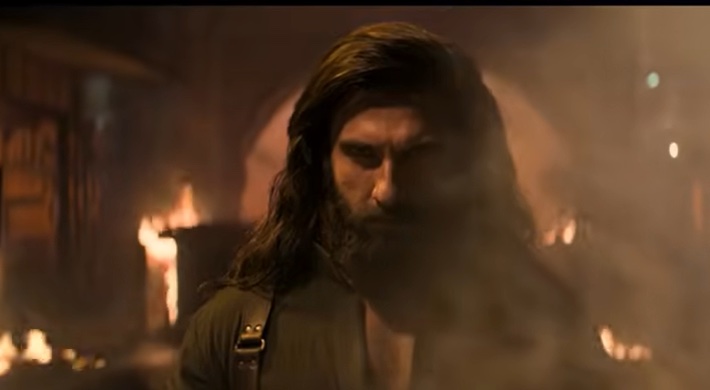
And so, death-row prisoner Jaskirat Singh Rangi (Ranveer Singh) is trained and turned into Hamza Ali Madari and infiltrates Lyari, a mafia-infested district in Pakistan where two gangs are staging a war of one-upmanship. The Pakistani underworld also has a nexus with its politicians as well as ISI-sponsored terrorism.
Hamza befriends Baloch gang chief Rehman Dakait (Akshaye Khanna) by a cunning maneuver and leverages into his gang and gives him key advice that benefit his status as well as finances. A wily politician, Jameel Jamali of the Pakistan Awam Party (Rakesh Bedi) is also involved with him, and Hamza also falls for his medical student (we never see her as a student!) daughter, Yalina (Sara Arjun), who reciprocates despite knowing Hamza’s angst against society and his illegal activities.
Soon, Hamza comes to know of the conspiracies hatched against India, especially by the ISI’s Major Iqbal (Arjun Rampal) who is a sadistic India-hater. Hamza, along with his ‘handler’ Mohammed Aalam (Gaurav Gera), communicate information to the Indian authorities, but there are only inactions or collusions between malefic forces in India. As Sanyal says pointedly: “Hindustan’s biggest enemy is a Hindustani. Pakistan only comes in at number two!”
After 26/11, Hamza’s rage knows no bounds. He invokes strategic ties with the mafia-political nexus to ensure that Rahman, who supplied the arms and explosives to ISI-sponsored terrorists for 26/11, is killed and he takes over Lyari.
The film ends with the promise of Part II, titled, Revenge, scheduled for release on March 19, 2026.
The cinematography (Vikash Nowlakha) is awesome, replicating the grime and dust as well as the dark-hued emotional voltage. Loaded with much more than weaponry and violence in its emotions-rousing capability, the film reminds me more of the scathing, scorching realism of The Kashmir Files than of any other Indian film. The gore is deliberately kept revolting, like the torture of the Indian agent by Iqbal, or the bloodied and brutal way Hamza elicits a confession from Rahman’s trusted cook of decades when he poisons Rehman’s son.
The dialogues are fiery but far from jingoistic, as the screenplay is kept in tight control to move to the climax (which will be seen only in Part II), but there is an occasional flash of humor as well. The romantic track is seamlessly built into the narrative and does not really distract but capitalizes on the fractured relationship between Jamaal and his daughter, Yalina, which moves the story forward. Similarly, the introduction of SP Chaudhary Aslam (Sanjay Dutt), the vengeful suspended cop, is tangy and I, for one, found his character likeable even if ruthless and foxy. And Dutt is terrific in his long “special appearance”.
Ranveer Singh will take a long while to get a better character than this openly-violent, brooding and calculating man on a mission who can go to any lengths in both subterfuge and love. He is good beyond words, his every movement and facial expression bang-on for his role. Akshaye Khanna is colossal as Rahman, once again understating his versatility. His expressions may be a shade limited, but they are supremely in sync with his character. R. Madhavan looks amazingly like the real Doval and again shows his chameleonic skills as a tremendous artiste.
Sara Arjun does a sincere and effective Yalina, her dramatic scenes remarkably well-done for an actress of her comparatively limited experience. Three actors who are known for a completely contradictory comic image—Saumya Tandon, Gaurav Gera and above all, Rakesh Bedi, are all brilliant in their serious turns. Danish Pandor as Rahman’s second-in-command Uzair Baloch, Naveen Kaushik as Donga and the actors playing the Khanani brothers (Ankit Sagar and Mushtaq Naika) impress.
The editing (Shivkumar V. Panicker) is as sharp as a razor, the action (Yannick Ben, Ramazan Bulut and Aejaz Gulab) spectacular and raw, and the production designer (Saini S. Johray) and art directors Yogesh Bansode, Choudhari Nilesh and Neeraj Kumar Singh along with the VFX team deserve high encomiums. The replication of Pakistan, the shots of Leh Ladakh and more are done with exemplary efficacy by the joint efforts of all these.
Shashwat Sachdev’s background music is top-class, his songs (original and also with interspersed recreations) notable, with Shararat and Gehra hua standing out. Irshad Kamil’s lyrics in Ishq jalaakar and Gehra hua stand out.
The film is an Aditya Dhar baby as writer and director, though there are script supervisors also mentioned. The director in him, returning after six years as a filmmaker, reaffirms his credentials after URI—The Surgical Strike and creates a near-epic in his second film. It will not be a patriotic Indian who is not unmoved by the film and finds a tight lump in his throat on many an occasion, along with intense feelings of how so many people work for us so that we may lead safe and normal lives.
Onwards then to March 19, 2026!
Rating: ****1/2
B62 Studios’ & Jio Studios’ Dhurandhar Produced by: Lokesh Dhar, Aditya Dhar & Jyoti Deshpande Written & Directed by: Aditya Dhar Music: Shashwat Sachdev with re-created music from Roshan & R.D. Burman, Music piece by Laxmikant-Pyarelal, Bappi Lahiri (Original song) & Hasan Jahangir (Original song) Starring: Ranveer Singh, Akshaye Khanna, Sanjay Dutt, R. Madhavan, Arjun Rampal, Sara Arjun, Rakesh Bedi, Gaurav Gera, Saumya Tandon, Manav Gohil, Danish Pandor, Naveen Kaushik, Akash Khurana, Krystle D’Souza, Ayesha Khan & others