Join WhatsApp Channel


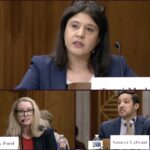
On February 17, the U.S.-China Economic and Security Review Commission held a hearing on “India, China, and the Balance of Power in the Indo-Pacific,” at the Dirksen Senate Office Building, in Washington DC.
On the agenda, “Economic and Technology Stakes in China-India Relations,” commissioners questioned three experts on how the United States and India can work together to limit China’s influence and stay ahead in technology and supply chains.
Distinguished Visiting Fellow at the Hoover Institution and former official at the National Security Council Tarun Chhabra framed India as central to the technology contest with China. “The U.S.-India Government initiatives to enhance defense and technology partnerships, I think, are critical because India represents the single most important swing state in our global technology competition with the Chinese Communist Party,” he told the commission. He said India’s choices will shape “whether the Indo Pacific operates within a U.S.-led democratic technology ecosystem or a CCP led authoritarian one.”
He said India matters because of scale. “India is the only market on Earth that combines more than 1,400 million consumers, a rapidly expanding digital economy and broad alignment with the United States on the China challenge,” he said. He argued that when American firms work at scale in India, it helps the United States compete.
Commissioner Hodges raised the toughest security concern. He said India remains “structurally dependent on Chinese components across its technology supply chains.” He also warned that “cloud and API access are significant loopholes.”
Tarun Chhabra said India has already shown it can take tough steps. “There’s good news in that since 2020, India has taken some significant steps,” he said. “They banned a number of Chinese software applications,” he added. He also said India has created “standards for trusted supply chain to critical communications goods.” He then described a plan focused on alignment. “If we were to come into better alignment,” he said, “on the security risks of discrete IoT goods, of cloud services, of Chinese connected vehicles,” then “we can actually, again create a common trusted market.”
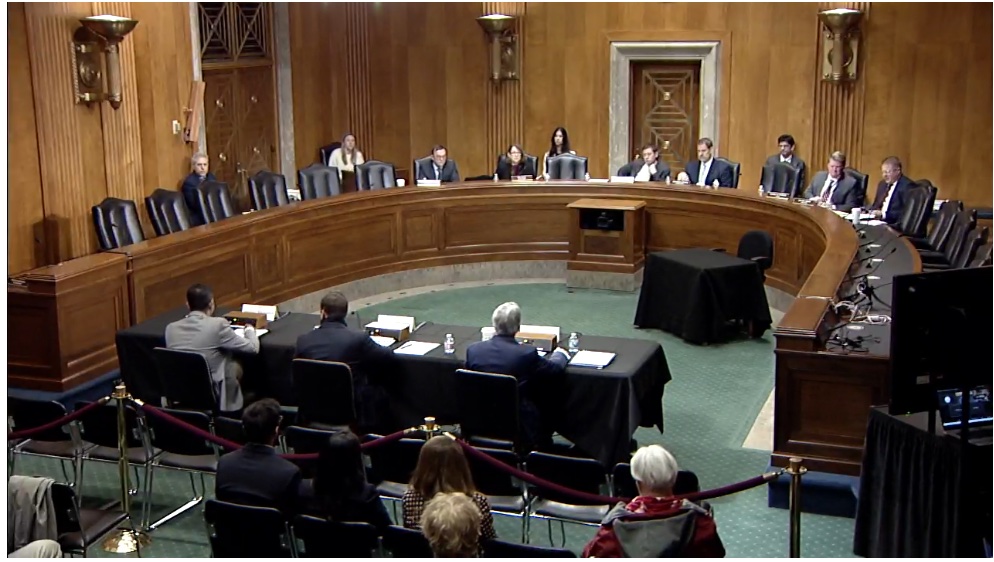
Commissioner Hal Brands questioned Tarun Chhabra on export controls, enforcement, and whether the United States should raise the bar before sharing advanced technology. Chhabra said export control alignment was “a sine qua non of further technology sharing.” He said the issue is not only rules on paper. He stressed “actual implementation capability and enforcement capability.”
Commissioner Slevin asked what Congress can do when the problem demands speed but also long-term continuity. To which Chhabra replied that oversight matters, and he urged lawmakers to use existing tools. He called for “strong oversight of the ICTS authorities that the Commerce Department already has.” He also warned that China-linked risks are moving into everyday systems. “Cars are going to be integrated into smart cities,” he said. “These cars will also be integrated [into] our grid.” He added, “We have to stop thinking about these as kind of discrete goods.”
He argued the United States should work with partners on a shared approach. “Why would we create more vulnerabilities for these goods?” he asked. He said Washington should go to “like minded countries” to “align on what the threat landscape looks like” and build “a common framework.”
Fellow at the Observer Research Foundation Soumya Bhowmick told the commission India cannot unwind its China exposure quickly. He described India’s approach as “managed interdependence under strategic competition.” He said India can reduce dependence, but he warned against treating it as an instant political campaign. “The answer is yes,” he said, “but only if it is understood as a medium-term capability and ecosystem project, not a short-term political slogan.”
Commissioner Price asked Bhowmick what would be most impactful for U.S. policymakers who want to work with India. He replied, “There has to be more clarity so that you bring down transaction costs for in terms of economic partnerships.” He also warned commissioners not to force India into a simple choice. Bhowmick said the hearing’s framework should move away from “binary assumptions of India and China.” He said India is “taking up a strategic interdependence with China, which you cannot do away with over a short period of time.”
Soumya Bhowmick also summed up his point about uncertainty. “Right now, confusion is the biggest tariff,” he said. He said confusion creates disruption, and it affects “forecasting” and “hedging processes.”
Visiting Fellow at Duke University’s Margolis Institute for Health Policy Chan Harjivan spoke about the strategic significance of medicine supply and biotechnology. He told the commission, “Leadership in biotechnology and security of America’s medicine supply is no longer a narrow health policy issue. It has become an urgent core question of economic certainty, technological leadership and strategic resilience.” He described the supply chain split in one sentence: “China dominates the upstream, India the downstream.”
Harjivan warned about knock-on effects if China restricts key inputs. “If China restricts the exports of critical inputs, ripple effects cascade into India’s manufacturing base and ultimately into U.S. pharmacies,” he said.
He told commissioners the solution should be de-risking, not total separation. “The question for the U.S. policy is not how to decouple completely, but how to derisk and lead,” he said. He recommended steps for Congress. “Congress should amend existing law to require manufacturers to report Tier two and Tier three suppliers for medicines,” he said. He also said the federal government should change how it buys medicines. “The federal government through CMS, DoD and the SNS should shift procurement criteria to explicitly reward multiyear purchasing contracts and pay for resilience,” he said.
The U.S.-China Economic and Security Review Commission is a legislative branch commission created by the United States Congress in October 2000 with the legislative mandate to monitor, investigate, and submit to Congress an annual report on the national security implications of the bilateral trade and economic relationship between the United States and the People’s Republic of China, and to provide recommendations, where appropriate, to Congress for legislative and administrative action.