 Join WhatsApp Channel


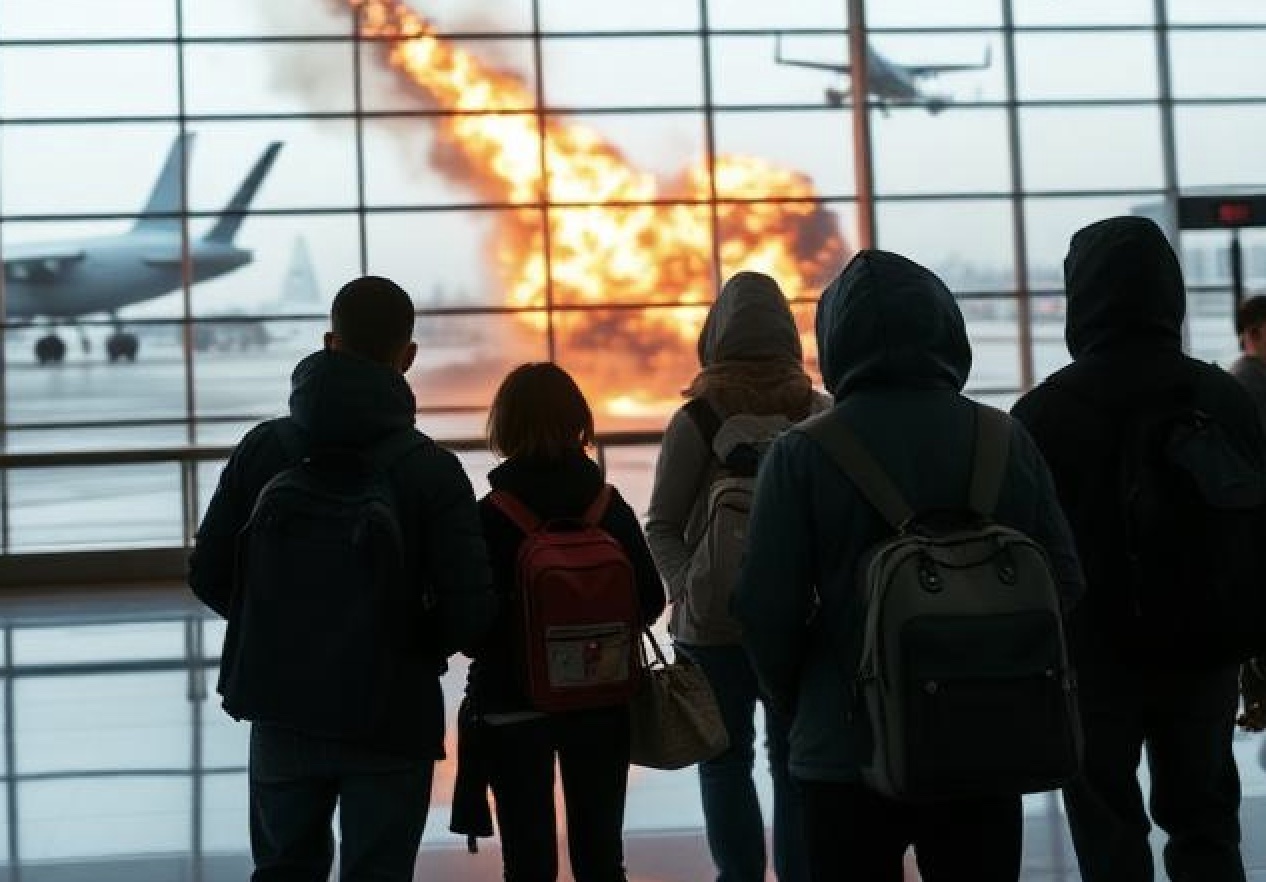
The first explosion sounded, they say, like a door slamming somewhere in the sky.
Then came the sirens.
In the early hours after coordinated strikes by the United States and Israel killed Iran’s Supreme Leader Ayatollah Ali Khamenei on February 28, the war stopped being something distant and strategic. For millions of South Asians across West Asia, it became immediate — a vibration under their feet, a flash above their labor camps, a message from home asking, “Are you safe?”
From the glass towers of Dubai to student dormitories in southern Iran, the chill of conflict has crept into ordinary lives.
“We watched the sky flare and dim”
In Ahvaz, southern Iran, 22-year-old Asif Gulzar stands by the ninth-floor window of his medical hostel. The city lights blink in and out. Missile interceptions streak across the night like unnatural lightning.
“We have been hardly able to sleep since the attacks began,” he says. “Almost every other minute, there are explosions happening in the city.”
After Khamenei’s death was confirmed by Iranian authorities, retaliation followed swiftly. Iranian missiles and drones targeted Gulf states — the UAE, Bahrain, Kuwait — and shipping lanes in the Strait of Hormuz. Airspace shut down. Airports froze mid-sentence. Internet access flickered.
“From here,” Asif says quietly, “we just watch the sky flare and dim.”
He is one of roughly 3,000 Indian students in Iran. Universities have closed for 15 days. Many are cut off from regular communication. Their families in Kashmir, Delhi and Kerala call repeatedly, clinging to patchy connections.
An unnamed Indian student in Tehran posted a trembling video appeal: “We are hearing bomb sounds every 15 minutes. It is very disturbing here. Please take us home.”
But there are no flights out. The airspace is sealed.
Airports that turned into waiting rooms of fear
At Abu Dhabi airport, what began as routine departures dissolved into confusion.
Esha Gupta, an Indian actor who was scheduled to fly out on February 28, recalls the moment screens went blank.
“By 1 pm, the airport was closed. Chaos all around as none of us knew what happened,” she said later. “Strangers consoling each other, all calling their families back home.”
Phones buzzed with alerts from the UAE’s Ministry of Interior: Seek shelter.
Passengers disembarked. Some wept quietly. Others scrolled obsessively through news feeds. Smoke was reported near parts of Dubai after debris from intercepted drones fell.
Tushar Gagerna, a Dubai-based professional waiting to fly to Delhi, described “that strange collective silence” on the aircraft before they were told to get off.
Then something shifted.
“The UAE kicked into gear immediately,” he said. Dedicated waiting areas appeared. Free food and water were distributed. Emergency visas were issued on the spot. Buses lined up to take stranded passengers to hotels.
“Not chaos. Not bureaucracy. Instant humanity.”
Within 48 hours, limited commercial operations resumed. Etihad Airways and Emirates restarted selected flights from Abu Dhabi and Dubai. Indian carriers — Air India, IndiGo, and SpiceJet — mounted special services to ferry citizens home.
On March 3, one Air India flight from Dubai carried 149 passengers and eight crew into Delhi — the third such “special flight” in days.
For those who boarded, relief arrived in waves. Applause broke out on landing. Some knelt to touch the ground.
In the labour camps, there is no applause
Beyond the airports, in worker housing clusters on the outskirts of Dubai and Abu Dhabi, the fear has been rawer.
Rakib Sikdar, a 37-year-old security guard sharing a room with six others in Dubai Silicon Oasis, says they broke their Ramzan fast when they heard a blast.
“We ran outside and saw what seemed like a drone fall down,” he says. “Our building was shaking. Nobody could sleep last night.”
Whenever another explosion echoed, men rushed to balconies, scanning the sky. Some recorded videos; most simply stared.
In a labour camp near Abu Dhabi housing up to 4,000 mostly Punjabi workers, Gagandeep, 24, says they have been told to remain indoors. “It’s scarier at night,” he says. “Work is suspended.”
A missile reportedly fell less than a mile from another camp, engulfing the area in smoke. Debris injuries have been reported across the UAE and Bahrain. At least one Indian, one Pakistani, two Bangladeshis and one Nepali national are among the confirmed civilian dead in the Gulf since the strikes began. Several Indian seafarers were killed or injured when vessels near Oman were hit.
For families back in Jalandhar, Baramulla or Dhaka, the news arrives stripped of context — just names, villages, and a call that did not connect.
“I spoke to my family in Dubai and they are living in fear,” says a relative in Punjab. “They say drones are visible from the balcony.”
Governments in overdrive
India, with nearly nine million citizens in the Gulf, has launched one of the largest coordinated responses.
The Ministry of External Affairs activated 24×7 helplines and relocated its Tehran embassy operations. Prime Minister Narendra Modi held calls with Gulf leaders, thanking the UAE for protecting Indian nationals. The Cabinet Committee on Security met in New Delhi to assess contingencies.
The Indian Navy has been placed on standby, recalling its role in past evacuations like Sudan’s 2023 mission. Quick-response teams are assisting Indian seafarers as shipping through the Strait of Hormuz faces disruption.
Pakistan says it has evacuated over 650 citizens from Iran, some via road crossings into Azerbaijan. Bangladesh has sought transit support for stranded workers. Nepal and the Philippines have issued shelter-in-place advisories.
China, too, has evacuated more than 3,000 nationals from Iran.
But even as aircraft lift off, thousands remain in limbo — stuck in dormitories, camps, hotel rooms.
“This is the first time a war felt personal”
An Indian content creator who landed in Dubai mid-crisis described seeing smoke near Palm Jumeirah and crowded terminals filled with anxious families.
“It’s the first time a war felt personal,” he wrote.
That sentiment echoes widely. For decades, Gulf migration has been an economic lifeline for South Asia. Construction workers, nurses, drivers, engineers — nearly 24 million South and Southeast Asians underpin the region’s workforce.
Now, they are navigating missile alerts and financial uncertainty. Prolonged airspace closures mean missed wages. Workers paid daily fear income gaps. Students worry about exams, degrees, and visa timelines.
And always, the phones ring.
Back in Kashmir, parents refresh news feeds deep into the night. In Madhya Pradesh, a mother tells neighbours her son says the explosions sound “like thunder that doesn’t stop.”
As of March 3, limited flights are resuming. Governments urge calm. Host nations emphasise civilian safety.
But the war’s geography has already expanded — into cramped dorm rooms, into WhatsApp groups buzzing with SOS messages, into the quiet dread of watching the sky.
For millions of South Asians in West Asia, this is no longer about geopolitics or strategic deterrence. It is about getting through the night.
Related posts:
 ‘Indiaspora Forum for Good’ to Unite Global Indian Leaders for Actionable Solutions, Collaboration, and Innovation
 Indiaspora Forum for Good Summit in Abu Dhabi Strengthens India-UAE Partnership, Says UAE Minister
 Iran War Raises Energy, Trade and Inflation Risks for India and South Asia
 Bridging Cultures and Strengthening Partnerships: Reflections on the Indian American Delegation to UAE and Bahrain
