Join WhatsApp Channel



America’s volatile foreign policy is forcing India to revisit its own priorities. Domestically, the Modi government seems intent to move faster on domestic reforms to buttress growth that is ordinarily fueled by commercial ties with the United States. Internationally, India is redoubling efforts to build stronger bilateral connections with key partners. Recent summits with the leaders of Russia and China received a great deal of attention. Fortunately, India’s emerging concrete, long-term security, and commercial deals tend to focus on America’s partners and allies. These partners also seem eager to embrace India as part of their own hedging strategy.
Despite recurring difficulties, the United States is India’s indispensable economic partner. America is India’s largest export destination for both goods and IT services; the largest source of remittances; and, while “official” totals for inward foreign investment place the United States as the third-largest source, this is significantly distorted by Indian and third country investors taking advantage of India’s favorable tax treaties with Singapore and Mauritius. Some of our team’s earlier internal analyses places the U.S. in the top spot, accounting for around one-quarter of all of India’s foreign investment. India is also the top source of foreign students in American colleges and universities.

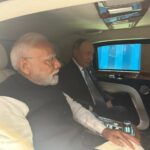
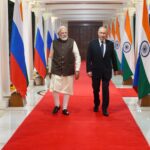
Despite these important proof points of U.S.-India connectivity, India’s membership in BRICS and the Shanghai Cooperation Organization (SCO) raises questions about whether India is drawing even closer to American adversaries. Recent summits of these groups—and resultant photographs of Prime Minister Modi embracing Presidents Putin and Xi—reinforce this view. President Putin visited India on December 4-5, meeting with Prime Minister Modi and other senior Indian leaders. India’s linkages to these two nations are not inconsequential; both rank among India’s top 5 goods trade partners, and Russia remains a significant supplier of military equipment to India.
Helpfully, the “flash” of India’s engagements with American adversaries is overshadowed in “substance” with the quality of its agreements with America’s friends and allies. Some agreements pre-date President Trump’s return to office, but the pace of concluding agreements is accelerating. Look no further than comparing the outcomes of Prime Minister Modi’s late 2025 engagements with Japan and Philippines versus that of Russia. The India-Russia agreements are sectoral and tactical, covering topics like healthcare, food, and some modest investments.
The only outcome of real strategic value during the leaders’ summit might be the program of training Indian seafarers on polar routes, though the two countries subsequently signed a military “Reciprocal Logistics Support Agreement (RELOS)” in December 2025. India’s new agreements with Japan and Philippines are far more strategic, covering big picture security cooperation, tangible investments, space, and more.
India is increasingly comfortable with significant trade agreements. This is another key arrow in India’s quiver as it widens its economic relationships. India has signed six trade agreements in the last four years; three of these came in the last seven months.
Of these six agreements, three are with U.S. security treaty allies (Australia, United Kingdom, and New Zealand) while the other three are with countries that regularly cooperate with the United States on security matters (UAE, Oman, Swiss-led EFTA).

India will also highlight the renewed vigor in its relations with the European Union later this month. The annual Republic Day ceremonies on January 26 will feature the European Commission President, Ursala von der Leyen, and the European Council President, Antonio Costa.
India is also improving relations with China. But most of the concrete outcomes are merely returning to the status quo from a decade back, such as resuming direct flights, greater Indian openness to Chinese imports, and reports that India is streamlining visa processes for Chinese business leaders. However, the ceiling on the relationship remains quite low due to persistent frictions over their trade imbalance, Tibetan Buddhism, Pakistan, and more.
There are certainly some good opportunities for the United States and India to repair their damaged relationship. First, President Trump should commit to visit India soon for the Quad Leaders meeting and bilateral engagements. And second, the United States should move forward with the first phase of the trade agreement. The current version may not encompass everything President Trump wants, but it is likely pushing against India’s real redlines.
During this period of stagnant U.S.-India ties, it is comforting to know India’s most significant global engagements have largely centered around American partners. The distance to a “return to normalcy” is less vast than if India were strongly cementing ties with Russia, China, and Iran.
(The article was published by the Center for Strategic and International Studies (CSIS), on January 8, 2026. South Asian Herald republished it with permission from CSIS.)
Disclaimer: The opinions and views expressed in this article/column are those of the author(s) and do not necessarily reflect the views or positions of South Asian Herald.