Join WhatsApp Channel


Dhaka has spoken — loudly, decisively, and yet not without ambiguity.
The 13th Jatiya Sangsad election has handed the Bangladesh Nationalist Party (BNP) and its allies between 209 and 213 seats in the 300-member parliament, comfortably above the two-thirds mark. In parallel, voters endorsed the sweeping “July National Charter” with nearly 60 percent turnout and roughly 67–73 percent approval. On paper, it is a transformative mandate: regime change through the ballot box, institutional reform through referendum, and a return to competitive politics after the 2024 uprising.
But politics in Bangladesh rarely unfolds on paper.
The numbers are striking. The Election Commission confirmed turnout at 59.44 percent — significantly higher than the controversial 2024 vote and closer to historical participation rates. Postal ballots reportedly crossed 80 percent participation, a sign that expatriate and absentee voters were unusually mobilized. Officials described the process as “neutral, credible and festive,” a pointed attempt to contrast this election with the turbulence that preceded it.
Yet beneath the arithmetic lies a deeper question: does this result represent a democratic reset, or simply the rotation of dominance?
The Rise — and Risk — of a Supermajority
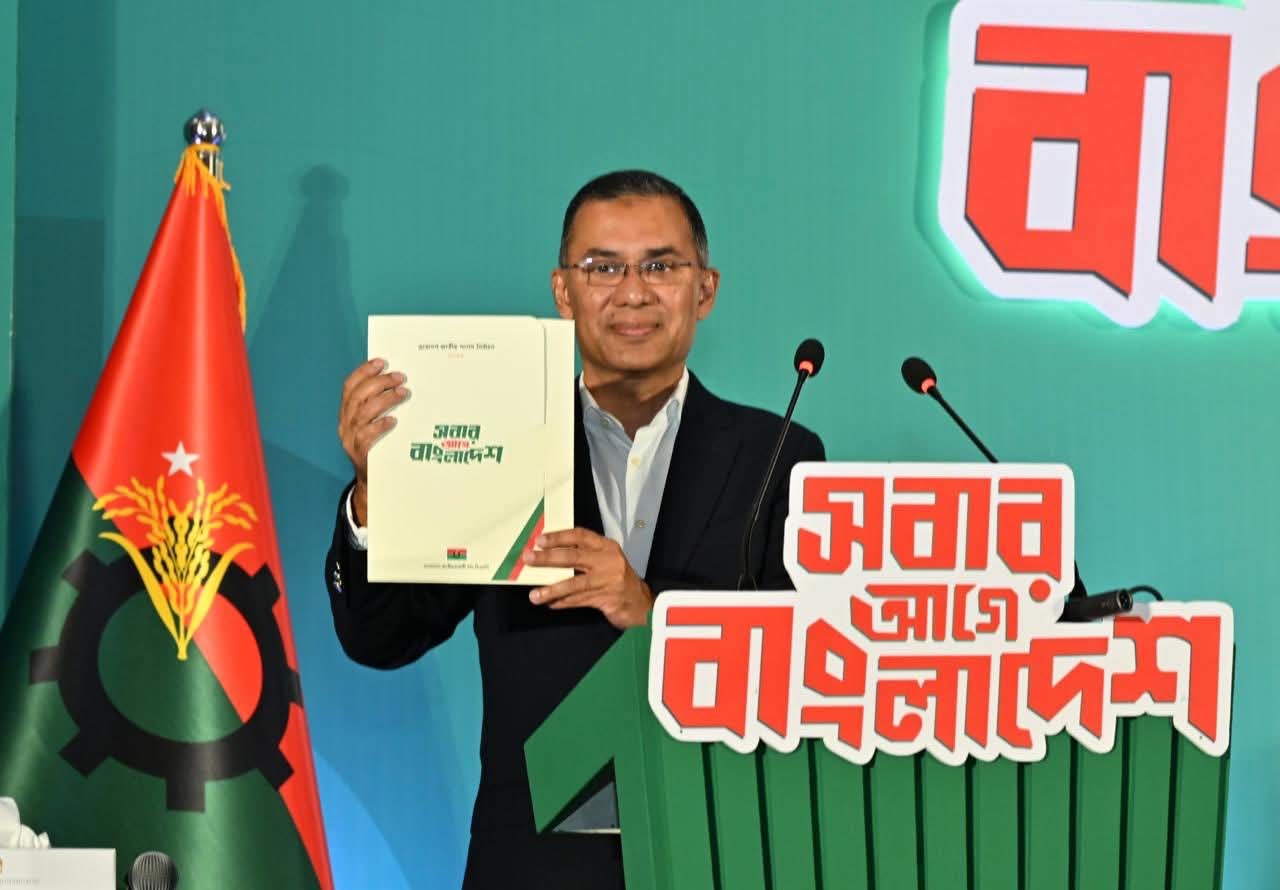
Tarique Rahman, son of former president Ziaur Rahman and former prime minister Khaleda Zia, now stands on the cusp of assuming office. His political resurrection — from exile in London and multiple convictions later overturned after the 2024 upheaval — is as dramatic as Bangladesh’s own recent history.
The BNP’s supermajority is politically powerful and constitutionally potent. With more than 200 seats, it has the numbers not merely to govern, but to amend. And amend it intends to.
The July National Charter, born from the student-led uprising that forced Sheikh Hasina into exile, proposes over 80 reforms: a 10-year lifetime cap on prime ministerial tenure, a bicameral parliament, reduced executive control over appointments, and expanded protections for fundamental rights. If implemented within 180 days, the reforms could dismantle what critics described as the “super-executive” model consolidated during Hasina’s long tenure.
But here is the paradox: reforming hyper-centralization through the instrument of a hyper-majority demands restraint. Bangladesh’s history is instructive. Large mandates have often tempted incumbents to entrench rather than disperse power. The Awami League once justified its dominance as necessary for stability; the BNP now claims reform as its moral authority. Whether it resists the gravitational pull of centralization will define this era.
A Competitive Election — Without a Historic Pole
The election was competitive, but not fully plural.
The Awami League, one of the two historic pillars of Bangladeshi politics, did not contest — barred or effectively excluded amid allegations linked to the 2024 crackdown. Its supporters called for a boycott. That absence reshaped the field.
In that vacuum, Jamaat-e-Islami emerged as the principal opposition, securing around 68–70 seats — its strongest parliamentary presence in years. Its rise is politically significant. Once banned from contesting, Jamaat now occupies a formal parliamentary platform at a time when secular-liberal forces are fragmented.
BNP leaders argue this is the logical consequence of suppressed democracy under the previous regime. Jamaat, for its part, has raised concerns about counting inconsistencies while urging calm. The Election Commission insists the process was credible and largely peaceful.
Still, the ideological balance of parliament has shifted. The contest was framed as democracy versus authoritarianism. The next contest may well be about the character of that democracy.
Economy: The Unforgiving Variable
Politics may dominate headlines, but the economy will judge the new government.
Bangladesh remains under pressure from inflation, currency volatility and stress in its garment sector, which accounts for over 80 percent of export earnings. The post-uprising period unsettled investor confidence. Foreign exchange reserves dipped. Multilateral lenders tightened scrutiny.
The BNP campaigned on restoring growth, tackling corruption and rebuilding institutions. Markets will look for early signals: fiscal discipline, engagement with the IMF and World Bank, clarity on export competitiveness, and above all, political stability.
Reform without macroeconomic stability will falter. Conversely, economic missteps could quickly erode the moral capital earned from this electoral wave.
India: Pragmatism Over Sentiment?
New Delhi wasted no time.
Prime Minister Narendra Modi congratulated Rahman on his “decisive victory,” signaling India’s preference for continuity over uncertainty. Under Hasina, bilateral ties deepened significantly — from counter-insurgency cooperation to connectivity projects linking India’s northeast to the Bay of Bengal.
But optics have shifted. Hasina’s continued presence in India has complicated perceptions in Dhaka. The BNP historically adopted a more nationalist posture toward India, occasionally accusing New Delhi of favoring the Awami League.
The recalibration now underway will be pragmatic. Bangladesh is indispensable to India’s eastern strategic geometry — particularly the Siliguri Corridor and transit routes to the northeast. For Dhaka, India remains a critical trade partner and security interlocutor.
Rahman’s government may seek symbolic distance while maintaining substantive cooperation. The real test will be whether domestic political pressures — especially nationalist or religious constituencies — push Dhaka toward rhetorical assertiveness that unsettles cross-border stability.
South Asia’s Shifting Board
Beyond bilateralism, Bangladesh sits at the heart of a crowded geopolitical chessboard.
China’s infrastructure footprint in the Bay of Bengal is substantial. Turkey has cultivated ties with Islamist networks. Western partners view Bangladesh as a linchpin in supply-chain diversification away from overdependence on single markets.
A politically stable BNP government could leverage these competing interests to secure investment and diplomatic space. Instability, however, would magnify vulnerabilities — particularly in debt sustainability and trade competitiveness.
For South Asia more broadly, Bangladesh’s election underscores a recurring regional pattern: regime change through public mobilization followed by the far harder task of institutional consolidation. Nepal and Sri Lanka, each navigating post-crisis recalibrations of their own, will watch closely.
The Democratic Question
The Election Commission’s defense of the process — transparent, impartial, credible — is important. Turnout figures lend legitimacy. The absence of widespread violence offers reassurance.
Yet legitimacy in democracies is cumulative. It depends not only on how elections are conducted, but on whether opposition space remains protected, media freedom expands rather than contracts, and institutions outlast personalities.
Bangladesh has oscillated between competitive elections and centralized dominance before. The 2026 verdict offers a rare alignment of reform mandate and parliamentary power. That alignment is both an opportunity and a temptation.
The spirit of the July uprising demanded accountability, pluralism and limits on executive authority. Translating that ethos into constitutional text — and then into lived political practice — is the real challenge.
If the BNP uses its supermajority to disperse power, strengthen oversight and tolerate dissent, February 12 may indeed mark a foundational moment in Bangladesh’s democratic evolution. If, however, reform becomes rhetoric and dominance merely changes hands, the cycle will resume — only under a different banner.
In South Asia, decisive mandates are common. Durable institutional restraint is not.