 Join WhatsApp Channel


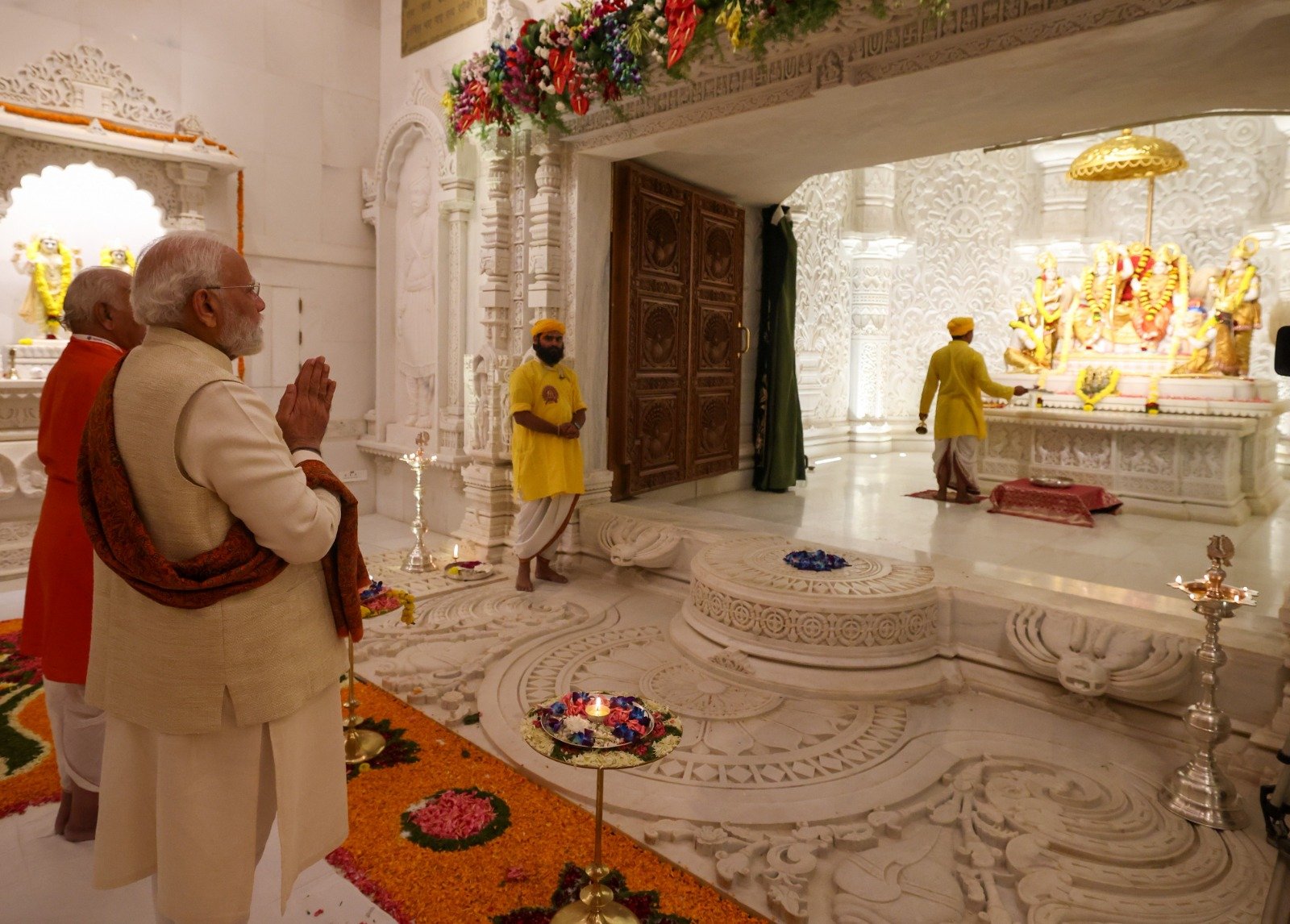
On a still, sunlit afternoon, when the winter air over the Sarayu seemed almost suspended in reverence, a vast saffron flag lifted slowly into the sky above the Ram Temple’s 161-foot shikhara. Its ascent — measured, almost ceremonial in its pace — drew silence first, then a rising swell of chants as thousands of devotees realized they were watching a moment that would enter the city’s long, uneven memory.
This was the Dhwajarohan Utsav, performed during the auspicious Abhijit Muhurat on Vivah Panchami, a ritual that temple priests describe as the final spiritual activation of a mandir. For Ayodhya, still adjusting to the scale and symbolism of its rebirth, the flag’s unfurling felt less like an event and more like a culmination: centuries of yearning, decades of dispute, and a generation’s worth of political and cultural reconfiguration converging into one carefully choreographed afternoon.
Prime Minister Narendra Modi, who hoisted the 22-by-11-foot dhwaj before a sea of saffron-clad devotees, framed the ceremony as a “civilizational milestone.” In the official text released by the PMO, he said, “Today the whole of India, the entire world is filled with Ram. Centuries-old wounds are healing.” For many in the crowd, murmuring “Jai Shri Ram” in rhythmic waves, the line rang less as rhetoric and more as a shared sentiment carried on the breeze.
The Ritual That Completes the Temple
Though the pran pratishtha in January 2024 marked the moment Ram Lalla’s idol was imbued with life, Tuesday’s ceremony had a different texture — quieter, deeper, almost inward-looking. Priests explained that Dhwajarohan is the point at which a temple becomes wholly active: the stone, the sculpture, the sanctum and the shikhara aligned in one continuous current of ritual energy.
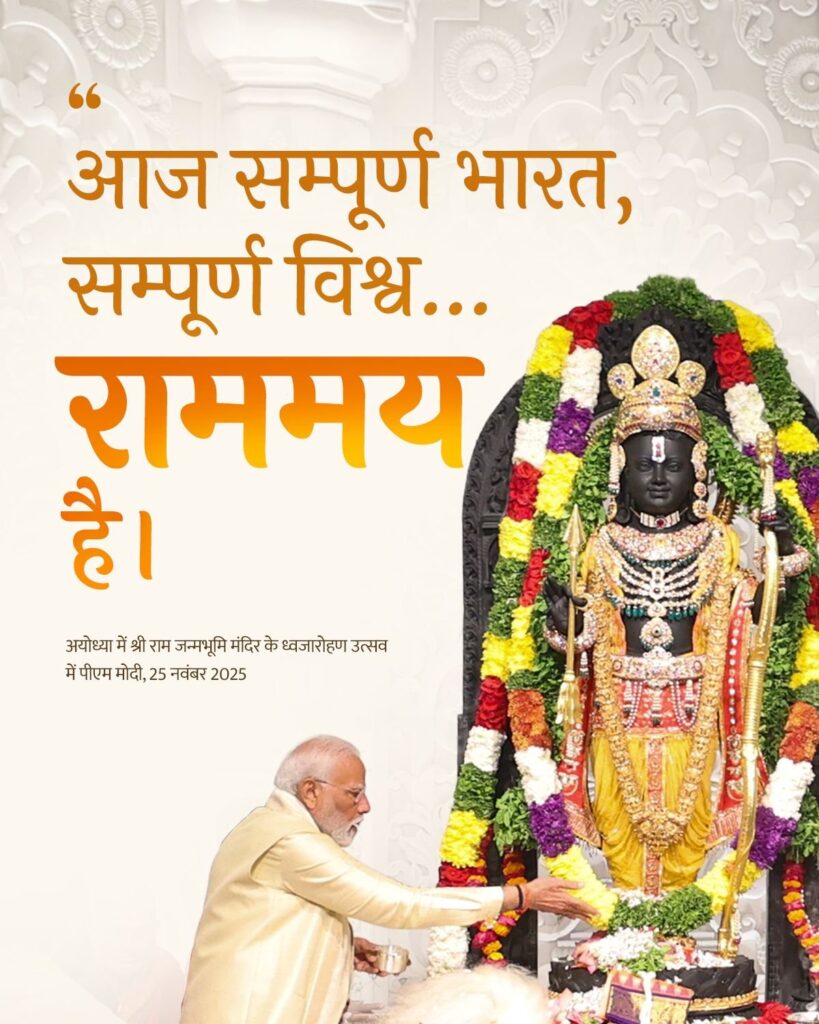
Modi underlined this in his remarks: “This temple is complete, and today its sacred ritual of Dhwajarohan has been performed.”
The flag itself held layers of symbolism — the radiant Sun of the Suryavanshi lineage, the resonance of Om, and the sacred Kovidara tree symbolizing purity and prosperity. As it steadied in the wind, the dhwaj seemed to echo the ideals the Prime Minister repeatedly spoke of: harmony over discord, moral order over chaos, the aspirational framework of Ram Rajya.
A Tribute Etched in Memory and Struggle
One of the most emotionally charged sections of Modi’s address came when he paused to acknowledge those who carried the temple movement through its most turbulent decades — saints, kar sevaks, litigants and ordinary devotees who, in his words, “sacrificed everything for this moment.”
“I bow to all the saints, kar sevaks and countless devotees,” he said, invoking a line from the Ramayana: “One may lose life, but not one’s word.”
In a gesture that was quietly noted by observers, the temple trust had invited descendants of families from both Hindu and Muslim communities historically linked to the dispute. For some, their presence felt like a symbolic acknowledgment of the complex, interwoven past that Ayodhya has long carried.
A Fully Awakened Temple
The temple — a three-storey Nagara-style structure resting on a massive 380×250-foot platform — formally entered its complete operational phase with the Dhwajarohan. All 44 doors were opened as part of the ritual sequence, a detail that priests described as signifying an unobstructed flow of divinity through the inner and outer mandapas.
Modi highlighted the values embedded in the temple’s seven mandapas: “This temple teaches us to move forward with devotion, not division; with faith, not discord.”
While the museum, auditorium and sections of the Parkota are still being finished — works that will continue until mid-2026 — the sanctum and principal structures are now open to the lakhs who arrive daily.
A Message Stretching Beyond Borders
Much of the Prime Minister’s speech carried an outward gaze. “Ram is not conflict, Ram is resolution,” he said. “Ram does not belong only to India; Ram belongs to the world.”
He urged citizens to carry the moral charge of the moment into everyday life, calling for a collective commitment to building a “developed, prosperous, capable and cultured Bharat.” It was, in many ways, a political message delivered in devotional cadence — a reminder that the temple, now complete, sits at the center of both spiritual and national narratives.
Ayodhya Steps Into Its New Dawn
As the golden Sun on the saffron flag caught the last sharp rays of the afternoon, Ayodhya felt oddly suspended between its layered past and its freshly minted identity. A city once synonymous with dispute now positioned itself as a global spiritual hub — a draw for pilgrims, a magnet for cultural tourism, and a symbolic centerpiece in India’s evolving story.
Modi’s closing words — “Victory to Mother India. Victory to Lord Ram.” — rolled across the temple grounds, matching the rhythm of a crowd that lingered long after the ceremony ended.
For millions watching from across India and the world, the Dhwajarohan did more than complete a ritual. It marked the moment the Ram Temple claimed its place as the radiant heart of a timeless faith — and the moment Ayodhya stepped, finally, into the light of a new chapter.
Related posts:
 Thousands Attend Four-Day Annual Religious Event at Sri Venkateswara Temple in Pittsburgh, PA
 Sri Ganapathy Sachchidananda Swamiji to Lead Maha Kumbhabhisheka Celebrations at Sri Venkateswara Temple in Frisco, Texas
 BAPS Abu Dhabi’s Brahmaviharidas Swami Praises Indiaspora’s Mission of “Doing Good” ahead of Indiaspora Forum for Good 2025
 Thousands Gather at BAPS Swaminarayan Akshardham in NJ to Celebrate Birth Anniversaries of Shri Ram and Shri Swaminarayan
