As India marks its 80th year of independence, many rightly celebrate South Asia’s extraordinary civilizational legacy, diversity, and resilience. From philosophy and mathematics to literature, cinema, democratic thought, and religious pluralism, India’s contributions have shaped the subcontinent and the wider world. India’s successes matter because they shape the fortunes of the entire region.
As a Bangladeshi-born American, I view this anniversary as both a celebration and a moment for reflection. India and Bangladesh share languages, cultures, anti-colonial struggles, triumphs, and tragedies. Geography ensures they will remain indispensable partners. The question is what kind of relationship South Asians and our global diaspora choose to build.
One reason I have long admired India is its capacity for critical self-reflection. I first watched Rang De Basanti during my junior year in a South Asian Politics course at Vanderbilt University. Its impact was deeply personal. The film reminded me that education carried both responsibility and opportunity, and that true patriotism involves confronting your country’s shortcomings rather than tapering them over with shallow jingoism.
I have since screened the film for friends from many countries, and nearly all recognized that central tension. Confident societies criticize themselves because they believe they can become better. I long for Bangladesh to cultivate that same instinct, particularly after its own horrific Air Force-related tragedies.
Partition and a Shared Anti-Colonial Legacy
No account of India’s independence is complete without Partition. Liberation from colonial rule coincided with mass displacement, communal violence, and hardened identities that still reverberate across South Asia. Bangladesh’s history cannot be separated from that legacy.
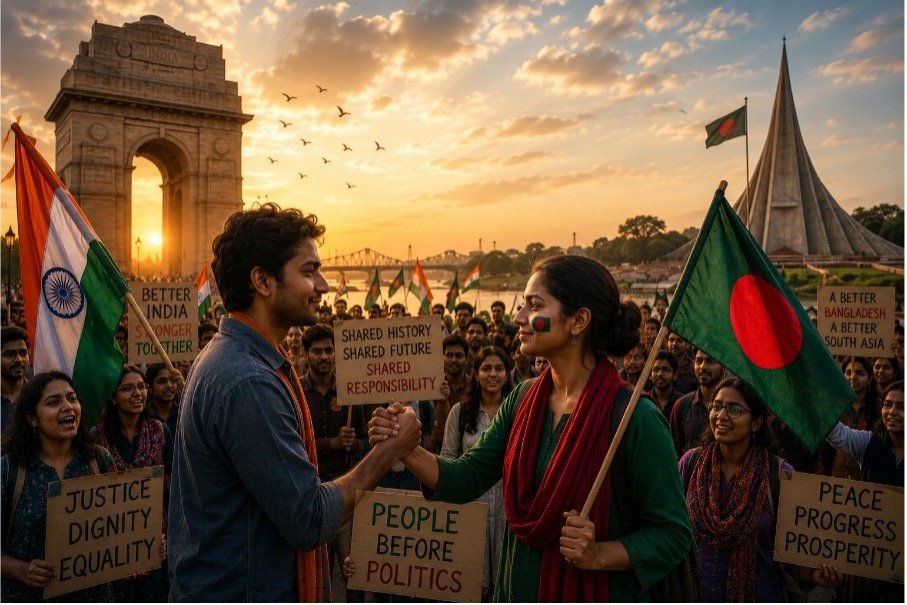
Yet our shared history also offers reasons for solidarity. India’s role in Bangladesh’s 1971 Liberation War remains consequential: it hosted nearly ten million refugees, supported liberation forces, and ultimately helped enable Bangladesh’s independence. That history should anchor renewed trust rather than be politicized. Modern borders have since divided communities whose languages, faiths, trade, and family ties developed across centuries. India and Bangladesh best honor their independence when sovereignty becomes a foundation for cooperation between equals rather than permanent suspicion.
Advertisement
What Kind of Regional Power Does India Want to Be?
India rightly aspires to global leadership. Yet great powers are judged not only by how they confront rivals, but by how they treat neighbors as well as their own people. Freedom House, the V-Dem Institute, and Reporters Without Bordershave documented democratic backsliding, shrinking civic space, pressure on independent media, and hostility toward religious minorities. I have watched with growing horror as anti-Muslim rhetoric has merged with hostility toward Bangladeshi people as a group. People merely suspected of being migrants have faced lynchings, arbitrary detention, and deportation efforts that bypass due process. Reports of people rounded up at night and subjected to attempted “push-ins” into Bangladesh raise grave legal and humanitarian concerns. Inflammatory rhetoric and violent actions portraying Bangladeshis primarily as demographic or security threats makes a durable partnership harder to sustain.
This animus travels far beyond South Asia. The two occasions on which I most viscerally felt hatred because of my Bangladeshi identity occurred in the United States. One involved the mother of an undergraduate friend whose family came from Gujarat; the other involved a hotel receptionist who had recently arrived from India. In both cases, the visible derision was searing. Neither represents an entire people, but both encounters demonstrated how prejudice can survive across oceans.
Such hatred is deeply irrational. India and Bangladesh share history, culture, geography, and intertwined security and prosperity. And many of the strongest opponents of majoritarian abuse have long been themselves Indians—journalists, lawyers, activists, students, and ordinary citizens committed to justice and equality.
Responsibility Is Shared—But Not Equal
Improving relations requires effort from both sides. Bangladesh must strengthen democratic institutions, protect minorities, uphold the rule of law, and ensure criticism of India is expressed peacefully. Anti-India rhetoric should not become a substitute for confronting Bangladesh’s own governance failures.
Yet Bangladeshi mistrust of India cannot simply be dismissed as nationalism. Many deeply distrust New Delhi’s intentions as India continues to host former Prime Minister Sheikh Hasina following her 2024 ouster. That distrust has been compounded by Hasina’s inflammatory political speeches from Indian soil directed toward supporters inside Bangladesh. Whatever India’s reasons for allowing her to remain, the perception that it provides sanctuary and a political platform to a deposed leader accused of serious abuses makes rebuilding trust harder.
Responsibility is also asymmetric. India is vastly larger economically, demographically, militarily, and diplomatically. Disproportionate power brings disproportionate responsibility. India’s Neighborhood First policy astutely recognizes that regional stability serves its interests. Yet leadership must rest on consistency, respect, and confidence—not coercion or dismissiveness.
A prosperous, democratic, and secure Bangladesh should be one of India’s greatest strategic opportunities. Bangladesh’s growth expands regional markets and creates opportunities for connectivity. Its military modernizationand diversified partnerships need not threaten India. Bangladesh faces real security challenges, including instability spilling over from Myanmar, maritime insecurity in the Bay of Bengal, and increasingly dangerous U.N. peacekeeping missions.
Rather than treating Bangladesh’s modernization or independent choices as challenges to Indian primacy, New Delhi should recognize a capable Bangladesh as an asset. Regional leadership cannot be secured through size alone; it depends on whether neighboring publics regard India as a dependable partner. Respecting Bangladesh’s strategic autonomy would demonstrate the confidence of a mature power.
Beyond Ultranationalism
India is hardly alone in needing self-examination. Bangladesh wrestles with polarization and its own treatment of minorities; Pakistan with civil-military relations; Sri Lanka with the legacy of ethnic conflict. The United States, my adopted homeland, also struggles with polarization and debates over democratic norms.
Yet because of India’s scale and influence, its choices reverberate throughout South Asia. Criticism of India’s trajectory need not reflect hostility toward India. It can instead reflect belief in its potential to lead through pluralism rather than majoritarianism, persuasion rather than intimidation, and partnership rather than hierarchy.
Climate change, migration, inequality, public health, and transnational security threats do not respect national borders. South Asia needs habits of consultation that allow disagreement without dehumanization. A healthier regional order would allow countries to celebrate their achievements without demanding silence about their failures. It would recognize that criticism offered in a spirit of mutual dignity can be an expression of friendship.
What gave me hope in Rang De Basanti was not a perfect India, but an India confident enough to question itself. Resilient nations nurture people willing to confront uncomfortable truths and challenge governments when they are wrong.
As India celebrates independence, I hope it renews that tradition of critical self-reflection. A democratic, pluralistic, and confident India would not only strengthen the world’s largest democracy. It could help foster a more peaceful, prosperous, and connected South Asia.
Disclaimer: The opinions and views expressed in this article/column are those of the author(s) and do not necessarily reflect the views or positions of South Asian Herald.